Evaluate a fictional celebration
By UK GCSE German · independent study · myAudience
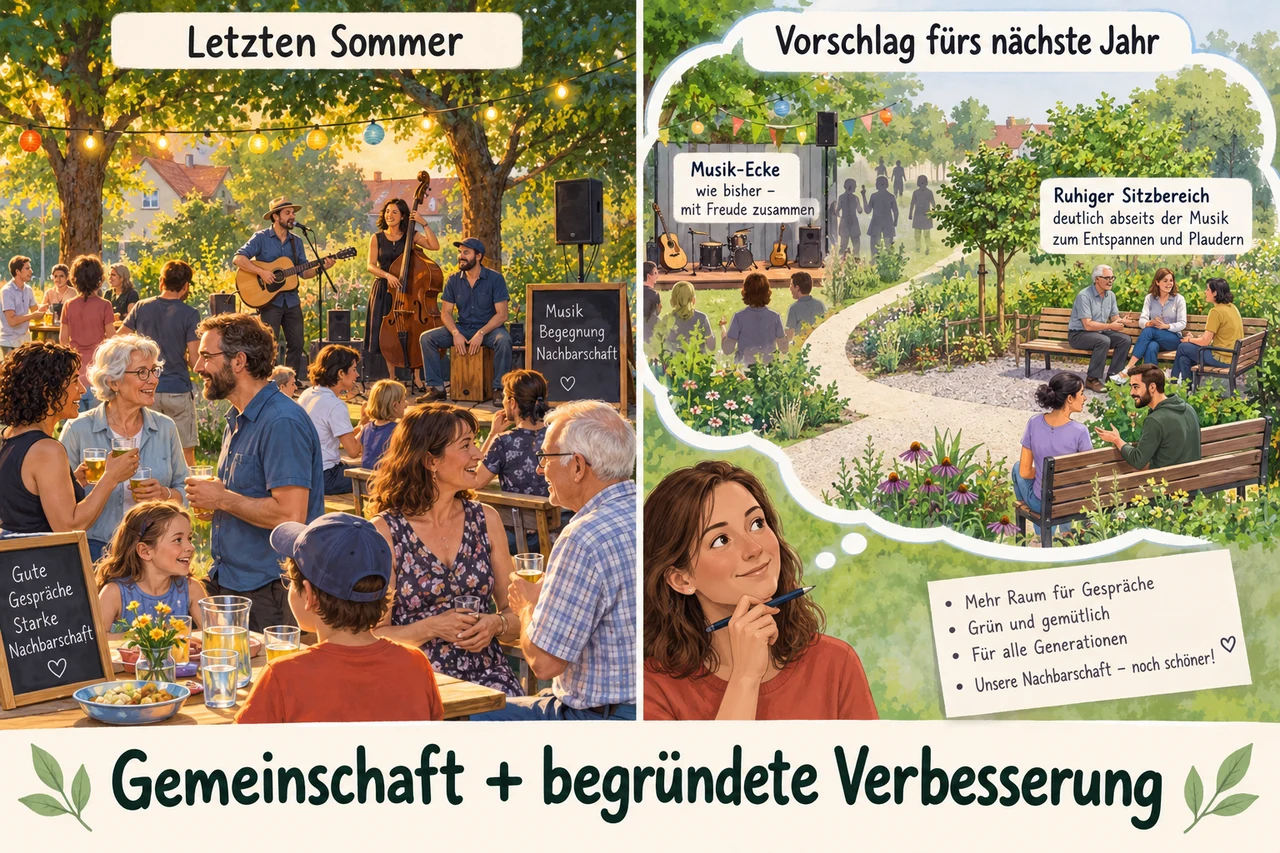
Image: illustration, not a documentary photograph. Original teaching model created for myAudience. · Original generated teaching illustration; no board endorsement or source textbook artwork reproduced.
Evaluate a fictional celebration
An extended response should develop its two bullets while keeping invented practice distinct from cultural fact. Our original task is: describe a community celebration you attended and evaluate what worked or did not; explain how you would improve a future event, with reasons. Aim for approximately150 German words. The celebration below is fictional and is not presented as a German national custom, historical festival or authentic account of a real neighbourhood. This lesson gives a complete instructional model and evaluated choices, not an official examination question, mark scheme or grade promise.
Plan the first bullet as event, participation, benefit and limitation. Plan the second as a change that responds to the limitation, another practical improvement and a justified priority. Evaluation needs a relationship between evidence and judgement: loud music affects the possibility of conversation, so a quiet area has a reason. A generic interesting event followed by an unrelated memorised environment paragraph would not develop the same task. Past statements report the invented experience; conditional forms propose an alternative without pretending it has been agreed or implemented.
Full original model: Letzten Sommer organisierte unsere Nachbarschaft ein kleines Fest im Park. Ich ging mit meiner Schwester dorthin, weil wir unsere Nachbarn treffen wollten. Zuerst halfen wir am Tisch mit den Getränken. Danach hörten wir Musik und sprachen mit zwei älteren Nachbarn. Mir gefiel besonders, dass verschiedene Menschen zusammenkamen. Allerdings war die Musik später sehr laut, und meine Schwester wollte nach Hause gehen. Deshalb blieben wir nicht bis zum Ende. Wenn wir nächstes Jahr ein Fest hätten, würde ich einen ruhigen Bereich vorschlagen. Dort wäre es ruhiger, und die Menschen hätten mehr Zeit für Gespräche. Außerdem würde ich vorher fragen, wer helfen möchte. Ein Plan wäre nützlich, aber er muss für alle verständlich sein. Ich würde gern wieder mitmachen, wenn wir die Aufgaben gut verteilen würden. Das Fest müsste nicht größer sein; mir wäre ein angenehmer gemeinsamer Nachmittag wichtiger. Für mich sind Gespräche wichtiger als eine große Bühne, weil ich dabei mehr über die anderen Menschen erfahre.
Faithful translation: Last summer our neighbourhood organised a small celebration in the park. I went there with my sister because we wanted to meet our neighbours. First we helped at the drinks table. Afterwards we listened to music and spoke with two older neighbours. I particularly liked different people coming together. However, the music was very loud later and my sister wanted to go home. Therefore we did not stay until the end. If we had a celebration next year, I would suggest a quiet area. It would be quieter there and people would have more time for conversations. I would also ask beforehand who wants to help. A plan would be useful, but it must be understandable to everyone. I would gladly participate again if we distributed the tasks well. The celebration would not need to be bigger; a pleasant shared afternoon would matter more to me. For me, conversations are more important than a large stage because I learn more about the other people through them.
Trace the argument through the language. Organisierte, ging, halfen, hörten and sprachen locate actions in the past; the account varies forms according to the verbs rather than adding a single ending to all of them. Allerdings introduces a limitation, and deshalb links the early departure to the preceding difficulty. Wenn … hätten / würde … vorschlagen expresses a proposed alternative. The conditional müssten/müsste family is used here in Das Fest müsste nicht größer sein to convey that greater size would not be necessary; it is an explicitly explained extension, not a claim that this single lesson closes every prescribed form.
The plate pairs a fictional past park event with a clearly proposed quiet-area plan. An attractive past gathering is not evidence that every attendee enjoyed it: the written account supplies the narrator's judgement and the sister's wish. A proposed area with benches separated from a music corner illustrates why conversation might be easier, but it is not a measured sound map, venue design or guarantee. The labelled change answers the actual limitation in the task. No national flag or real festival name turns this invented scene into a cultural source.
Transfer task: Replace the loud-music limitation with long queues at the drinks table, while keeping the community benefit. Write a reasoned improvement rather than mechanically retaining the quiet area. One complete answer is Allerdings mussten wir lange auf Getränke warten. Wenn wir nächstes Jahr ein Fest hätten, würde ich zwei Tische vorschlagen. Dann hätten die Menschen vielleicht weniger Wartezeit. Vorher würde ich fragen, wer helfen möchte. — However, we had to wait a long time for drinks. If we had a celebration next year, I would suggest two tables. Then people might have less waiting time. I would ask beforehand who wants to help. Vielleicht appropriately avoids guaranteeing that a second table solves all delays.
An author rubric checks both bullets, specific supporting experience, coherent improvement and accurate distinction between reported and hypothetical events. Accept other justified solutions; more words or rarer vocabulary are not automatically better. Ask what evidence could change the judgement: quieter music, different staffing or attendee preferences might support another proposal. Full festival/customs contexts, prescribed vocabulary, independently produced150-word responses and external assessment remain open. Reading this supplied model does not establish a grade, cultural expertise, listening or speaking mastery.
Worked example: A celebration had long drink queues. Is a quiet area alone a developed response to that limitation?
Identify queue delay as the new problem.
Choose a directly related change.
Qualify expected benefit rather than guarantee it.
Answer: A second staffed drinks table could address queues; its benefit depends on staffing and demand. The quiet area alone addresses a different problem.
Check your understanding: Why is Dann hätten die Menschen vielleicht weniger Wartezeit better bounded than a guaranteed result?
Answer: Perhaps marks uncertainty: staffing, demand and how the tables work could affect waiting time.
Why: A reasoned proposal needs a mechanism and acknowledged assumptions.