Track singular and plural reflexive participants across a routine
By UK GCSE Spanish · independent study · myAudience
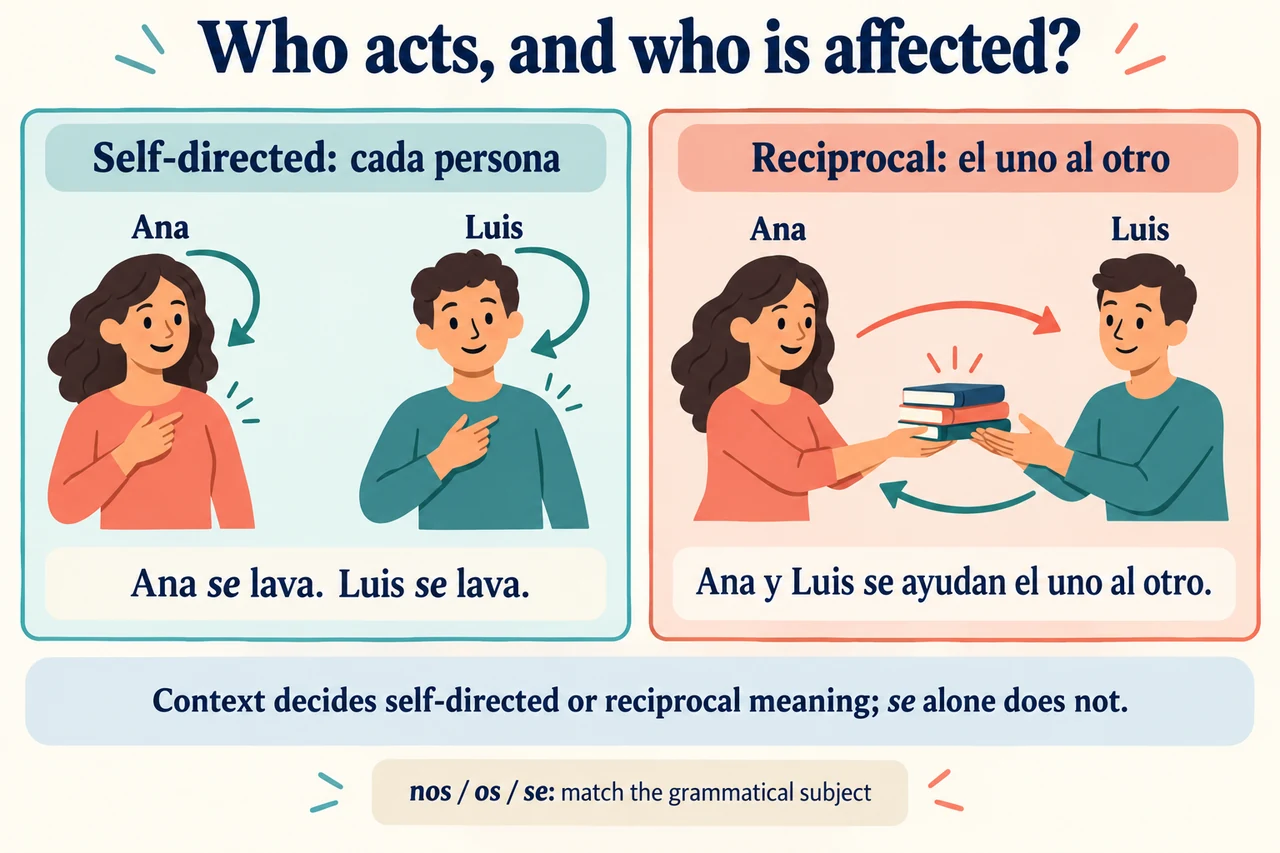
myAudience original generated teaching concept. Image: illustration, not a documentary photograph. · Operator-authored generated artwork; fictional bounded language models, no exam-board plate reproduced.
Track singular and plural reflexive participants across a routine
A reflexive construction connects the grammatical subject with the affected participant. In « Ana se lava », Ana performs the washing and is the person washed. Compare « Ana lava el coche »: the verb still names washing, but its object is the car. Neither person nor action should be inferred from a picture alone. Begin a participant ledger with four columns: stated subject, finite verb, pronoun and affected participant. This makes a changed actor visible before it becomes an agreement error.
In the simple present pattern, yo me lavo, tú te lavas, él/ella/usted se lava, nosotros/nosotras nos lavamos, vosotros/vosotras os laváis and ellos/ellas/ustedes se lavan keep subject, pronoun and verb aligned. The pronoun is not an extra subject. Usted uses third-person grammar despite addressing the listener, and ustedes uses third-person plural. Vosotros is a familiar plural form particularly associated with Spain; other communities normally address a group with ustedes. Teach these as grammatical choices with regional context, not a hierarchy of correct speakers.
A plural subject does not automatically make an action reciprocal. « Ana y Luis se lavan » can describe each washing themself. « Ana y Luis se ayudan el uno al otro » explicitly describes mutual help. Nos, os and se can occur in reciprocal expressions, but context and the predicate establish the intended relationship. Many other uses of se exist outside this lesson. Do not infer that every sentence containing se means either washing oneself or helping each other.
With a finite modal and a following infinitive in the examples taught here, the reflexive pronoun can stand before the finite verb or attach to the infinitive: « Me debo lavar » and « Debo lavarme »; « Nos podemos ayudar » and « Podemos ayudarnos ». Both placements keep the same participant. A repair changes the whole combination: « Nosotros puede lavarse » becomes « Nosotros podemos lavarnos ». This flexibility is not a rule for every sequence of two Spanish verbs; some prepositional and other constructions restrict movement.
Negation applies to the action without replacing the participant. « No me lavo ahora » says that I do not wash now, not that somebody else washes me. « Ana no se lava antes de estudiar; Luis sí se lava » separates two actors and two claims. If a later sentence begins « Se lava después », state a name when context no longer makes the referent unique. Keeping a recoverable subject is more useful than mechanically omitting every name or repeating every pronoun.
The participant plate shows two separate self-return arrows on its left and two opposite arrows between people on its right. The left drawings symbolise affected participants rather than depict actual washing. On the right, the book-sharing scene illustrates mutual help; the wording el uno al otro makes that interpretation explicit. No arrow crosses between the two left-hand people. Colours are teaching aids, not grammatical categories, and the written explanation remains necessary when the small thumbnail makes the arrows hard to inspect.
Original transfer account: « Por la mañana, Ana se lava antes de leer. Luis se lava después de leer. Por la tarde, los dos se ayudan el uno al otro con los libros ». The first two se forms have different singular referents. The final se belongs to the plural subject los dos and an explicitly reciprocal predicate. Changing the narrator to a member of the pair requires « Por la tarde, nos ayudamos el uno al otro » in this two-person context. It does not require changing each earlier sentence about Ana or Luis.
The September 2025 update includes plural reflexive and reciprocal constructions in Foundation grammar. That change does not move all Higher tense patterns into Foundation: prescribed plural imperfect, simple future and conditional demands still need their own scope checks. This lesson supplies a present-tense participant method and written repair tasks. Transfer to an unfamiliar spoken account requires separately reviewed listening and speaking practice; a successful written ledger is evidence about this task rather than complete mastery of all reflexive or reciprocal language.
Worked example: Three fictional speakers report: I wash before reading; you can wash later; Ana and Luis help each other. Write an explicit-subject Spanish account, then give the alternative pronoun position in the middle clause.
I is yo: pair me with lavo and keep antes de + infinitive leer.
You is tú: use puedes; te can precede the finite modal or attach to lavar.
Ana y Luis is third-person plural: se ayudan, with el uno al otro to make reciprocal meaning explicit.
Answer: Yo me lavo antes de leer. Tú puedes lavarte después. Ana y Luis se ayudan el uno al otro. Middle-clause alternative: Tú te puedes lavar después.
Check your understanding: Repair « Nosotros se lava antes de estudiar. Ana y Luis nos ayudan el uno al otro ». Assume the first subject is the narrator's group and the second describes only Ana and Luis. Explain every changed form and give a valid alternate position after adding podemos to the first sentence.
Answer: Nosotros nos lavamos antes de estudiar. Ana y Luis se ayudan el uno al otro. With the modal: Nosotros podemos lavarnos antes de estudiar; also Nosotros nos podemos lavar antes de estudiar. Nos matches nosotros and lavamos/podemos are first-person plural; se and ayudan match the named third-person plural pair.
Why: Changing only a pronoun leaves the finite verb wrong. The second sentence originally made the narrator's group the object of help, contradicting the stated reciprocal pair. The repair preserves the intended participants and distinguishes grammatical evidence from a guessed social relationship.