Sequence actions with before and after without changing the actor
By UK GCSE Spanish · independent study · myAudience
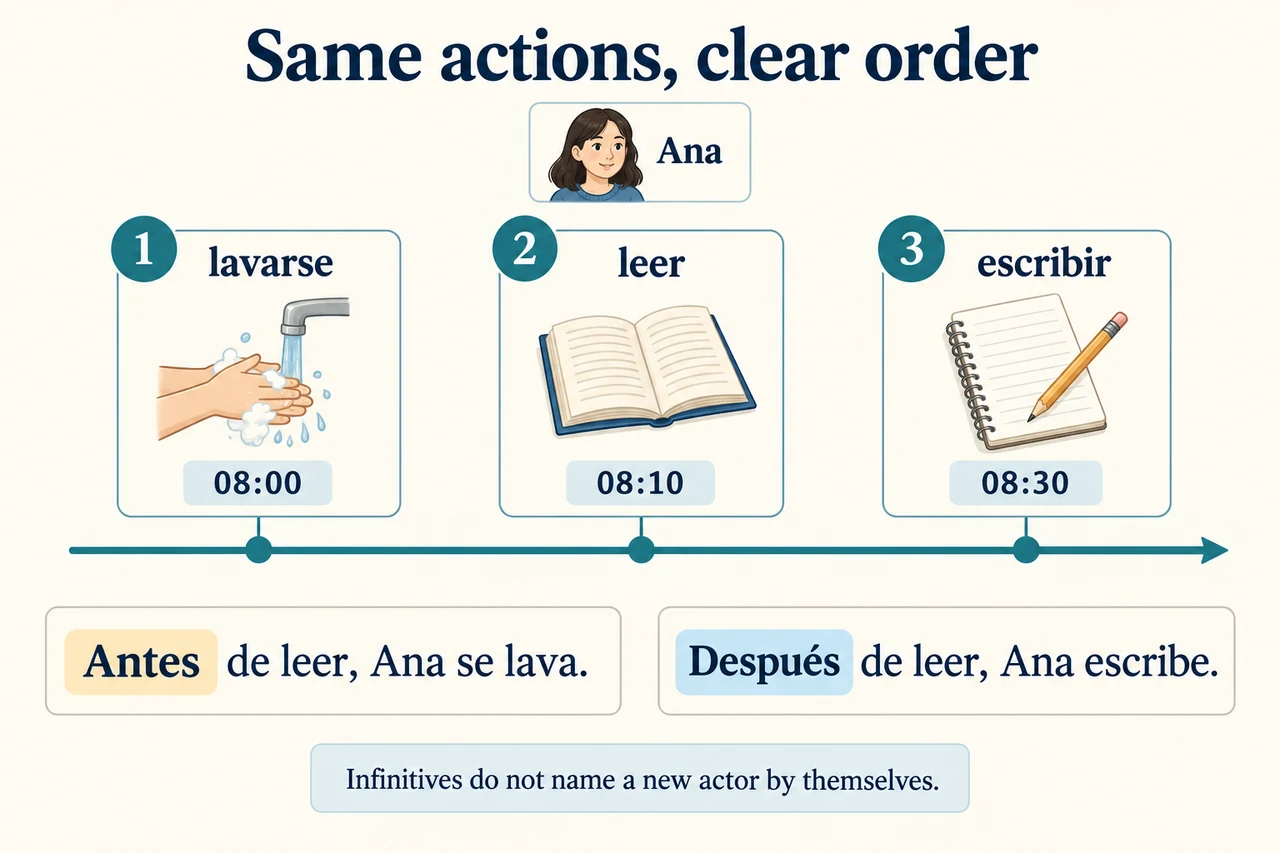
myAudience original generated teaching concept. Image: illustration, not a documentary photograph. · Operator-authored generated artwork; fictional bounded language models, no exam-board plate reproduced.
Sequence actions with before and after without changing the actor
A time expression links an action to a reference event. « Ana se lava antes de leer » places Ana's washing earlier than her reading; « Ana escribe después de leer » places her writing later. Antes de and después de take an infinitive in these examples, so leer does not receive a person ending. The finite verb and the surrounding context identify the actor. The relation is earlier or later; it does not state that the actions happen immediately next to one another or exactly how long they last.
Use an event ledger before assembling a sentence. In our fictional timetable Ana washes at 08:00, reads at 08:10 and writes at 08:30. Washing is before reading; writing is after reading. The generated plate shows the same Ana on all three cards with one forward timeline. These are chosen teaching times, not anybody's private routine. The minutes verify the ordering, but the sentences remain correct even when the gaps change, provided the relative sequence stays the same.
The infinitive keeps the same spelling when the clear shared actor changes: « Me lavo antes de leer », « Nos lavamos antes de leer » and « Ana se lava antes de leer ». What changes is the finite verb and its aligned pronoun. With a reflexive infinitive, the attached pronoun still identifies the intended participant: « Ana lee después de lavarse ». In this bounded example, Ana reads after washing herself. Do not leave the pronoun as me merely because the original model was written in the first person.
Reference events can be swapped without changing chronological facts. « Ana escribe después de leer » and « Ana lee antes de escribir » describe the same ordering from different anchors. They are not interchangeable with « Ana escribe antes de leer », which reverses it. A useful error check draws the event arrows after reading a sentence, then compares them with the timetable. A grammatically tidy sentence can still be a poor answer when it contradicts the source information.
A changed actor needs particular care. The simple sentence « Ana se lava antes de leer » normally encourages the shared-actor reading taught here. It is unsafe to use it as the sole expression for Ana washing before Luis reads. At this stage, retain supported finite clauses and explicit subjects: « Ana se lava a las ocho. Luis lee a las ocho y diez ». The times establish the order without introducing an unstudied finite before-clause. This is a teaching boundary, not a claim that every Spanish infinitive construction always has the same actor.
Negatives and frequency words affect what the timetable supports. « Ana no escribe después de leer » conflicts with the stated positive sequence if it describes the same occasion. « Ana normalmente escribe después de leer » adds a habit that one observed timetable cannot establish. For a fictional practice answer you may choose a routine when the prompt allows it; for a source-based answer, do not promote one occasion into always or normally. Distinguishing invented narrative from reported evidence protects meaning as much as conjugating the verb correctly.
Now move Ana's writing to 08:05 while keeping washing at 08:00 and reading at 08:10. The earlier model « Ana escribe después de leer » fails, even though all its forms remain correct. A repaired pair is « Ana escribe después de lavarse. Ana escribe antes de leer ». A different valid pair is « Ana se lava antes de escribir. Ana lee después de escribir ». This transfer requires comparing two event relations rather than substituting a noun into a memorised sentence.
The dated update brings the named before/after plus infinitive constructions into the relevant Foundation scope. It does not authorise every advanced clause pattern. This lesson develops ordered-event reasoning, aligned reflexive participants and explicit-source repair in writing. Further contexts involving different actors, more complex reference times or live conversation need additional teaching and independent practice. Word order correctness, event ordering and assessment performance remain separate questions.
Worked example: Using Ana's original 08:00/08:10/08:30 timetable, write two different Spanish sentence pairs that establish washing before reading and reading before writing. Then shift writing to 08:05 and repair the account.
Choose leer as the reference for washing: se lava antes de leer.
Express reading/writing from either anchor: escribe después de leer or lee antes de escribir.
After the change, writing occurs between washing and reading; compare times before changing antes/después.
Answer: Original pair 1: Ana se lava antes de leer. Ana escribe después de leer. Pair 2: Ana lee después de lavarse. Ana lee antes de escribir. Changed timetable: Ana escribe después de lavarse. Ana escribe antes de leer.
Check your understanding: Luis washes at 09:00 and Ana reads at 09:20. Why does « Luis se lava antes de leer » not reliably report the intended two-person relation? Give a supported repair. Then explain whether before implies immediately before.
Answer: The infinitive sentence encourages the reading that Luis performs both actions. Repair with explicit finite clauses and the given times: Luis se lava a las nueve. Ana lee a las nueve y veinte. Antes establishes earlier ordering, not an immediate transition or a stated duration.
Why: The repair preserves two distinct actors without asserting an untaught grammatical pattern. The twenty-minute difference is evidence for ordering, but no general immediacy meaning is supplied by antes.