Use present stem patterns and modals in an unfamiliar study plan
By UK GCSE Spanish · independent study · myAudience
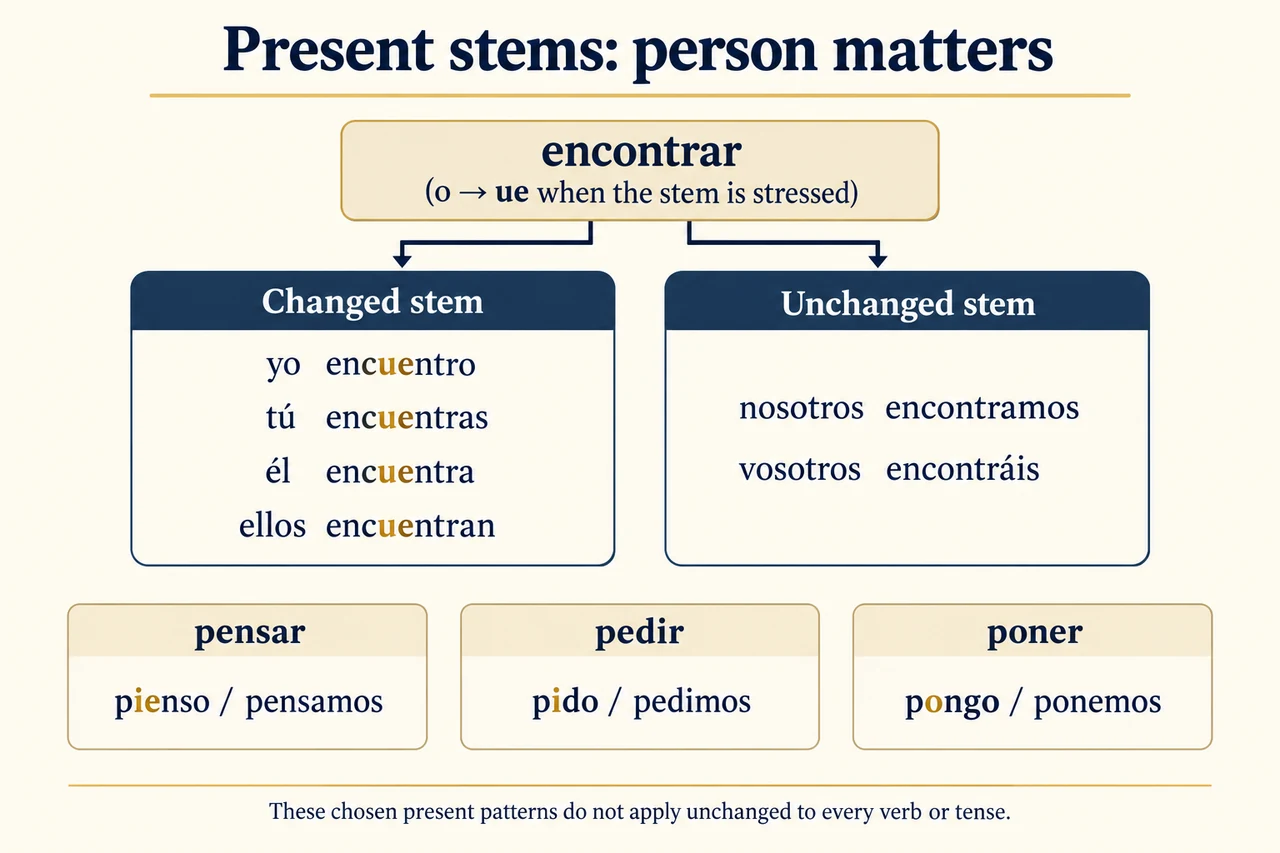
myAudience original generated teaching concept. Image: illustration, not a documentary photograph. · Operator-authored generated artwork; fictional bounded language models, no exam-board plate reproduced.
Use present stem patterns and modals in an unfamiliar study plan
An unfamiliar present-tense task requires two decisions: identify the verb family, then identify its subject. Stem changes are not randomly distributed endings. In the present forms taught here, encontrar changes o to ue, pensar changes e to ie and pedir changes e to i when that stem vowel carries stress. Nosotros and vosotros use the unchanged stem in these paradigms. This observation is specific to these present patterns; it is not a promise that every irregular form in every tense follows the same rule.
Read complete person families rather than learning just yo: encontrar gives encuentro, encuentras, encuentra, encontramos, encontráis, encuentran; pensar gives pienso, piensas, piensa, pensamos, pensáis, piensan; pedir gives pido, pides, pide, pedimos, pedís, piden. Their endings still distinguish -ar from -ir. In « Nosotros pedimos un libro », changing to ellos gives « Ellos piden un libro », not ellos pedimos or ellos piedan. The new subject and the verb's own change both matter.
Conocer and poner illustrate different first-person irregularities. Their complete present families are conozco, conoces, conoce, conocemos, conocéis, conocen; and pongo, pones, pone, ponemos, ponéis, ponen. Do not transfer conozco's zc to every form or invent ponge by analogy. Conocer describes knowing or being acquainted with someone/something; a personal direct object needs the appropriate a: « Conozco a Ana ». That is different from using saber for knowing a fact or how to do something.
The morphology plate separates encontrar's four changed forms from encontramos and encontráis. Its bottom cards compare pienso/pensamos, pido/pedimos and pongo/ponemos. The poner card is a first-person irregularity, not a stem-stress branch equivalent to the first two. The accent in encontráis remains important, even when a thumbnail makes it small. The graphic is written-form evidence and cannot demonstrate spoken stress or pronunciation without a separately checked recording.
Modal constructions require an infinitive after the finite modal: « Puedo estudiar », « Podemos leer » and « Debemos escribir ». A subject change belongs on puedo→podemos; estudiar remains an infinitive. Poder itself has present forms puedo, puedes, puede, podemos, podéis, pueden. Querer gives quiero, quieres, quiere, queremos, queréis, quieren; deber gives debo, debes, debe, debemos, debéis, deben. These mean ability/possibility, wanting and duty in the bounded examples, so replacing one with another can change meaning even when the following infinitive stays correct.
Original plan: « Yo encuentro un libro y pienso estudiar en la biblioteca. Ana pide otro libro porque no conoce al profesor. Nosotros ponemos los libros en la mesa y podemos leer juntos ». Find each actor before editing. Conoce refers to Ana; ponemos and podemos refer to the narrator's group. Al contracts a + el before profesor. The negative no conoce says that Ana does not know the teacher; it does not say that she has no teacher or that the teacher does not know her.
Change the constraints: the narrator now cannot read today, Ana already knows the teacher, and two friends request the books. A coherent recipient response is « Hoy no puedo leer. Ana conoce al profesor. Mis amigos piden los libros y nosotros podemos estudiar mañana ». This is not obtained by pluralising every verb. The request changes actor to mis amigos; the future-time plan uses the already taught present modal with mañana, not an unintroduced plural future conjugation. The response preserves both new information and grammatical scope.
A present paradigm is a tool for unfamiliar writing, not a guarantee of complete lexical or conversational competence. Usted/ustedes take third-person forms; vosotros forms remain relevant to the course while address conventions vary across communities. The named anchors and RAE conjugation models support these patterns. Wider irregular verbs, other tenses, real audio, unseen vocabulary and independently marked tasks remain separate work. When a chosen word is not yet checked against the specification list, disclose that teaching extension rather than claiming an exam-style lexical audit.
Worked example: Turn this plan into Spanish: I find a book; we think about the school; Ana asks for a book; we know Ana; they put the books on the table. Then write a two-sentence reply saying you cannot read today but your group can study tomorrow.
Use encuentro, pensamos en and pide: different subjects select different forms.
Use conocemos a Ana for knowing a person; ellos ponen for putting objects.
Keep leer and estudiar as infinitives after puedo/podemos; no belongs before the finite modal.
Answer: Encuentro un libro. Pensamos en el colegio. Ana pide un libro. Conocemos a Ana. Ellos ponen los libros en la mesa. Reply: Hoy no puedo leer. Mañana podemos estudiar.
Check your understanding: Repair « Nosotros piensamos estudiar, Ana pedimos un libro y yo conoce al profesor ». Explain why a single rule such as ‘change e to ie everywhere’ fails. Give the ustedes equivalent of nosotros podemos leer.
Answer: Nosotros pensamos estudiar, Ana pide un libro y yo conozco al profesor. Nosotros has the unchanged pensar stem; Ana needs third-person pide from pedir; yo requires conozco from conocer. Ustedes pueden leer uses third-person plural grammar. An e→ie rule would mis-handle pedir's e→i and conocer's first-person zc, as well as unstressed nosotros forms.
Why: Person, verb family and construction must all be correct. The repaired meanings preserve who intends, asks and knows, while the regional-address alternative changes the grammatical subject rather than merely deleting a pronoun.