Read and produce recognisable derived forms with honest lexical limits
By UK GCSE Spanish · independent study · myAudience
myAudience original generated teaching concept. Image: illustration, not a documentary photograph. · Operator-authored generated artwork; fictional bounded language models, no exam-board plate reproduced.
Read and produce recognisable derived forms with honest lexical limits
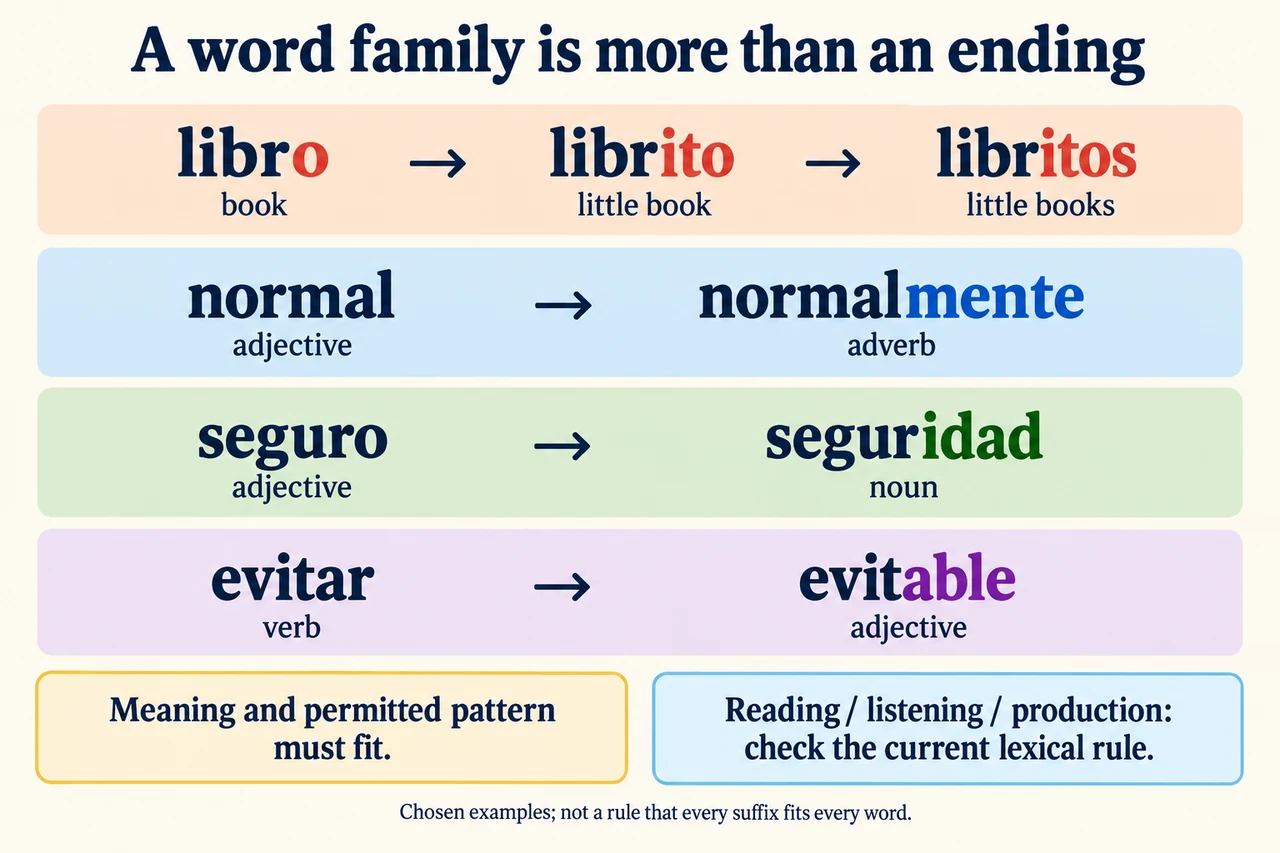
A recognisable derived form is related to a base by a derivational change that contributes meaning or changes word class. Libro→librito introduces a diminutive; librito→libritos adds plural inflection. Keep these operations separate: the plural does not create the small-book meaning. specific recognised-form exception allows the named processes under stated recognisability conditions. It does not mean that every possible Spanish affix can be attached to every listed word or that a guess is automatically suitable for an assessment.
The plate's first row distinguishes a base, one derivation and an optional plural inflection: libro→librito→libritos. In this invented textbook example the diminutive can refer to a small book. In real usage diminutives may also convey affection, politeness or other contextual attitudes; they do not always describe physical size. Hermanita similarly can describe a little or affectionately referred-to sister. Do not infer a person's actual age or emotional relationship simply from a suffix or an illustrated object.
The -ísimo process intensifies an adjective in examples such as fácil→facilísimo. Agreement still matters: « una tarea facilísima » and « unos ejercicios facilísimos ». The accent follows the resulting word's spelling and stress; retaining fácil unchanged inside a longer word would produce an incorrect form. This lesson uses the regular selected example, not a universal algorithm: other adjectives can require spelling or stem changes, and some established alternatives need separate checking.
Adverbs in -mente describe how an action is performed. Normal→normalmente uses the unchanged adjective form; lento→lentamente uses the feminine singular base; rápido→rápidamente retains the base's written accent. « Ana lee lentamente » comments on how Ana reads. It does not require lentamente to agree with Ana or with plural readers. Do not turn every English word ending in -ly into a mechanically invented -mente form; conventional meaning and Spanish usage still have to be checked.
A noun and an adjective can change grammatical jobs. Seguro→seguridad gives a noun for safety/security in an appropriate context; real→realidad gives a noun for reality. Evitar→evitable gives an adjective meaning avoidable in the selected example. « Un error evitable » describes an error; « Podemos evitar el error » uses the infinitive after a modal. The plate's three lower rows are separate examples, not successive transformations of one word into all possible word classes.
Build a ledger with base, operation, resulting form, word class and sentence meaning. For « Los libritos son útiles », write libro / diminutive then plural / libritos / plural noun / the little books are useful. For « Ana trabaja normalmente », normal / -mente / normalmente / adverb / Ana works normally. Recognising a suffix is only the first step: identify which item it modifies and check whether the resulting meaning fits the sentence rather than simply removing letters until a familiar base appears.
Original repair passage: « Mis librito son útiles. Ana lee rápidoamente. Este error es evitable y la seguridad es importante ». Repair the first two sentences to « Mis libritos son útiles. Ana lee rápidamente ». In the last sentence, evitable describes error while seguridad names an abstract concern. A valid alternative « Ana lee de forma rápida » expresses similar manner using a phrase, but does not itself demonstrate formation of a -mente adverb. Different correct meanings provide different evidence about the targeted process.
The current amendment and specific annex permit clearly recognisable specified derived forms beyond the older Reading-only overview under their stated conditions. This written lesson teaches the named processes and their limits; it does not close listening or speaking requirements without actual recordings and independent responses. Existing reading-focused requirement identities are preserved rather than silently broadened. Full listed vocabulary, recognisability judgments, productive use in unseen tasks and pronunciation remain open. Examples of a pattern are evidence for those examples, not a blanket licence for invented words.
Worked example: Classify libro→librito→libritos, normal→normalmente and evitar→evitable. Then write one coherent two-sentence message containing a plural diminutive, a -mente adverb and evitable. Explain the grammatical job of each.
Separate diminutive derivation from plural inflection in libritos.
Normalmente is an adverb; evitable is an adjective derived from the chosen verb.
Use the new forms where their meanings and agreement fit, without asserting that all suffix combinations are productive.
Answer: Los libritos son útiles y Ana los lee normalmente en casa. Este error es evitable. Libritos is a plural diminutive noun; normalmente modifies reading; evitable describes error. The message is an original language exercise, not a universal statement about mistakes.
Check your understanding: Repair « una tarea facilísimo; dos librito; Ana lee rápidoamente ». Which repair changes derivation, which changes agreement/number, and why does the specific recognisable-form exception not authorise an arbitrary invented suffix?
Answer: Una tarea facilísima; dos libritos; Ana lee rápidamente. Facilísima corrects adjective gender; libritos corrects plural number after a derivation already present; rápidamente corrects the feminine-base adverb formation while retaining its accent. The exception names limited processes and requires a recognisable relation to a permitted base; conventional formation and meaning still matter.
Why: A meaningful repair identifies what is wrong rather than labelling every change vocabulary. The task supplies written evidence for a few selected transformations, not a claim of complete lexical, audio or spontaneous production coverage.