From a psychological claim to a testable prediction
By UK A Level Psychology · independent study · myAudience
myAudience original rendered educational illustration. Image: illustration, not a documentary photograph. · Generated for this isolated pending curriculum pack; no third-party artwork licence claimed.
From a psychological claim to a testable prediction
Psychology often explains behaviour using constructs that cannot be read directly from a person: attention, remembered information or willingness to agree. Operationalisation turns a construct into a specified manipulation or measure. It makes a claim testable, but it also narrows what the study can establish. Counting correctly recalled words measures performance on that task; it does not measure all memory. A student who recalls fewer words may have encoded less, misunderstood the instructions, or chosen a different strategy. The explanation therefore needs a chain from theory to prediction to observation, with alternatives left visible.
An aim describes the purpose of an investigation. A hypothesis predicts a relationship or difference in operational terms. In a hypothetical study of instructions and recall, an independent variable could be instruction type: silently repeat each word or make a meaningful sentence using it. The dependent variable could be the number of target words correctly recalled after a ten-minute filled delay, scored from a prewritten key. A directional hypothesis predicts higher recall under meaningful-sentence instructions; a non-directional hypothesis predicts a difference without selecting which condition is higher. The null hypothesis predicts no population difference attributable to instruction condition. Choosing direction after seeing the results makes a supposedly prior prediction circular.
A laboratory experiment offers a controlled setting; a field experiment manipulates a variable in a more everyday setting. A natural experiment studies variation produced by events rather than an investigator, while a quasi-experiment compares an existing characteristic, such as a pre-existing class grouping. These labels do not automatically establish quality. A manipulation without balanced groups or equivalent instructions can still leave an alternative explanation. A naturally occurring timetable change might coincide with a different teacher. The revised list retains extraneous variables but removes the separate named confounding-variable entry; the underlying obligation to control rival explanations remains essential scientific reasoning, and is taught here without restoring a removed assessed bullet.
Correlation is different. Two co-variables are measured for each person, with no manipulated condition. A relationship between weekly revision time and recall might reflect practice, prior knowledge, motivation, or recall influencing willingness to revise. A positive association alone cannot choose among these directions. Even in an experiment, a measured outcome is only evidence for a mechanism if the design distinguishes that mechanism from competitors. Asking participants whether they used imagery can add useful information, but their self-report is not an objective record of every mental operation and can be affected by the question itself.
Objectivity is an aspiration supported by publicly inspectable procedures, predefined coding rules and transparent analysis, rather than a promise that researchers have no perspectives. Empirical claims depend on observation. A falsifiable prediction identifies observations that would count against it: for example, no advantage for meaningful processing under a specified delayed test, or the opposite pattern across a replication. Theory construction connects findings into an account; hypothesis testing examines particular consequences. A paradigm supplies shared questions and methods. One anomalous result need not cause a paradigm shift, but repeated unresolved findings can motivate a change in assumptions rather than endless exceptions.
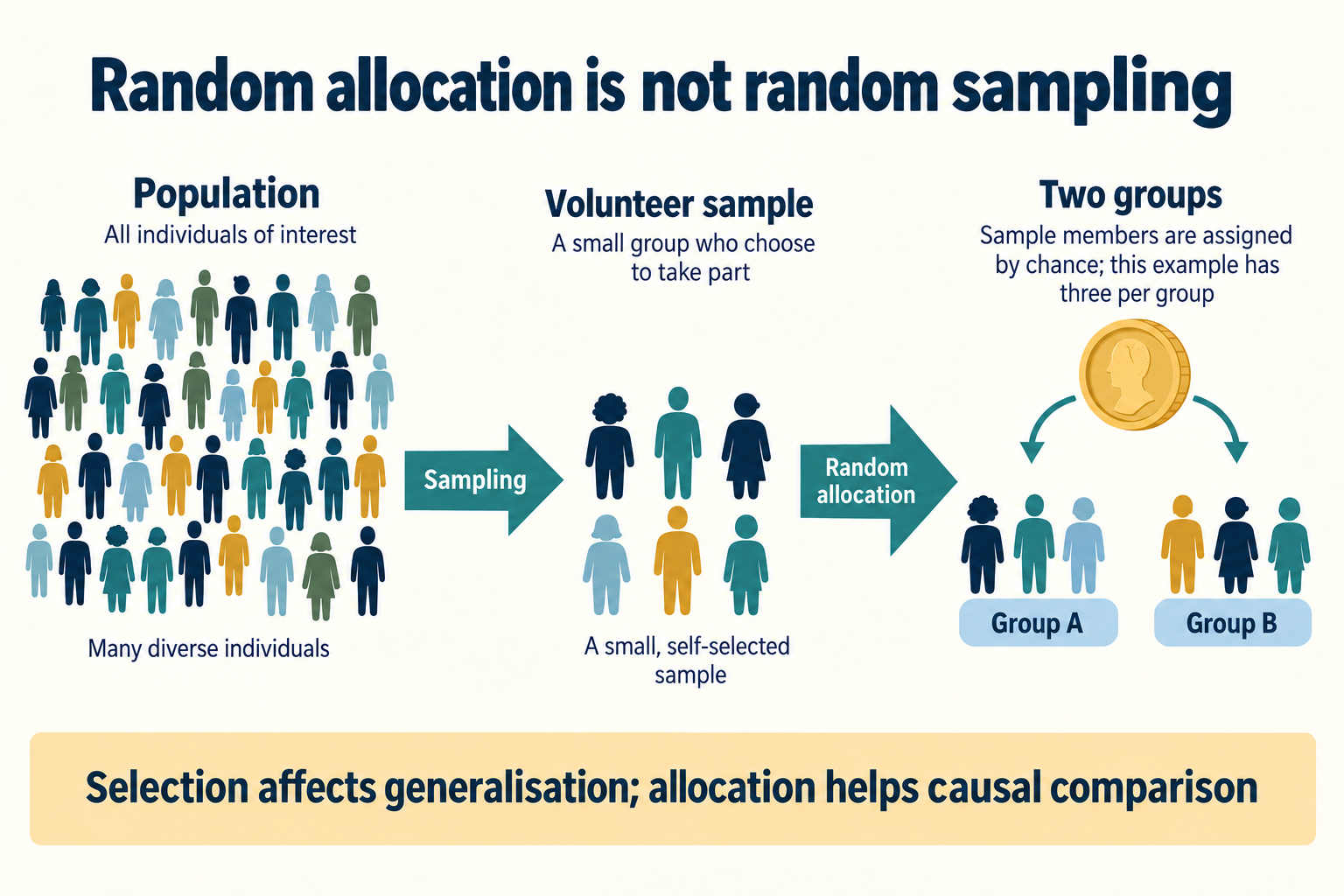
The sampling/allocation image follows two separate inferential steps. Its volunteers are selected before being allocated to groups; assignment by chance helps comparison, while recruitment determines whom the results can plausibly describe. Neither arrow converts a task score into a complete measure of a mind. An extended answer should therefore specify the claim, its operational evidence and its boundary. A persuasive model may explain a pattern economically while remaining provisional. This lesson targets the revised 2027-onward A-level content; it does not treat the earlier 2026 A-level paper as a current practice paper or confer AS qualification coverage.
Worked example: Hypothetical study: twenty adult volunteers are assigned by chance to repetition or sentence-generation instructions. Mean delayed recall is 6/12 versus 8/12. The researcher calls this proof that sentence generation increases memory capacity. Reconstruct a defensible claim and hypothesis.
Specify the manipulated instruction and the outcome: number of the twelve target words recalled after the same ten-minute filled delay.
A prior directional hypothesis predicts more correct words under sentence generation. A null hypothesis concerns no population condition difference, not identical individual scores.
The observed mean difference is 2 words. Random allocation helps balance existing differences in expectation, but no sample dispersion or uncertainty is supplied.
Capacity is not manipulated or directly measured. Better encoding or retrieval strategy could produce the result without changing the amount that can be held at once.
Answer: The hypothetical result supports an instruction-related difference on this delayed recall task, subject to uncertainty and design checks. It does not prove a general increase in capacity or a benefit for every learner.
Check your understanding: Transfer: a school compares an old class taught last year with a new class taught this year and obtains the same 2-word difference. Explain why its causal claim is weaker. Propose one ethically feasible design improvement and an observation that would challenge the original theory.
Answer: Different cohorts, teachers and prior attainment provide rival explanations. Randomly allocate consenting participants within the same cohort to equivalent instructions, using the same assessor and delay. A well-conducted replication finding no sentence-generation advantage would challenge this specified prediction, although it would not settle all memory theory.
Why: Indicative rubric: credit operational detail, distinction between experimental and historical comparison, a mechanism alternative and a falsifiable prediction. Merely calling the new class a field experiment or naming validity is insufficient; explain how the rival factor could create the observed difference.