Design, control groups and the causal comparison
By UK A Level Psychology · independent study · myAudience
myAudience original rendered educational illustration. Image: illustration, not a documentary photograph. · Generated for this isolated pending curriculum pack; no third-party artwork licence claimed.
Design, control groups and the causal comparison
A causal claim asks what would have happened to the same person under another condition. We cannot observe both possibilities at the same moment, so design constructs a defensible comparison. Independent groups use different participants in each condition. Repeated measures test the same participants in both conditions. Matched pairs use different participants paired on a relevant prior characteristic before assignment within pairs. Matching on one variable does not equate every individual difference; repeated measures remove stable participant differences from the comparison but introduce order and carry-over effects. Design is a trade-off, not a hierarchy in which one label always wins.
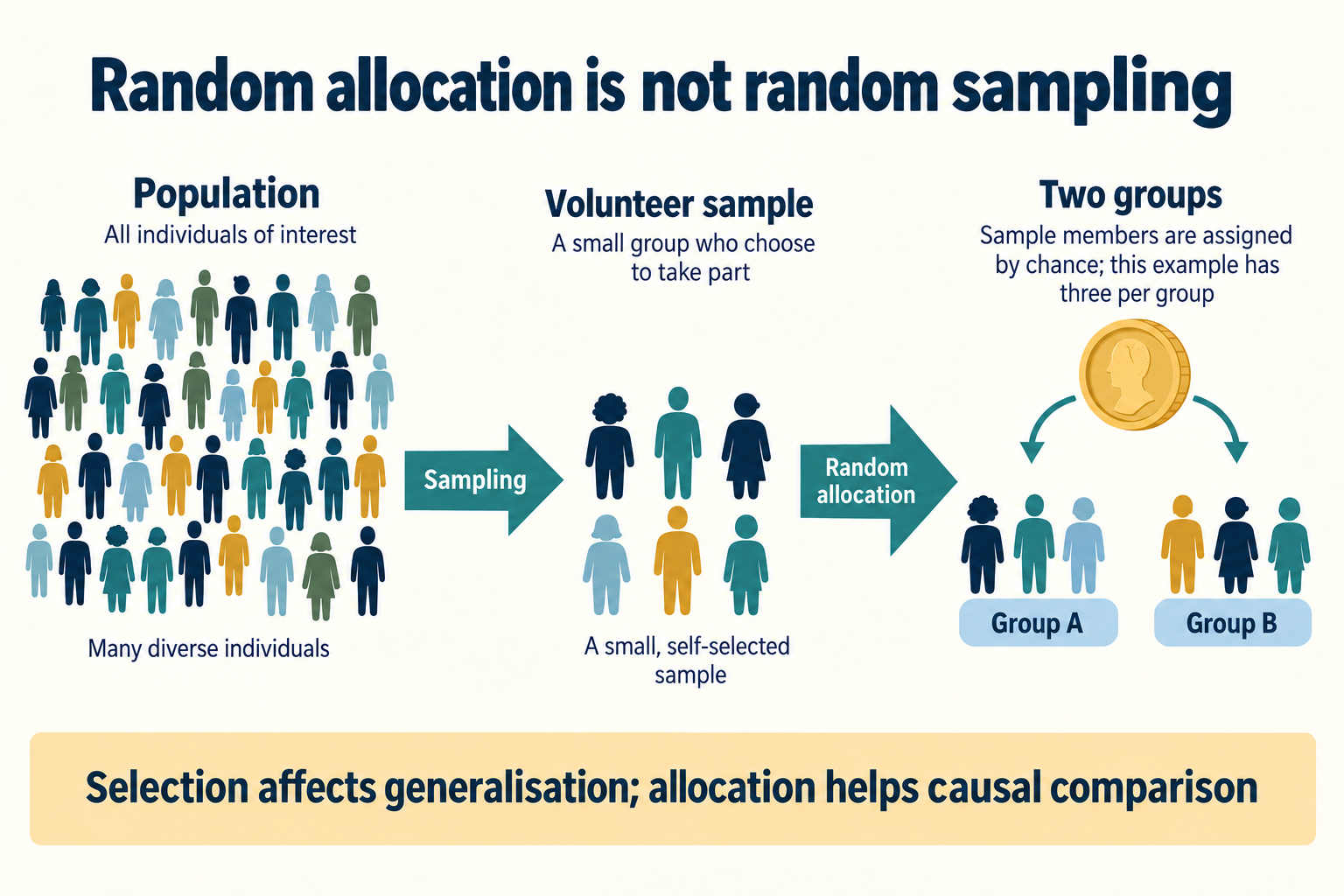
Random allocation assigns already recruited participants by chance. Random sampling recruits from a population by chance. The image shows why a volunteer sample can be randomly allocated yet remain unrepresentative. Allocation balances measured and unmeasured prior differences in expectation over repeated randomisations; an individual small sample can still be uneven. Standardisation keeps specified procedures consistent, such as instructions, display time and scoring. Randomisation can also vary word order so that one condition is not always paired with easier items. These are distinct operations with distinct purposes; describing them precisely is more useful than saying everything was random.
Counterbalancing distributes condition orders. Half a repeated-measures sample might complete A then B, the other half B then A. It allows ordinary practice or fatigue effects to be distributed across conditions. It cannot undo learning that permanently changes later performance, and a short rest does not necessarily remove carry-over. Equivalent alternative word lists reduce direct item learning but need piloting for difficulty. A matched-pairs design is useful when repeated testing would teach the answers, though recruiting well-matched pairs can be expensive and incomplete. Explain why the chosen feature addresses the particular task rather than merely naming the design.
Control groups are explicitly added in the revised specification. A no-intervention comparison can test whether change exceeds ordinary time-related change. An active comparison equates time, contact or expectancy while differing in the hypothesised ingredient. For a sentence-generation activity, a repetition group is an active comparator, not an absence of instruction. If the sentence group receives twice the time per word, any advantage may reflect study time. The investigator must specify whether the desired estimate concerns the whole teaching package or the semantic ingredient alone. Holding time constant answers a different causal question from allowing a naturally longer activity.
Demand characteristics arise when cues lead participants to infer the purpose and change their behaviour. Investigator effects arise when a researcher's expectations change instructions, interaction or scoring. Standard scripts and scoring blind to condition reduce some pathways without making the task automatically valid. A pilot checks whether people understand instructions, whether the measure has ceiling or floor effects, and whether the procedure produces unforeseen burdens. Pilot observations should improve the method; choosing whichever outcome gives the biggest advantage and presenting it as preplanned would conceal selection. Ethical review and genuinely voluntary participation precede data collection.
A useful extended causal model treats performance as a combination of instruction, person, list difficulty, order and measurement error. The model is an original teaching framework, not an estimated equation or published finding. It suggests design checks: distribute people by chance, balance lists and orders, blind assessors and report departures. Reporting should distinguish the abstract's concise overview, the introduction's reasoning, the method's reproducible procedure, the results' observations and the discussion's explanations and limits, followed by references. Peer review can scrutinise this chain but cannot guarantee that every undisclosed choice or error has been detected.
Worked example: Hypothetical counterbalanced recall study. AB participants score A=4,6,8 and B=7,9,11. BA participants score B=5,7,9 and A=6,8,10. Calculate the condition means and explain how order can conceal the effect in one order.
AB means are A=6 and B=9, giving a B−A difference of 3 words. BA means are B=7 and A=8, giving a B−A difference of −1 word.
Pooling equal-sized order groups gives A=(18+24)/6=7 and B=(27+21)/6=8: the condition difference is 1 word.
These constructed means fit an additive illustration in which B has a 1-word advantage and whichever condition occurs second gains 2 words. This is an explanation of the hypothetical values, not a confirmed psychological mechanism.
Balanced orders remove that simple additive order contribution from the pooled difference. A condition-specific carry-over effect would require a different analysis or independent groups.
Answer: The pooled B advantage is 1 word, while the order-specific contrasts differ. Counterbalancing addresses the illustrated practice effect; it does not establish significance or exclude every carry-over mechanism.
Check your understanding: Transfer: students permanently learn a set of symbols in A, then use those same symbols in B. Explain why AB/BA may be inadequate. Compare an independent-groups active control with matched pairs, and specify what it controls.
Answer: Counterbalancing cannot erase learned symbols. Use different randomly allocated groups with equal time and equivalent unlearned materials, or matched pairs based on a prior unrelated ability measure. The active control equates contact and practice time while varying the instructional ingredient. Matching addresses only selected prior differences; allocation and consistent assessment still matter.
Why: Indicative rubric: justify the carry-over pathway, comparator and design in the scenario, not just generic strengths. Credit equal-time control, blind scoring and acknowledgement that matching cannot control unknown traits. No numerical p-value can be inferred from the four means alone.