Sampling, consent and the limits of generalisation
By UK A Level Psychology · independent study · myAudience
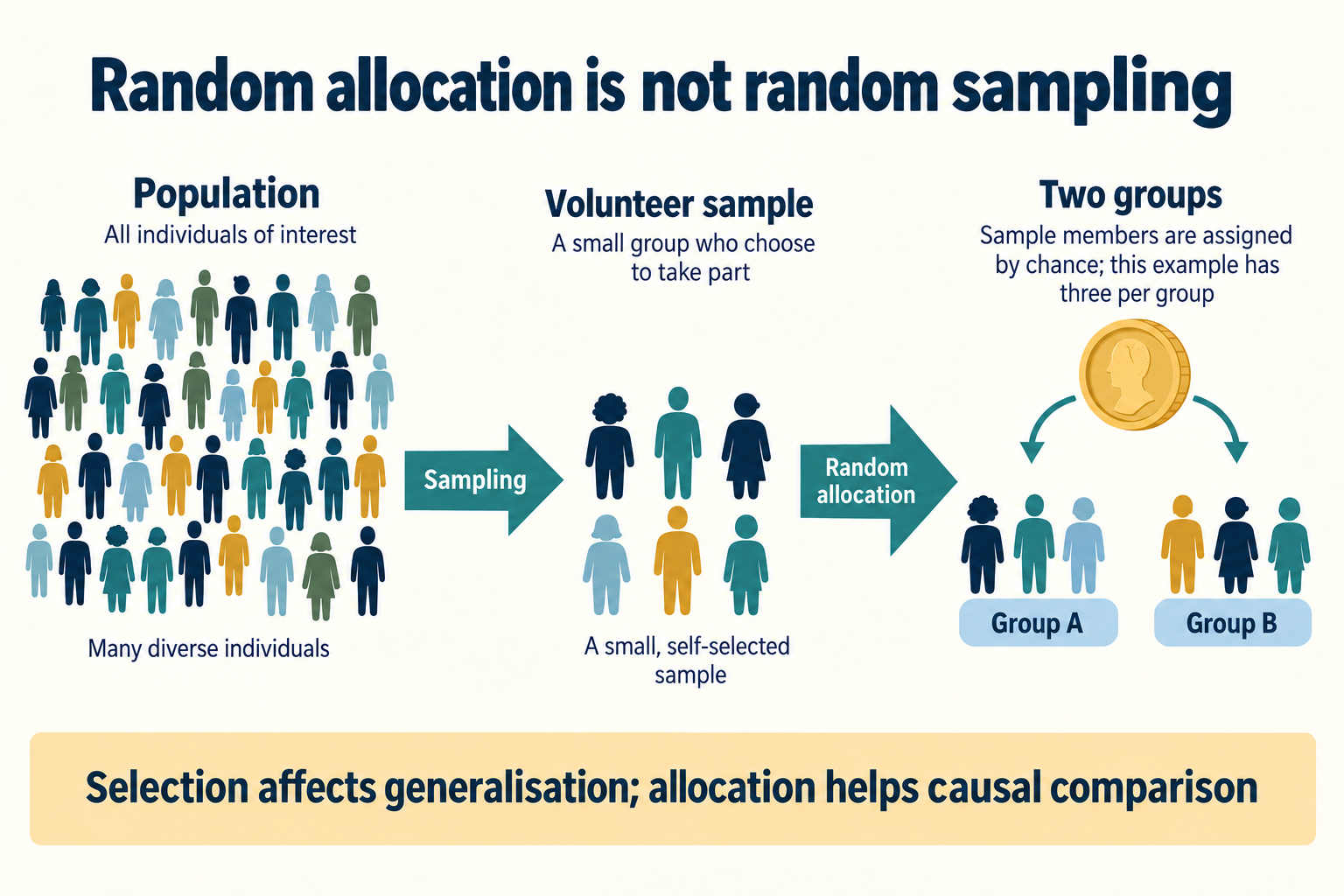
myAudience original rendered educational illustration. Image: illustration, not a documentary photograph. · Generated for this isolated pending curriculum pack; no third-party artwork licence claimed.
Sampling, consent and the limits of generalisation
The target population is the group a researcher wants a claim to concern; the sample is the group actually studied. A sampling frame is an accessible list from which people can be selected. If the frame excludes people who do not use a platform, a random selection from that list cannot represent every person. Opportunity sampling recruits accessible people, while volunteer sampling recruits people who choose to respond. Both can be practical but may select particular experiences, available time or interest. A large biased sample can estimate its own pattern precisely while describing the target population badly.
Random sampling gives each member of the defined frame an equal selection chance when implemented as simple random sampling. Systematic sampling selects every kth entry after a random starting point; periodic ordering can accidentally align selection with a subgroup. Stratified sampling divides the population into relevant categories and samples within each in a planned proportion. This ensures representation on the chosen stratifier, not every characteristic. A hypothetical frame containing 600 first-year and 400 second-year students would contribute 24 and 16 people to a proportional sample of 40. Non-response can still change the achieved proportions or leave the responders different from those invited.
Consent concerns a decision made with adequate information and freedom, not merely a signature. The BPS human research code frames research around autonomy/privacy/dignity, scientific integrity, social responsibility and benefit/harm. Applied safeguards here are original design proposals: clear task and time information, no academic penalty for declining, an accessible way to stop, minimal data collection and an explained withdrawal deadline before irreversible anonymisation. A teacher's authority can make a class feel unable to refuse. A neutral recruitment route and an equivalent non-research activity address that pressure more concretely than saying the researcher has permission from the institution.
Deception and incomplete disclosure can damage autonomy and trust. Debriefing explains the true purpose and offers a meaningful opportunity to raise concerns, but does not retrospectively make all risks acceptable. A harmful procedure is not justified simply because participants are told afterwards. Historical conformity and obedience studies pose this tension sharply. Studying their published evidence is different from recreating deception or distress in a classroom. The present worked examples are hypothetical desk analyses; they are not instructions to conduct a harmful study, collect private disclosures or infer a participant's psychological condition.
Confidentiality means limiting access to identifiable information. Anonymity means that responses cannot be linked to a person, subject to the actual design and available information. Replacing a name with a code is pseudonymisation if a linking key remains. A small combination of age, role and unusual experience might still identify someone. Explain what is collected, who can access it and when identifiers are removed. Observing behaviour in an open space also needs a defensible privacy assessment; public visibility does not mean every recording, interpretation or publication is acceptable. Case studies can be informative precisely because detail is rich, which also makes privacy harder.
External validity asks about transfer to other people, settings or times. Sampling constrains transfer to people; an artificial task constrains transfer to settings; historical norms constrain temporal generalisation. The sampling image retains all six selected tokens during assignment but is only an illustration: equally sized drawn groups are not guaranteed by independent coin flips. For an extended answer, link each limitation to the particular claim. A claim about all sixth-form learners is broader than a claim about consenting adult volunteers from one class. Ethical exclusion and attrition can affect generalisation and should be reported rather than hidden to make a dataset look tidy.
Worked example: Hypothetical frame: 600 first-year and 400 second-year students. A researcher plans a proportional stratified sample of 40. Of 24 invited first-years, 18 respond; of 16 invited second-years, 8 respond. Calculate planned and achieved proportions. Is replacing nonresponders with nearby friends neutral?
The frame is 60% first-year and 40% second-year, so planned allocations are 24 and 16.
The achieved sample is 26 people: first-years 18/26≈69.2% and second-years 8/26≈30.8%. Response rates are 75% and 50%, respectively.
Replacing nonresponders with friends changes the selection mechanism to convenience recruitment. It may restore counts without restoring comparable representation.
Report invitations and responses separately. If recruiting replacements, use a predefined random procedure within strata and record non-response rather than forcing participation.
Answer: The achieved sample overrepresents first-years relative to the frame. Stratification at invitation does not guarantee stratification among responders; equalised counts alone do not remove response bias.
Check your understanding: Transfer: a school wants to publish verbatim comments about obeying teachers from a small class. Explain one risk that remains after names are removed, one sampling limitation, and an ethical redesign preserving the research question.
Answer: Distinctive wording or contextual details could identify a pupil. A single accessible class limits generalisation, especially where students feel recruitment pressure. Use a neutral opt-in route with a non-research alternative and collect minimal non-sensitive responses; paraphrase or aggregate under an approved disclosure plan rather than automatically publishing identifiable quotations.
Why: Indicative rubric: credit re-identification reasoning, distinction between pseudonymisation and anonymity, and a feasible change that reduces pressure without claiming perfect safety. Consent must be voluntary and specific; neither headteacher permission nor a larger convenience sample solves the problem.