Compliance, internalisation and competing social motives
By UK A Level Psychology · independent study · myAudience
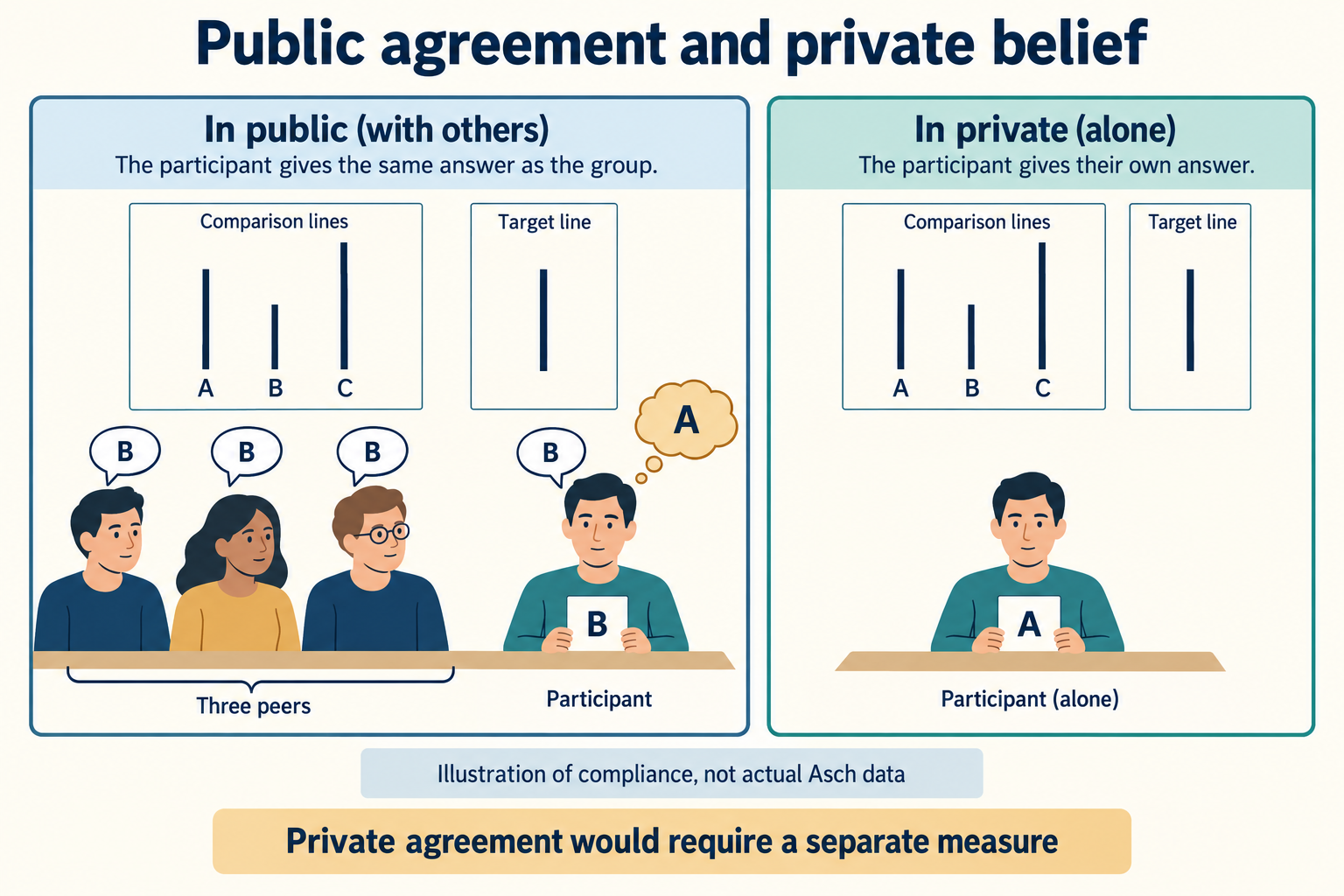
myAudience original rendered educational illustration. Image: illustration, not a documentary photograph. · Generated for this isolated pending curriculum pack; no third-party artwork licence claimed.
Compliance, internalisation and competing social motives
Conformity is a change in response toward a group's position without a direct command from an authority. Compliance means public agreement without corresponding private acceptance; internalisation means accepting the group's view privately as well as publicly. A person may agree in a meeting and later reject the same answer alone. That pattern is consistent with compliance, but a single public response cannot identify private belief. The image makes this distinction through an explicitly hypothetical thought bubble; psychological observation never literally sees the contents of thought. The revised conformity-type list contains compliance and internalisation; identification is not restored as a third current requirement.
Normative social influence concerns acceptance, belonging or avoiding disapproval. Informational social influence concerns using others as evidence about what is correct, especially when a task is uncertain. They are explanations, while compliance and internalisation describe outcomes. Do not map normative influence to compliance or informational influence to internalisation as if each combination were compulsory. A person could privately believe that a group norm deserves loyalty, or temporarily use another answer while remaining unsure. The same behaviour can arise through multiple routes. A good explanation identifies the reason in the scenario and evidence that could distinguish it from a competing reason.
Suppose a hypothetical student chooses the group's answer on a clear line comparison in public but chooses the correct line in a confidential later test. The public/private contrast supports an acceptance-pressure account more than a stable perceptual change account. Yet the later test may differ in confidence, exposure or task details. A comparison keeping the task constant and changing whether answers are public tests the visibility prediction more directly. If influence mainly rises on ambiguous problems even when responses are confidential, informational reasoning becomes more plausible. A factorial design crossing task difficulty and visibility helps separate these predictions without pretending either motive is measured perfectly.
Asch's original research used disagreement between an individual's line judgement and a unanimous majority. Its importance is that agreement with an incorrect majority can occur even when a task seems clear; it does not show that every participant always yielded or that private perception was universally replaced. The paper includes interviews as well as response counts, useful for exploring reasons but vulnerable to retrospective reconstruction and researcher interpretation. The college sample and contrived short task bound population and everyday transfer. These method-based limits are inferences from the reported design, rather than invented findings about a modern replication.
Conformity can be adaptive when other people know something useful, and dangerous when their confidence is mistaken. Correctness and social influence are separate dimensions. Copying a well-informed group's correct answer is still potentially social influence; disagreeing with a mistaken group is not proof of a fixed independent personality. Consider an extended original model in which a response depends on task uncertainty, anticipated social cost, group credibility and the availability of alternative support. It predicts conditional changes across situations rather than a single 'conformist' label. This is a teaching model to generate testable questions, not a diagnostic classification or fitted equation.
Evaluation should turn a limitation into an implication. An artificial line task makes stimulus difficulty easier to control, which strengthens comparison, while limiting transfer to sustained value-laden decisions. Deception about peers' roles affects informed consent and trust even when the task has no physical harm; debriefing reduces misunderstanding without retroactively removing it. Current ethical classroom work can analyse hypothetical data or openly explained simulations without recreating hidden pressure. For an extended response, connect theory, operational evidence, a competing interpretation and a bounded judgement rather than attaching a generic 'low ecological validity' sentence to every study.
Worked example: Hypothetical task with 40 people per condition. Public responses: 24 choose the majority answer; confidential responses: 12 choose it. On a later separate private test, 10 of the 24 public agreers still choose it. Calculate agreement rates and compare compliance with internalisation interpretations.
Public agreement is 24/40=60%; confidential agreement is 12/40=30%, a 30-percentage-point difference, not a 30% relative increase.
Of public agreers, 10/24≈41.7% later agree privately; 14/24≈58.3% do not. The latter pattern is consistent with compliance.
Later private agreement is consistent with internalisation but can also reflect recall of the earlier answer or unchanged independent belief. Pre-influence private judgements would help test genuine change.
No raw response reveals a motive by itself. Assignment, task equivalence and confidential measurement determine how strongly the visibility contrast can be interpreted.
Answer: Public visibility is associated with more agreement in this constructed comparison. The public-only subgroup fits compliance; the persistent subgroup needs further evidence before claiming internalisation.
Check your understanding: Transfer: a navigation team accepts a majority route on an unfamiliar map even though all answers are confidential. Another team publicly endorses an obviously inefficient route to avoid upsetting friends. Explain the likely motives and design a discriminating test if both teams later give the same answer.
Answer: Uncertainty and reliance on peers support informational influence in the first case; anticipated rejection supports normative influence in the second. Cross public/confidential response with clear/ambiguous map information and measure prior and delayed judgements. Predict a visibility effect for the acceptance account and a difficulty/credible-information effect for the information account, while allowing both to operate.
Why: Indicative rubric: credit motives linked to scenario details, distinction from outcome labels, two operational predictions and a limitation of belief measurement. Persistent agreement alone does not prove a change in belief, and conformity is not automatically an error or a personality diagnosis.