Asch: isolate group variables and preserve the denominator
By UK A Level Psychology · independent study · myAudience
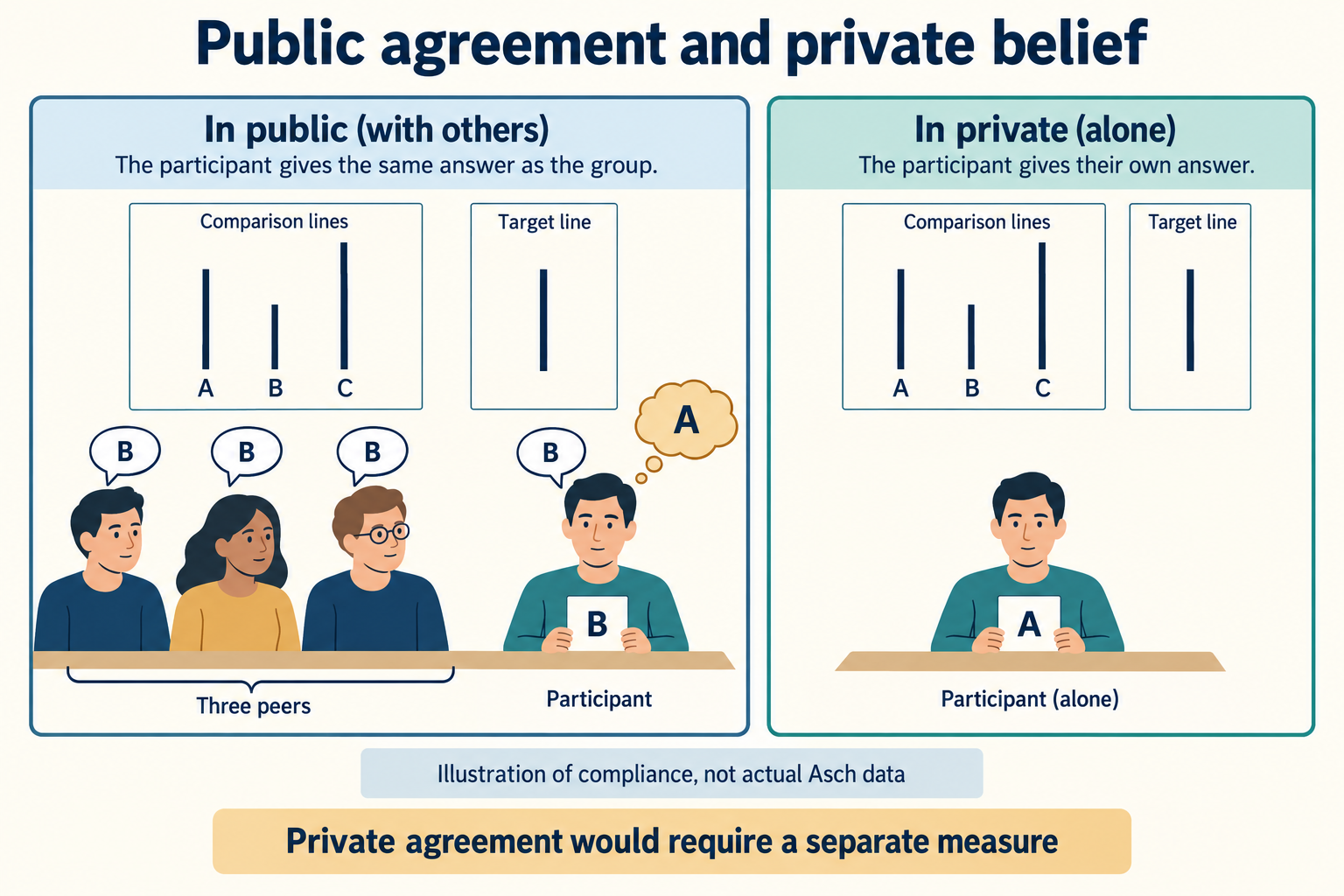
myAudience original rendered educational illustration. Image: illustration, not a documentary photograph. · Generated for this isolated pending curriculum pack; no third-party artwork licence claimed.
Asch: isolate group variables and preserve the denominator
Asch's 1956 monograph studies an individual facing an incorrect unanimous majority on line judgements. The original task isolates group disagreement around a clear perceptual answer; it is not a model of every social decision. The evidence should be attached to a particular condition and outcome. A proportion of critical trials answered with the majority differs from the proportion of people who ever agree. Repeated trials from the same person are correlated observations, so twenty people completing ten trials are not automatically two hundred independent participants. A headline percentage without its denominator is not a usable finding.
Group size concerns how many others support the position. The classic pattern rises with initial increases in majority size but does not support an unlimited linear increase for every added person. An original mechanism account is that additional independent voices initially add credibility or pressure, while later voices add less if consensus is already clear. Unanimity concerns whether everyone else gives the same answer. A dissenter can reduce the sense that resistance is isolated. A dissenter need not supply the correct answer to make disagreement possible, so a support explanation differs from simply receiving correct information. Match the manipulation to the proposed route.
Task difficulty matters because it changes uncertainty and therefore the value of others as evidence. A smaller distinction between comparison lines can make an informational account more plausible, while public disagreement may also create normative pressure. The generated illustration uses a clear match between A and the target, with B shorter and C longer. It is a conceptual compliance example, not a scale reconstruction or a reproduction of Asch's actual stimuli. Comparing that clear panel with a harder task would require newly controlled stimuli, rather than assuming the decorative line drawing itself supplies experimental data.
A carefully designed follow-up would vary one feature while keeping line difficulty, response sequence and scoring constant, or use a planned factorial comparison. If a larger group also contains older or more expert members, group size is tangled with credibility. If participants know that all peers share the same source, their answers are not independent informational votes. The original study's college context, male sample and historical setting limit generalisation to other ages, cultural contexts and online interaction. These are design-based limits, not proof that the effect disappears outside the laboratory. Temporal and ecological validity need evidence from relevant new settings.
Interviews can enrich response counts by asking whether a person doubted the judgement or avoided standing out. Their interpretation must remain cautious: a later explanation can be rationalisation, and respondents may infer what researchers expect. Combining private judgements, confidence ratings and a visibility manipulation supplies converging evidence but no direct readout of motive. The original procedure's undisclosed collaborators create a consent problem and can induce discomfort. Modern ethical teaching should evaluate that trade-off without reenacting covert social pressure. A legitimate rationale is specific about informational value and alternatives rather than saying classic status makes the procedure acceptable.
An extended model distinguishes headcount from independence of information. Ten people who all repeat one online message may represent one informational source but substantial social visibility; three genuinely independent observations might convey more evidence. This is an original transfer hypothesis, not a result attributed to Asch. It invites an experiment crossing the number of speakers with whether their information source is shared. A reasoned essay can then argue that situational pressure is demonstrable in a bounded task while group structure, motives and measurement determine how far the account extends. The revised cohort retains Asch variables while removing Zimbardo and social-change bullets.
Worked example: Hypothetical data: twenty participants per condition each complete ten critical trials. A unanimous group produces 70 majority answers from 200 trials, with 14 participants agreeing at least once. A dissenter group produces 20/200, with 8 participants agreeing at least once. Compare the four rates and the inferential unit.
Trial-level agreement is 70/200=35% versus 20/200=10%, a 25-percentage-point contrast.
Participant-level ever-agreement is 14/20=70% versus 8/20=40%, a 30-percentage-point contrast. These are different questions, not inconsistent calculations.
The participant, not every repeated trial, is the independently recruited unit. Treating 400 trials as 400 independent people understates dependency.
The dissenter condition is consistent with social support reducing pressure, but credibility and the dissenter answer must be specified before choosing a mechanism.
Answer: Report both outcomes with their denominators. The hypothetical comparison shows lower agreement with a dissenter; it does not establish why, or license a participant-level significance test from trial counts.
Check your understanding: Transfer: an online panel shows ten unanimous accounts, all copying one expert, while a second panel shows three people making independent judgements. Predict different normative and informational effects, and propose a control against mistaking account count for independent evidence.
Answer: Visibility/headcount may increase anticipated social pressure in the ten-account panel, while genuine independent observations may make the three-person panel more informative. Keep message content, expertise, task difficulty and presentation time constant and explicitly manipulate shared versus independent sources. Measure public and confidential responses; the predictions remain provisional.
Why: Indicative rubric: credit trial/person denominator distinction, dependency, a source-independence prediction and scenario-specific control. Do not import famous Asch percentages into these invented data or conclude that ten online accounts must cause more internalisation than three independent judges.