Obedience, authority and explanatory alternatives
By UK A Level Psychology · independent study · myAudience
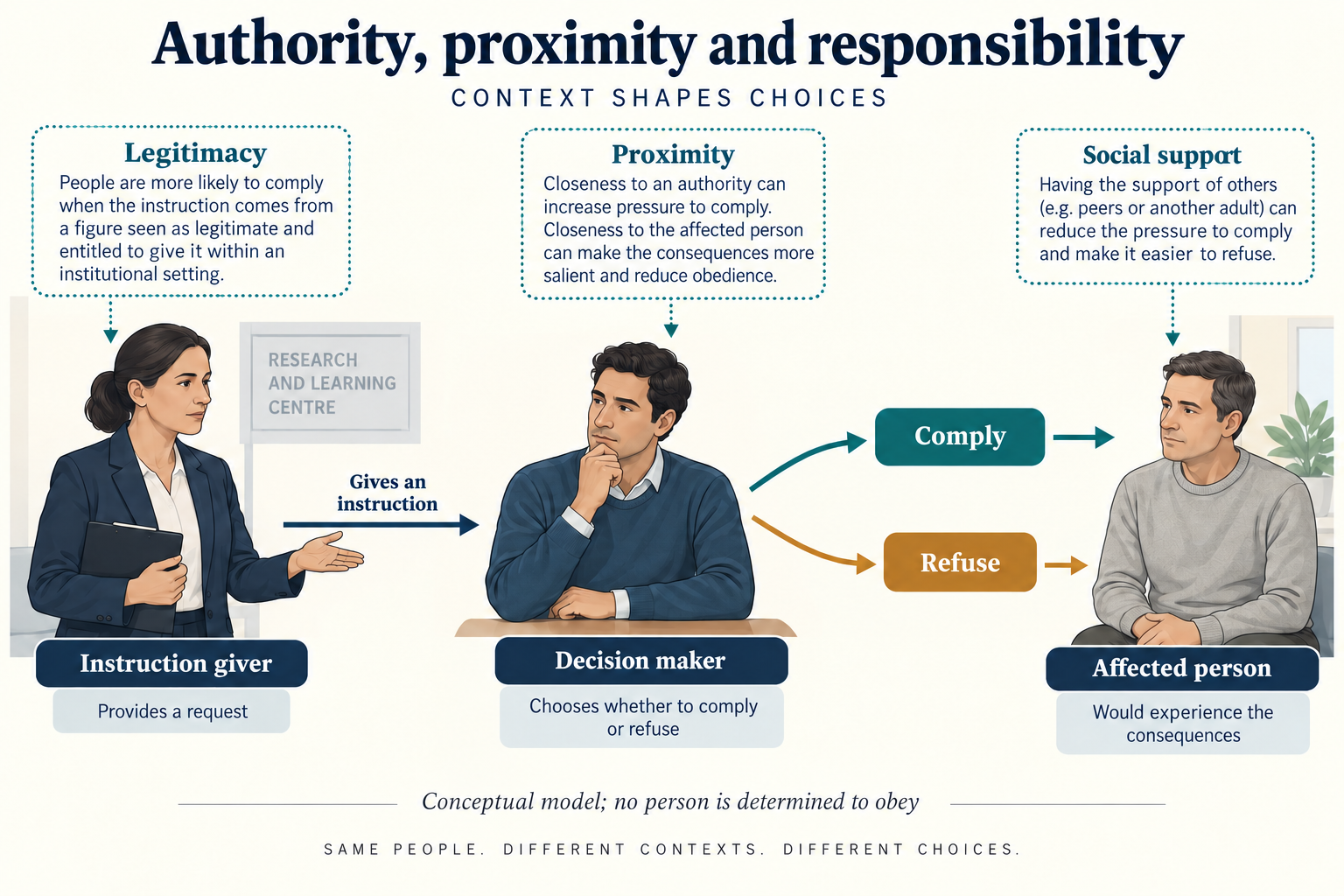
myAudience original rendered educational illustration. Image: illustration, not a documentary photograph. · Generated for this isolated pending curriculum pack; no third-party artwork licence claimed.
Obedience, authority and explanatory alternatives
Obedience is responding to a direct instruction from an authority, whereas conformity concerns aligning with a group. An agentic explanation proposes that a person sees themself as carrying out another's wishes and shifts perceived responsibility to that authority. Legitimacy of authority concerns whether the instruction giver is viewed as entitled to direct behaviour in the setting. These concepts are distinguishable: someone can recognise an authority's role yet retain personal responsibility and refuse an instruction. Explaining behaviour does not excuse it or make the response inevitable. A model needs evidence for the intervening psychological process, not only an observed act of compliance.
Milgram's 1963 paper reports forty male volunteers recruited around New Haven for a purported learning investigation at Yale. The learner was a collaborator, and the apparent shock apparatus did not deliver the escalating shocks to that learner. Twenty-six participants reached the maximum labelled setting, while fourteen stopped earlier. Distress was reported during the procedure. These are observations from that reported condition, not percentages for all variations or all populations. Reaching a labelled setting is an operational outcome; it is not proof that a participant believed every detail or had become a passive agent.
Situational reasoning asks how proximity, location and uniform alter the meaning of the instruction. Proximity to an authority can make direction more immediate; proximity to the affected person can make consequences more salient and encourage refusal. A prestigious location may support perceived legitimacy, while a uniform can signal a recognised role. The revised specification requires these variables, but the 1963 baseline report is not a complete quantitative source for every later variation. We therefore do not attach unsourced variation percentages to it. The corrected generated diagram distinguishes the two proximity directions and represents choice rather than a universal causal law.
An alternative interpretation is that participants continue because they identify with what they think is a worthwhile scientific enterprise, rather than because an order mechanically removes agency. Another possibility is gradual commitment: each small step makes the next seem more continuous with the previous one. These are explanatory alternatives, not findings manufactured from the baseline count. To distinguish them, assess perceived scientific value and responsibility separately, and compare ethically low-stakes appeals that keep the task and authority constant. A correlation between a responsibility report and behaviour remains open to retrospective justification and does not by itself establish mediation.
The ethics are inseparable from evidence quality. Deception limits informed choice, and repeated insistence can make withdrawal feel unavailable even if a consent script says it is permitted. Observed distress means absence of actual shocks does not imply absence of harm. Debriefing can correct false beliefs but cannot retroactively eliminate distress or guarantee no later effects. The historical study can be evaluated through published evidence; these lessons do not instruct learners to recreate it. Consent, proportional risk, independent ethical review and alternatives are more meaningful than the claim that a famous experiment deserves imitation.
Transfer should remain bounded. A controlled laboratory permits specified procedures and comparisons but differs from institutions involving long relationships, real consequences and competing obligations. The volunteer male sample and historical US setting constrain universality. An extended original model connects instruction, perceived legitimacy, identification with the goal, available support and consequence salience to a decision. It predicts that the same person may refuse in one situation and comply in another. A reasoned answer weighs which manipulation distinguishes models, recognises methodological and ethical limits, and avoids diagnosing a person as obedient or equating a brief laboratory task with a whole historical atrocity.
Worked example: Use the actual reported 1963 baseline counts, 26 of 40 reaching the maximum labelled setting and 14 stopping, to calculate proportions. Then contrast a hypothetical harmless sorting task: 18/30 comply with a request in a formal setting and 12/30 in an informal setting. What can each comparison establish?
The historical proportions are 26/40=65% and 14/40=35%. The maximum concerns a labelled simulated apparatus outcome, not shocks delivered to the learner.
The separate hypothetical rates are 60% and 40%, a 20-percentage-point difference. They are not Milgram variation results.
If the hypothetical setting manipulation is randomly assigned and everything else is equivalent, it supports a setting effect on that harmless task.
Neither count alone measures agentic state. Measuring perceived legitimacy and responsibility, with cautious interpretation, would help distinguish mechanisms.
Answer: The historical count describes one studied condition. The constructed comparison could test location-related influence in a different low-stakes task; it cannot establish the mechanism or reproduce the historical effect magnitude.
Check your understanding: Transfer: an instruction appeals to a participant’s interest in helping science, while another says they have no choice. Design an ethically low-stakes test distinguishing identification with the goal from passive response to command. Explain a result that would weaken each interpretation.
Answer: Use informed adult volunteers who may decline without penalty, an innocuous optional task, equivalent task duration and random assignment to differently worded appeals. Higher voluntary continuation under a goal appeal would challenge a pure command account; equal continuation despite large differences in measured goal identification would weaken a simple identification-only account. Both interpretations need measurement and competing-cause checks.
Why: Indicative rubric: credit separate mechanisms, a clear behavioural outcome, voluntary stopping and operational predictions. Do not propose deception about injury or coercive withdrawal. An effect of wording is evidence for an appeal difference, not proof of a unique hidden state.