Dispositions, social support and resistance
By UK A Level Psychology · independent study · myAudience
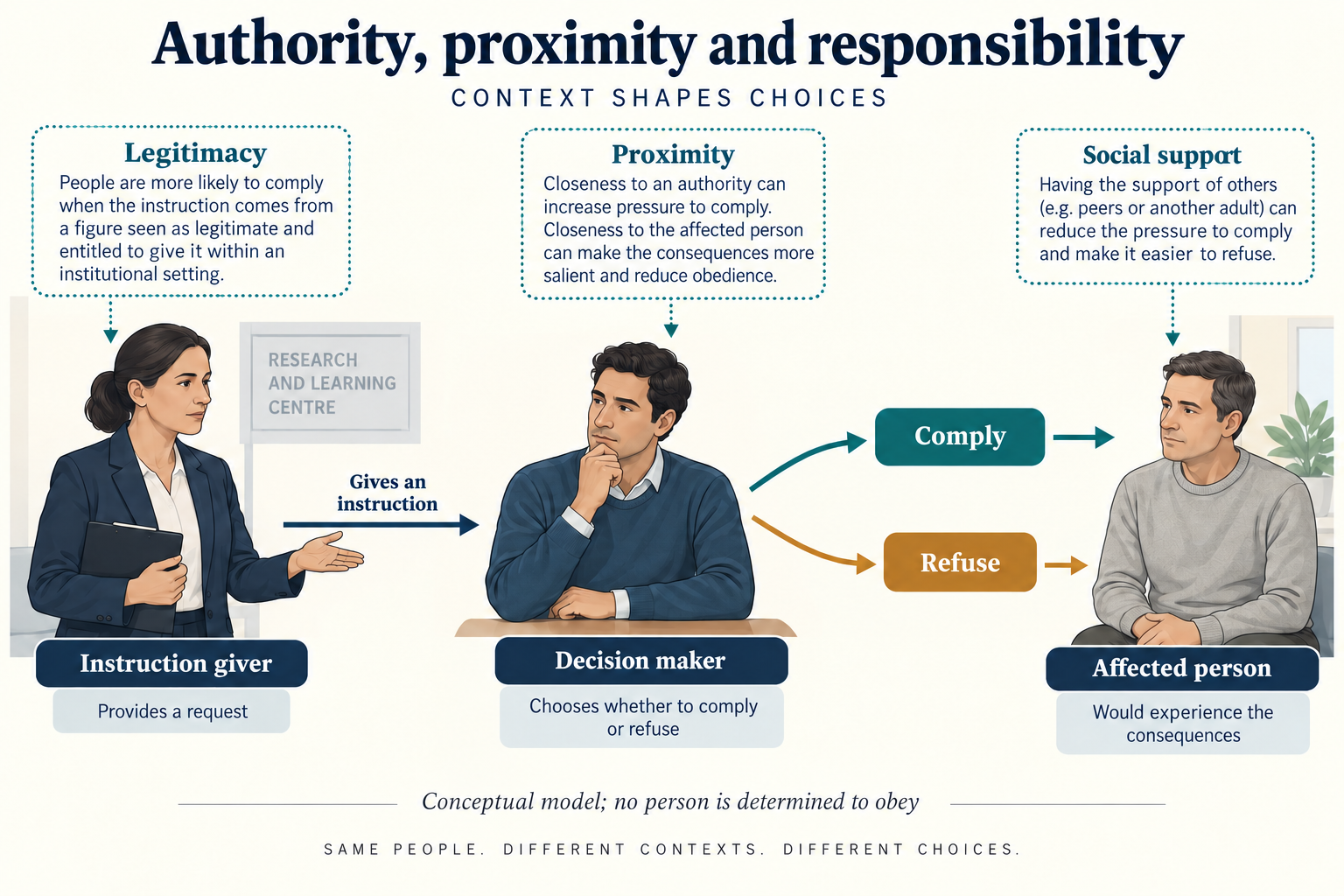
myAudience original rendered educational illustration. Image: illustration, not a documentary photograph. · Generated for this isolated pending curriculum pack; no third-party artwork licence claimed.
Dispositions, social support and resistance
A dispositional explanation attributes variation partly to enduring individual differences. The Authoritarian Personality account links deference to powerful authority with rigid conventionalism and hostility toward weaker or out-group targets. It is a historical theoretical explanation, not a diagnosis or a tool for labelling a classmate from one decision. Its developmental account invokes experiences such as strict parenting; retrospective association cannot establish that a particular childhood caused adult obedience. A psychological theory may organise observations while remaining vulnerable to measurement, cultural bias and causal ambiguity.
Adorno and colleagues' 1950 work developed questionnaires and interviews about authoritarian tendencies. The F-scale uses agreement items, so acquiescent responding is a plausible measurement alternative when agreement itself contributes to the score. Ideological wording can also narrow what the scale represents. These are methodological critiques of the instrument, not a fabricated claim that a particular reanalysis reversed its results. An original improved design would use carefully piloted balanced wording, separate constructs from political identity, and examine whether a score predicts independent behaviour in more than one setting. Better wording addresses one bias rather than certifying a neutral universal measure.
Social support changes the situation. Another person who resists can show that disagreement is possible, provide an alternative interpretation, or reduce anticipated rejection. The support need not be a universally dominant personality. Comparing resistance before and after a supporter arrives can suggest a contextual effect, but time and prior exposure might also change the response. Randomly allocating an openly explained low-stakes task with or without support is a cleaner comparison. Asch's dissent manipulation supplies historical context for this idea; generalising to obedience requires evidence relevant to a direct instruction, not merely transferring a conformity label.
Locus of control describes a general expectancy about whether outcomes depend on one's own actions or on external circumstances such as luck or powerful others. Rotter's account is about expected contingency of reinforcement, not a binary category of good and bad people. An internal expectancy might support taking responsibility for resistance in some contexts, but it cannot guarantee refusal or eliminate real institutional constraints. If a person accurately recognises that a decision is controlled by a powerful organisation, an external judgement may be realistic. Measurement context, wording and actual opportunities matter before making a broad prediction.
Person and situation can interact. A hypothetical internal-control group might resist more without a supporter, while a supporter raises resistance especially among people with lower expected personal control. This original model treats support as changing what actions seem possible rather than merely adding a constant. Testing interaction requires comparing differences between conditions, not observing one significant result and another non-significant result and declaring them different. Traits are measured rather than randomly assigned, so even a support experiment cannot make trait differences causal. Prior experience or confidence might explain the association.
The authority diagram includes both comply and refuse paths, with social support as a contextual cue. It does not measure personality, imply an inevitable response or establish responsibility shifting. Ethical reporting avoids turning average associations into personal verdicts. An extended answer should compare situational evidence, trait measurement and their possible interaction, then make a bounded judgement. The revised social-influence list retains disposition and resistance, while social-change processes are removed as a separate required bullet. Applying these ideas to an unfamiliar voluntary group is transfer practice, not a claim that the removed topic has been silently restored.
Original extended evaluation model. A refusal by someone with a high authoritarian questionnaire score contradicts an always-obey rule, but does not by itself refute a probabilistic dispositional account. A score and a single act measure different things, and the support context can change anticipated consequences. Rotter's account concerns expectations about reinforcement contingency, not an intrinsic classification of responsible and irresponsible people. The authority plate accordingly includes alternative comply and refuse routes. Its social-support cue represents a possible contextual influence, not a measurement of the participant's personality or a guarantee of resistance. The constructed four-cell example helps compare explanations without supplying a historical study result. With twenty people per cell, support-associated resistance changes from 60% to 80% in the higher-internal group and from 30% to 70% in the lower-internal group. The increases are twenty and forty percentage points, giving a twenty-point difference of effects. This descriptive pattern challenges a simple person-only account that predicts no contextual variation. However, a visible difference of effects is not an inferentially established interaction, and one significant comparison beside one non-significant comparison would not prove their effects differ.
For a stronger test, an original low-stakes study could measure expectancy before randomly allocating support within expectancy strata. Allocation would make the support comparison experimental; expectancy itself remains measured, so differences between its categories do not become causal effects of personality. Prior experiences, confidence or institutional constraints could contribute to that association. The study should define resistance behaviour and support delivery, check adherence, retain continuous trait information where appropriate, and preplan the interaction analysis. Generalising an Asch-style public-answer situation to refusal of a direct instruction also requires relevant evidence; conformity and obedience should not be treated as interchangeable outcomes. Questionnaire validity is a separate challenge. Pilot balanced agreement and disagreement wording, check comprehension, and compare content-related scores with an independently scored behavioural measure across settings. If responses mainly follow agreement wording rather than the intended construct, acquiescence becomes a plausible alternative. Balanced wording alone cannot guarantee validity because reverse wording can introduce its own comprehension difficulty. Consenting, non-coercive tasks and withdrawal protect participants; no score should become a diagnosis or moral verdict. Overall, both measured dispositions and situations can inform resistance, but the justified claim distinguishes experimental support effects from trait associations and states what further observations could challenge the explanation.
Worked example: Hypothetical data, twenty people per cell: measured higher internal expectancy/no support: 12 resist; lower internal expectancy/no support: 6; higher internal/support: 16; lower internal/support: 14. Calculate support effects and evaluate a person-only explanation.
Without support, resistance rates are 60% and 30%; with support, they are 80% and 70%.
Support raises resistance by 20 percentage points in the higher-internal group and 40 points in the lower-internal group. The difference of these effects is 20 points.
This constructed pattern is inconsistent with a simple person-only account in which context makes no difference. It suggests examining a person-by-support interaction.
No significance or causal trait conclusion follows from the percentages alone. Support can be randomly allocated; expectancy groups remain measured categories.
Answer: Both disposition-associated variation and context-associated variation appear in the hypothetical pattern. The larger support effect in one group is a descriptive interaction to test, not proof of a universal law.
Check your understanding: Transfer: someone scores high on an authoritarian questionnaire but refuses an instruction with a colleague’s support. Is the theory refuted? Propose a test of the claim that the questionnaire measures mere willingness to agree, and distinguish trait from situational evidence.
Answer: A probabilistic dispositional account permits exceptions and contextual effects; a deterministic always-obey claim would be contradicted. Compare responses to balanced agreement/disagreement wording and an independent behavioural measure across settings. Test support through random allocation while measuring traits separately. If scores mainly follow item direction rather than content, acquiescence is a stronger alternative.
Why: Indicative rubric: credit probabilistic versus deterministic claims, an operational measurement-bias test, and separate causal status for assigned support and measured disposition. Do not infer parenting history, diagnosis or moral character from a questionnaire score or a single refusal.