Minority influence: consistency without rigidity
By UK A Level Psychology · independent study · myAudience
myAudience original rendered educational illustration. Image: illustration, not a documentary photograph. · Generated for this isolated pending curriculum pack; no third-party artwork licence claimed.
Minority influence: consistency without rigidity
A minority can influence a majority without controlling the group's rewards. Consistency means a stable position across people or across occasions; commitment signals serious investment in the position; flexibility means willingness to consider reasonable adjustment while retaining the core argument. These are distinct qualities. Repeating a claim can make it salient without making it well supported. A group that changes every answer may seem unreliable, while a group that refuses every possible compromise may appear rigid. The explanation needs a reason that the observed behaviour encourages consideration, not a slogan that minorities always win by persistence.
Moscovici, Lage and Naffrechoux's 1969 colour task placed two collaborators in six-person groups and used blue stimuli labelled green by the minority. The reported consistent-minority condition produced more green responses than the control, and a later discrimination task was used to investigate whether the effect extended beyond verbal agreement. The evidence concerns a contrived perceptual task with a student female sample; it does not directly measure political persuasion or general commitment. The inconsistent condition tests consistency, not every possible form of flexibility. Do not attribute a flexibility manipulation or invented real-world outcome to this paper.
One explanation is that consistent disagreement creates conflict and encourages closer examination. Another is that participants infer something about what response the researcher wants, or simply repeat a label publicly. A private follow-up with stimuli not previously shown can help distinguish surface repetition from a wider change in judgement, although demand and ambiguous categorisation remain alternatives. Counting the number of people who ever agree differs from counting the proportion of trials with a minority answer, just as in majority influence. Repeated responses from the same participant are not independent replications of the social process.
Commitment may make a position seem sincerely held, but sincerity does not establish correctness. A costly personal sacrifice could suggest dedication or could provoke concern about judgement; context determines the interpretation. Flexibility can make a position approachable when it shows willingness to respond to evidence, while inconsistent reversal weakens a stable argument. An original transfer model distinguishes a core claim from negotiable implementation. A minority could consistently defend accessible meeting times while flexibly negotiating which day to use. This is a constructed example to explain the mechanism, not a study finding or a required social-change case for the revised cohort.
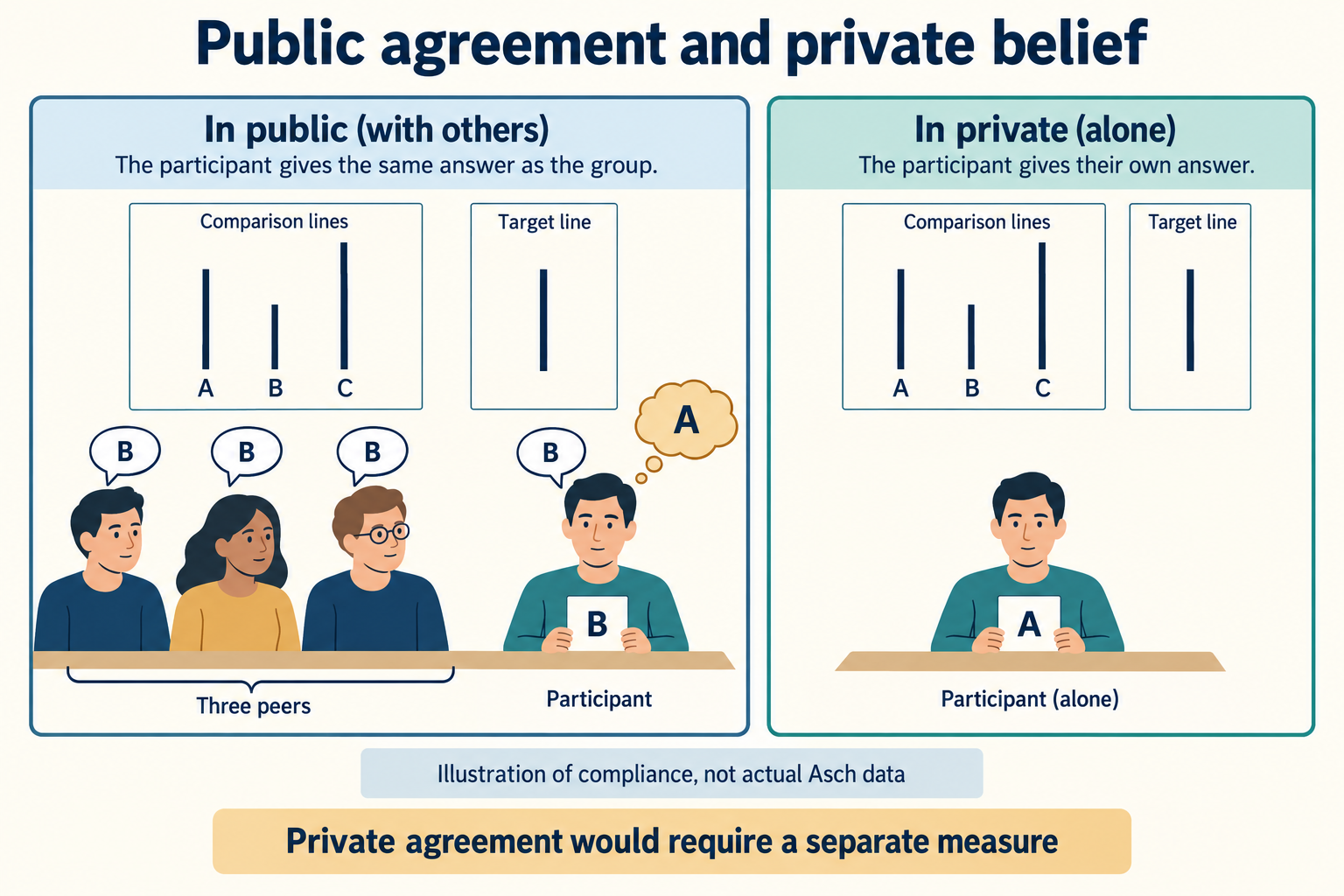
The compliance image is useful as a contrast: public assent is not a complete private-belief measure. Minority influence should be assessed using the same caution rather than assuming that its direction of influence makes internalisation automatic. A useful design crosses consistent versus changing core claims with flexible versus rigid negotiation, holding the strength of evidence and number of speakers constant. It could separately record public endorsement, confidential delayed judgement and willingness to reconsider a new example. Piloting is needed so that a 'flexible' message is not simply longer, friendlier or more informative than the comparison.
Deception about collaborator identity limits consent, and a minority task can still create discomfort even without physical risk. Evaluate the historical procedure and use openly described hypothetical analyses for learning. The current revised specification retains consistency, commitment and flexibility but removes the standalone social-change-process bullet. Here the unfamiliar meeting example practices explanatory transfer without pretending to deliver an old compulsory topic. An extended conclusion should state what feature was manipulated, which outcome changed, the plausible mechanism and what remains untested, including durability, setting and whether the minority's evidence is sound.
Worked example: Hypothetical negotiation study: twenty independent participants per condition. Consistent/flexible: 12 endorse; consistent/rigid: 8; changing/flexible: 6; changing/rigid: 4. Calculate differences and explain why the pattern does not show consistency alone is sufficient.
Rates are 60%,40%,30%,20%. At flexible negotiation, consistent versus changing differs by 30 percentage points; at rigid negotiation, by 20.
Flexibility differs by 20 points when the core position is consistent and 10 points when it changes. Both dimensions matter descriptively.
Consistent/rigid endorsement is 40%, so consistency does not guarantee agreement. Equally, flexible/changing is only 30%.
Separate participants permit a between-groups comparison, but significance, message equivalence and sampling still need checking. These counts are invented, not Moscovici results.
Answer: The hypothetical results suggest conditional contributions from consistency and flexibility. They justify testing the interaction and message alternatives, not a rule that a committed minority inevitably changes private beliefs.
Check your understanding: Transfer: a minority repeats the same proposal but accepts revisions to scheduling. A second minority changes its central justification each day while refusing every revision. Analyse both, then design one delayed measure distinguishing endorsement from enduring private acceptance.
Answer: The first retains a consistent core with flexible implementation; the second combines inconsistency with rigidity. After an equivalent delay, privately ask participants to judge a new scheduling scenario without the minority present, with prior judgements available for comparison. Persistent generalisation would be consistent with internalisation, but memory, demand and independent pre-existing preference remain alternatives.
Why: Indicative rubric: credit separation of core and implementation, a specific delayed outcome and a competing explanation. A public vote alone is inadequate evidence of enduring belief change; commitment should not be confused with proof that the claim is correct.