The multi-store model: structure, processes and exceptions
By UK A Level Psychology · independent study · myAudience
myAudience original rendered educational illustration. Image: illustration, not a documentary photograph. · Generated for this isolated pending curriculum pack; no third-party artwork licence claimed.
The multi-store model: structure, processes and exceptions
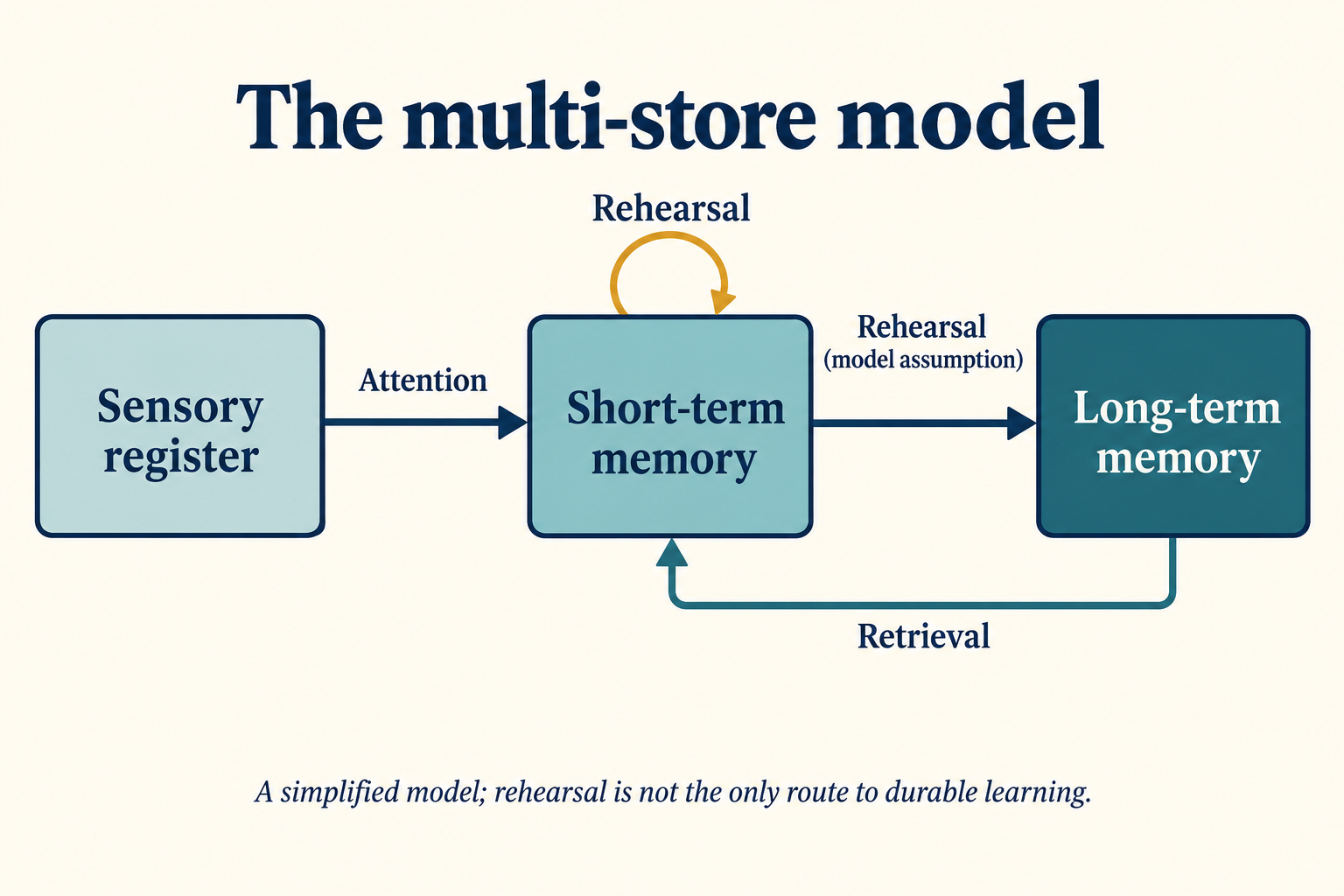
The multi-store model distinguishes a sensory register, short-term memory and long-term memory. Sensory information can be briefly available without sustained attention; attention selects information for short-term processing, and control processes affect retention and retrieval. The generated plate shows the simplified teaching sequence and return retrieval arrow. These are theoretical components rather than labelled pieces of brain tissue. Atkinson and Shiffrin's original 1968 account distinguishes structural features from flexible control processes; treating the whole proposal as a rigid conveyor belt controlled only by repetition understates it.
Coding concerns the form in which information is represented; capacity concerns the amount available under specified conditions; duration concerns how long it remains accessible. Sensory coding is tied to the incoming modality and is brief. Short-term tasks often show strong sound-based coding and limited capacity, with brief retention when rehearsal is prevented. Long-term performance often reflects meaning and much greater persistence and capacity. These are characteristic task-dependent descriptions, not exclusive coding laws or fixed time cut-offs for every person. Words can also be represented visually, and knowledge changes how apparently separate items are grouped into meaningful chunks.
A capacity estimate needs a defined unit. Eight unrelated digits are eight presented items, while a familiar date may be encoded as fewer meaningful chunks. Observing improved recall after grouping does not establish that a physiological container grew. A duration task that inserts distracting activity prevents rehearsal but may also introduce interference. An immediate/delayed comparison can therefore be consistent with separate retention processes without proving that elapsed time alone erases a trace. The distinction between trace availability and success of retrieval becomes especially important when a previously unrecalled item returns after a cue.
Rehearsal can maintain material, but maintenance and meaningful elaboration need not have the same effect on later performance. Craik and Tulving's 1975 experiments varied the kind of encoding operation and examined later recall or recognition; their evidence questions an explanation based solely on time or repeated exposure. This process-based alternative is supporting evaluation, not a newly mandatory revised content bullet. A controlled comparison can vary the type of encoding while equating exposure time. If meaningful processing changes retention at equal time, pure repetition duration is a less adequate explanation, though retrieval compatibility and task difficulty still require examination.
Evidence for distinctions can come from different retention patterns under manipulations or from well-supported dissociations between tasks. A dissociation means one function is impaired or disrupted while another is relatively preserved. It does not automatically identify a single anatomical store or show how every typical person remembers. Case evidence can be powerful for what is possible but weak for population frequencies, and sensitive individual data need careful ethical handling. These lessons use published general models and invented task data rather than personal clinical examples or diagnostic inference. Multiple converging methods support a richer evaluation than one remembered case name.
The revised specification removes the standalone episodic/semantic/procedural long-term-types bullet, but retains the multi-store features and the working-memory episodic buffer. A buffer is a current model component, not a back door restoring that removed taxonomy. An original extended model treats recall as the joint result of encoding, maintenance, interference and retrieval conditions. The plate's note that rehearsal is not the only route to durable learning fits this evaluation. A reasoned essay can acknowledge the value of structural distinctions while showing why control processes and task demands prevent a simple one-way explanation from exhausting the evidence.
Worked example: Hypothetical equal-time word task, twenty participants per group: repetition mean immediate recall 9/12 and delayed recall 4/12; meaningful-sentence processing mean immediate 8/12 and delayed 7/12. Calculate loss and compare a repetition-only account with an encoding-quality account.
Repetition falls by 5 words; sentence processing falls by 1. Immediate performance favours repetition by 1, while delayed performance favours meaning by 3.
The constructed reversal suggests that immediate performance and later retention need not move together. It is inconsistent with treating immediate score as a full measure of durable learning.
Equal time reduces a simple exposure-duration explanation, but instruction difficulty, prior knowledge and retrieval compatibility may still matter.
No variability is supplied, so significance is unknown. The pattern is a testable challenge to a repetition-only simplification, not proof that separate stores do not exist.
Answer: Encoding quality offers a plausible explanation of the hypothetical delayed advantage. The broader structural model may incorporate different control processes; evaluate the simplification and the full account separately.
Check your understanding: Transfer: a learner recalls an unfamiliar sequence poorly, recalls a familiar date sequence well, and later retrieves an initially missed word after a category cue. Explain why these observations do not prove increased capacity or decay. Propose a design distinguishing grouping from presentation length.
Answer: Familiar grouping changes effective chunks while presented digits stay the same; cue-assisted recovery shows earlier failure need not mean irreversible loss. Compare matched-length familiar and unfamiliar sequences with controlled timing, collect strategy reports cautiously and test uncued/cued recall separately. An advantage only for familiar groups supports a grouping account over simple item-count growth.
Why: Indicative rubric: credit coding/capacity/duration distinctions, reversible retrieval failure, controlled sequence length and a bounded model judgement. Avoid fixed universal limits, anatomical box claims and presenting the removed long-term taxonomy as a revised assessed requirement.