Working memory: make the model earn its components
By UK A Level Psychology · independent study · myAudience
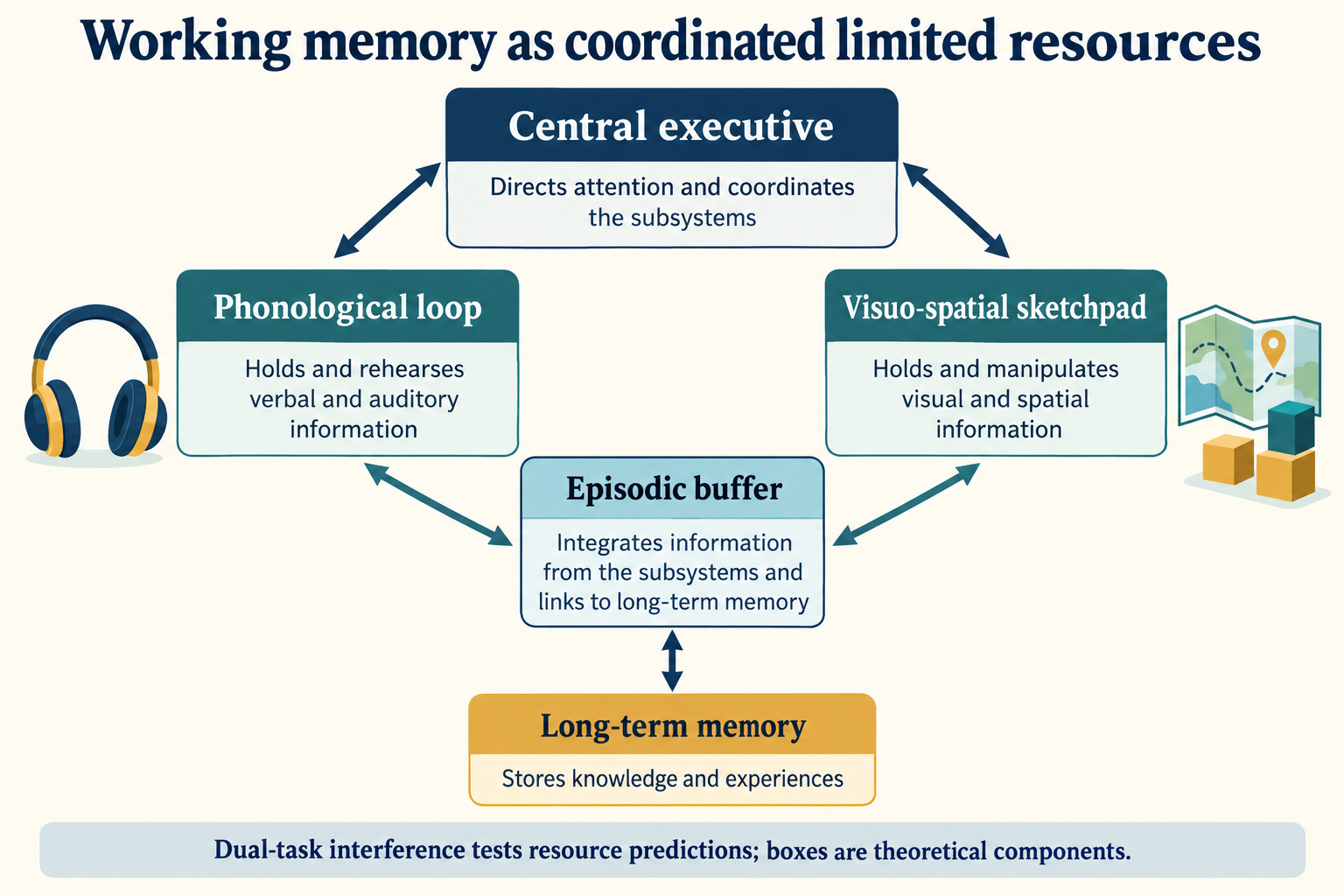
myAudience original rendered educational illustration. Image: illustration, not a documentary photograph. · Generated for this isolated pending curriculum pack; no third-party artwork licence claimed.
Working memory: make the model earn its components
Working memory explains temporary storage and processing during activities such as reasoning or comprehension. Baddeley and Hitch's 1974 model distinguishes coordinated resources rather than treating every short-term task as one passive store. The central executive controls attention and coordination but is not a large general-purpose container. The phonological loop supports verbal/acoustic material, including a temporary store and articulatory rehearsal. The visuo-spatial sketchpad supports visual and spatial material. The generated image depicts components as theoretical boxes; it is not a brain scan or an anatomically localised map.
Baddeley proposed the episodic buffer in 2000 to address integration across subsidiary systems and long-term knowledge. It is a limited-capacity temporary system using a multimodal code to bind information into coherent representations. This history matters: do not attribute the fourth component to the original 1974 version. The word episodic in the buffer's name does not restore the separate long-term-memory-types requirement removed from the revised specification. A component's explanatory role needs a prediction about integration that goes beyond simply renaming every unexplained result 'the buffer'. The image emphasises links but is schematic, not a complete set of every theoretical control pathway.
Dual-task reasoning tests whether tasks compete for the same limited resource. Holding spoken digits while judging verbal material may compete differently from holding digits while tracking a spatial route. If two tasks using similar resources disrupt each other more than tasks using different resources at matched difficulty, this supports functional differentiation. It does not prove perfect independence: both tasks may also require executive attention, response selection or motor coordination. A control condition must match general effort and exposure, rather than comparing one easy secondary task with one much harder task and calling the difference a separate subsystem.
Coding and capacity are task dependent. The loop's sound-based representation helps explain why articulatory activity could interfere with verbal maintenance; the sketchpad's spatial coding helps explain route or location tasks. Familiarity and chunking can alter how much can be retained, and executive coordination can become a bottleneck even when content differs. A useful original extended model separates representational overlap from executive demand. It predicts that two verbal tasks may interfere because they overlap in content coding, while a verbal and spatial task may still interfere if both require frequent switching. Those routes require different manipulations and should not be collapsed into one vague capacity label.
Evaluation should distinguish the framework's explanatory success from the precision of a particular component. Adding an executive can organise control functions, but if it explains every residual difficulty without independent measurement it becomes hard to falsify. Predefine a switching-cost outcome and compare it while controlling storage demands. A component model also needs integration evidence, since remembering a meaningful sentence or a map label involves more than isolated sound and shape. The 2000 buffer proposal is a theoretical extension, not one experiment proving a final complete memory architecture. Its publication motivates questions as well as answers.
Applied predictions are conditional. A spoken explanation plus a crowded route diagram can load different representations while still overloading coordination. Removing needless repetition may help on a given task, but these lessons do not certify a universal teaching method or diagnose an individual's memory. Ethical research should use low-burden consenting tasks, avoid personally sensitive information and report fatigue or attrition. A reasoned extended answer explains the model, derives competing predictions, uses appropriate evidence and identifies a result that would challenge it. Memorising four box names without analysing resource overlap leaves the core scientific reasoning unfinished.
Original extended evaluation model. Strong interference between different-modality tasks during frequent switching need not erase the distinction between verbal and spatial representations. The working-memory account combines differentiated storage with coordination, so two tasks can overlap in executive demand even when their content codes differ. Theoretical boxes on the plate are functional proposals, not brain locations. Baddeley and Hitch's original three-component framework and Baddeley's later multimodal buffer proposal must remain historically distinct: naming the buffer does not automatically explain every switching cost or convert one experiment into proof of the complete architecture. The constructed recall means demonstrate what an informative pattern could look like. Spatial recall falls from eight to seven with syllable repetition but to four with location tracking; verbal recall shows the reverse decrements. Matched interference is therefore three points greater than cross-modality interference in each comparison. This crossover is consistent with representational differentiation, yet unequal task difficulty, response demands or familiarity could imitate it. The figures are explicitly hypothetical, not results attributed to the 1974 or 2000 publications. Baseline performance, scoring sensitivity and secondary-task adherence should be examined before interpreting a named component.
A discriminating original design would cross same versus different modality with low versus high switching demand while holding storage load and exposure constant. Use consenting participants, pilot comparable difficulty, standardise response timing, counterbalance task order and check fatigue. Record primary recall accuracy and a separately defined switching outcome rather than merging them into one convenient score. The resource-overlap account predicts a same-modality disadvantage even at low switching; the coordination account predicts an additional switching cost across modalities. These are proposed predictions, not reported findings. Their joint pattern would explain more than simply saying both tasks were hard. Interpretation must also permit failure. If a sensitive, adequately controlled comparison found no switching cost, the proposed coordination explanation would weaken; if matched and cross-modality interference were indistinguishable under appropriate controls, the particular differentiation prediction would need revision. A non-significant contrast alone is not proof of no effect, so uncertainty and measurement precision matter. Repeated outcomes require an analysis suited to their measurement and participant pairing, with planned contrasts and transparent multiplicity handling. Ultimately, the model earns support by distinguishing outcomes and rivals, while integration remains an open theoretical issue. It does not license diagnosis, universal study advice or anatomical certainty from a schematic diagram.
Worked example: Hypothetical within-person spatial recall means: alone 8/10, with repeating an irrelevant syllable 7/10, with tracking moving locations 4/10. For verbal recall: alone 8/10, syllable repetition 4/10, location tracking 7/10. Describe the interaction and one design alternative.
Spatial-task decrements are 1 with syllable repetition and 4 with location tracking. Verbal-task decrements are 4 and 1 respectively.
The modality-matched interference is 3 points larger than cross-modality interference in both comparisons: a constructed crossover pattern consistent with differentiated resources.
Match secondary-task difficulty, timing and responses, and counterbalance orders. Otherwise effort, practice or fatigue might mimic a resource pattern.
Related ordinal outcomes could motivate Wilcoxon for a preplanned paired contrast; suitable interval outcomes/difference distributions could motivate a related t-test. Multiple contrasts require a reporting plan.
Answer: The hypothetical crossover supports functional differentiation more than a single undifferentiated interference account, while shared executive demands and task-equivalence alternatives remain.
Check your understanding: Transfer: two different-modality tasks interfere strongly only when frequent switching is required. Explain this without discarding subsystem distinctions. Design a test of representational overlap versus executive coordination and give a prediction that would weaken your account.
Answer: A shared coordination demand can disrupt different representations. Cross same/different modality with low/high switching while holding storage load and task difficulty constant. Predict overlap effects even at low switching and a switching cost across modalities. If switching produces no cost in a sensitive, well-controlled test, the proposed coordination account is weakened.
Why: Indicative rubric: credit the 1974/2000 distinction, a testable two-route account, modality-by-switching design and a genuine challenge prediction. Boxes are theoretical; a crossover alone neither localises brain tissue nor proves that every pair of different-modality tasks is independent.