Forgetting: competing learning and absent retrieval cues
By UK A Level Psychology · independent study · myAudience
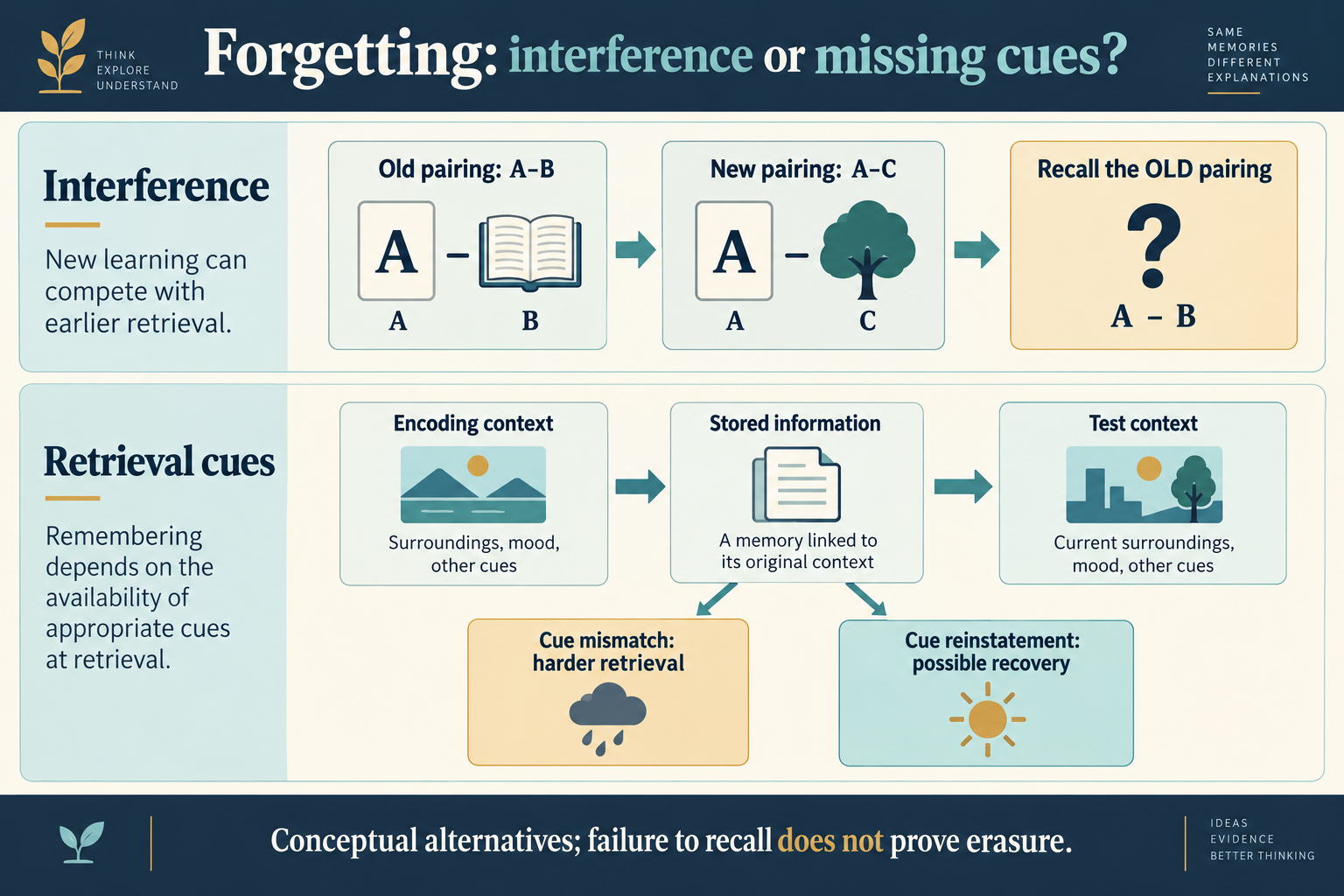
myAudience original rendered educational illustration. Image: illustration, not a documentary photograph. · Generated for this isolated pending curriculum pack; no third-party artwork licence claimed.
Forgetting: competing learning and absent retrieval cues
Failure to recall can result from competition among memories or from an ineffective retrieval cue, rather than a trace simply vanishing. Proactive interference occurs when earlier learning disrupts retrieval of later learning. Retroactive interference occurs when later learning disrupts retrieval of earlier learning. The direction is defined by which memory is being tested, not merely by whether a participant learns two lists. In the image's old A–B and new A–C example, testing the old B after learning C asks about retroactive interference; testing new C while old B competes asks about proactive interference.
Similarity supplies a possible competition mechanism. Two associations sharing A can activate alternative responses, whereas distinct cues might reduce that overlap. It is important to equate learning strength and time: a harder second list can change attention or fatigue as well as competition. Keppel and Underwood's 1962 experiments examine proactive inhibition in short-term retention, providing a primary source for questioning a pure time-decay reading of distracting-delay tasks. These lessons do not invent a universal percentage decline or claim their paper alone settles all forgetting. A competing-learning manipulation needs its own controlled evidence.
Retrieval failure concerns available information not accessed under the present cues. Encoding specificity predicts that a cue's value depends on its relation to how information was encoded, rather than on generic familiarity alone. Environmental context can supply cues; an internal state can also be a context, but these are distinct possibilities. Godden and Baddeley's 1975 diver study compared learning and recall on land and underwater and reported better recall when contexts matched. It is a specialised task and population, not proof that every examination should reproduce a classroom or that all memory tasks show equal context dependence.
Changing a context also changes more than a backdrop: comfort, effort and attention can differ. A factorial design with learning context crossed with testing context helps separate a simple context main effect from a match advantage. If both matching cells are better than both mismatching cells, that differs from one context always producing better recall. A control for time and intervening activity helps distinguish cue explanations from general delay or distraction. Cue reinstatement could be mental rather than physically returning to a place, but its effectiveness needs evidence; remembering a context is not a guaranteed method for recovering information.
An original extended model treats observed recall as a function of learning strength, competing responses and cue compatibility. A retrieved wrong answer might reflect competition or guessing, while an omission might reflect inaccessible information or weak encoding. To test the model, cross similarity of interfering material with cue reinstatement. A cue benefit only under high competition could suggest that cues help resolve competition, whereas an independent benefit across similarity levels could suggest additional retrieval support. These are hypothetical predictions, not reported classic-study findings. If cues do not recover an item, that alone still cannot prove irreversible erasure.
Method evaluation applies here as in social influence. Repeated list trials can accumulate proactive effects; randomising list order does not necessarily remove them. Counterbalancing distributes ordinary order effects but cannot undo learned pairings. Low-stakes word tasks can be ethically useful, while inducing harmful states or asking for distressing autobiographical recall is unnecessary for this foundation. The generated retrieval plate is a model distinction, not an empirical graph. A strong extended response selects the test memory, identifies the competing explanation and derives a discriminating design instead of listing interference and cue definitions without using them.
Worked example: Hypothetical 2×2 learning/test-context means out of 12: learned quiet/test quiet=9; learned quiet/test music=6; learned music/test quiet=5; learned music/test music=8. Calculate the match advantage and both context marginal means. Does one context always explain the pattern?
Matched mean=(9+8)/2=8.5; mismatched mean=(6+5)/2=5.5. The match advantage is 3 words.
Learning-context marginal means: quiet=(9+6)/2=7.5; music=(5+8)/2=6.5. Test-context means: quiet=(9+5)/2=7; music=(6+8)/2=7.
Equal test-context marginal means coexist with a match advantage. A claim that quiet testing alone raises recall cannot explain the crossover.
These are invented means with no uncertainty supplied. Context matching is a plausible explanation, but learning quality, task equivalence and allocation still need checking.
Answer: The hypothetical pattern shows a 3-word match advantage and equal overall test-context means. It supports investigating encoding/test compatibility rather than concluding that one test environment is universally better.
Check your understanding: Transfer: people learn A–B, then A–C, and are tested on C. Later they recover B after a distinctive old-context cue. Identify the interference direction in the C test and explain why B recovery challenges an erasure account. Propose a control for simply practising retrieval twice.
Answer: Earlier B competing with later C is proactive interference. Recovery of B is consistent with preserved information becoming accessible, challenging the claim that it had necessarily been erased. Compare distinct-cue and neutral-cue groups with equal numbers of tests and the same delays; include no-intervening-learning control. A second-test improvement without a cue would support practice as an alternative.
Why: Indicative rubric: credit the target-dependent direction, accessible versus available distinction, factorial pattern and equal-retest control. Do not call every two-list effect retroactive, or claim cue recovery is guaranteed for personal memories or all test formats.