Eyewitness evidence: memory change, response bias and anxiety
By UK A Level Psychology · independent study · myAudience
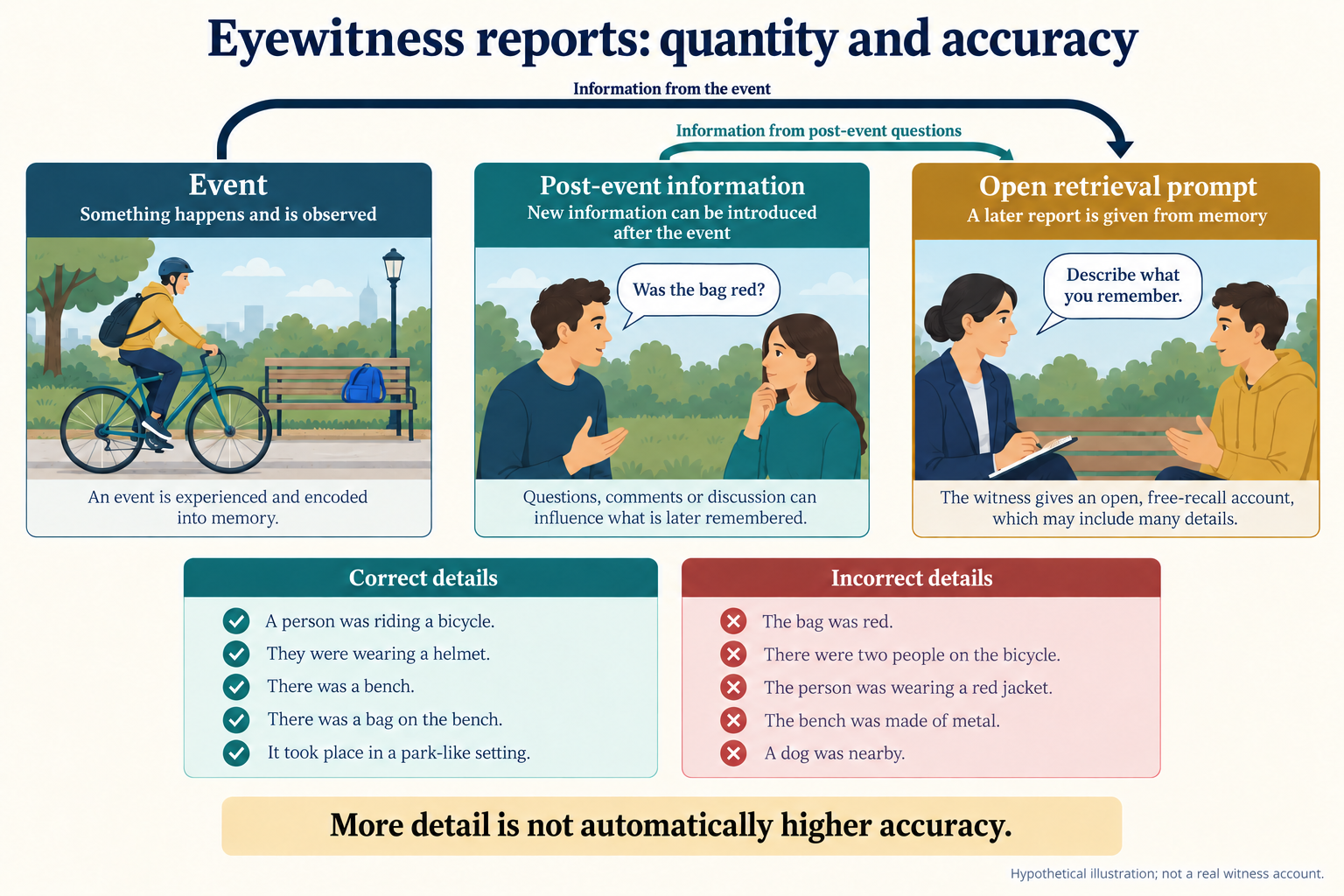
myAudience original rendered educational illustration. Image: illustration, not a documentary photograph. · Generated for this isolated pending curriculum pack; no third-party artwork licence claimed.
Eyewitness evidence: memory change, response bias and anxiety
An eyewitness report is the output of encoding an event, retaining information, interpreting a question and selecting a response. An error can arise at any stage. A leading question suggests an answer or embeds an assumption, while post-event discussion introduces another person's account. Both can change a later report, but the observed report alone does not reveal whether stored information changed or the reporting decision changed. The generated eyewitness image traces event information and later suggestions separately. Its bicycle scene is hypothetical and harmless; it is not evidence about an actual witness or a reconstruction of a published crime.
Loftus and Palmer's 1974 paper reports two film-based experiments. Question wording changed speed estimates; in a separate experiment, wording was followed a week later by a broken-glass question despite no broken glass in the film. The reported yes counts were 16/50 for smashed, 7/50 for hit and 6/50 for the control. This is actual sourced study information. It is distinct from the original bicycle dataset below. The later question moves beyond an immediate speed estimate, but response bias, expectation and source confusion still require consideration before claiming that the original memory trace was overwritten.
Post-event discussion can supply information that was not personally seen. A participant may remember a detail but misattribute it to the original event rather than a later conversation: a source-monitoring problem. Another participant may knowingly defer to a confident peer while remaining unsure. An ethically modest test can show two neutral versions of a scene with one different detail, then compare confidential recall with and without an openly described discussion condition. Equal exposure and a no-discussion comparator matter. Confidence should be measured separately from accuracy; a confident assertion does not establish the detail's truth.
Anxiety is not a single simple switch. It may affect attention at encoding, the balance between central and peripheral details, later rehearsal and willingness to report. Ethical laboratory analogues with controlled materials can isolate variables but differ from real stakes; field evidence has real events but cannot randomly assign distress or control every difference. A proposed non-linear relation is an explanatory possibility, not an established universal curve or a clinical interpretation. A hypothetical high-anxiety group might remember a central bicycle well but the background poorly, and prior viewing distance or exposure time could account for the same pattern.
Competing evidence needs comparable outcomes. A film experiment of wording does not directly contradict a field observation of good recall unless both examine the same information, timing and manipulation. A case can show that inaccurate recall is not inevitable while leaving the population risk uncertain. Ethical reasoning also constrains which comparisons may be performed: consent and minimal risk cannot be replaced by a desire for realistic distress. These lessons analyse theory and published methods, with no diagnosis, treatment or advice about an actual legal case. The current revised specification still includes anxiety and both leading questions and post-event discussion.
An original extended model separates event encoding, later information, source attribution and response criterion. It predicts different tests: an event-recognition task may differ from a yes/no suggestion question, and asking the source of a detail can distinguish some memory/confidence patterns. Blind scoring against a defined scene record helps assess accuracy, but even the definition of a detail needs consistency. In an extended answer, identify which pathway the design manipulates and avoid treating every reported difference as a global measure of memory reliability. Cognitive interviewing in the next lesson builds on retrieval without assuming that more speech is automatically more truth.
Worked example: First calculate the actual 1974 broken-glass yes rates from 16/50,7/50,6/50. Separately, a hypothetical bicycle task yields 9 false bag-colour reports among 30 leading-question participants and 3 among 30 neutral-question participants. Calculate that contrast and distinguish historical evidence from transfer data.
Historical rates are 32%,14%,12%; smashed versus hit differs by 18 percentage points and smashed versus control by 20.
The hypothetical false-detail rates are 30% and 10%, a 20-point difference and a risk ratio of 3 when comparing these constructed rates.
A risk ratio is not a p-value. Suitable independent nominal counts could be analysed with Chi-Squared if its assumptions, including expected counts, are met.
Randomly allocated wording supports a wording effect on reports. It still does not uniquely separate changed memory from a changed response criterion or source attribution.
Answer: The actual film study and the separate hypothetical bicycle task both concern report effects, but only the stated historical counts are Loftus/Palmer findings. A mechanism needs further discriminating evidence.
Check your understanding: Transfer: in a hypothetical observational dataset, people reporting greater anxiety recall more central details but fewer background details. Evaluate the claim that anxiety improves memory. Specify two rival factors and one ethically appropriate test of a narrower attention account.
Answer: The outcome depends on detail type, so a global improvement claim is too broad. Viewing distance and exposure duration could affect both anxiety and recall; prior relevance could also matter. Use informed low-risk neutral scenes, independently manipulate attention demands while holding exposure constant, and score central/background details blind. This tests a narrower mechanism without deliberately creating harmful anxiety.
Why: Indicative rubric: credit actual versus hypothetical separation, rate denominators, response-bias/source alternatives and detail-specific judgement. Correlational anxiety data cannot prove causation, and numerical confidence or more recalled words does not establish accuracy.