Cognitive interviewing: retrieval, accuracy and reasoned evaluation
By UK A Level Psychology · independent study · myAudience
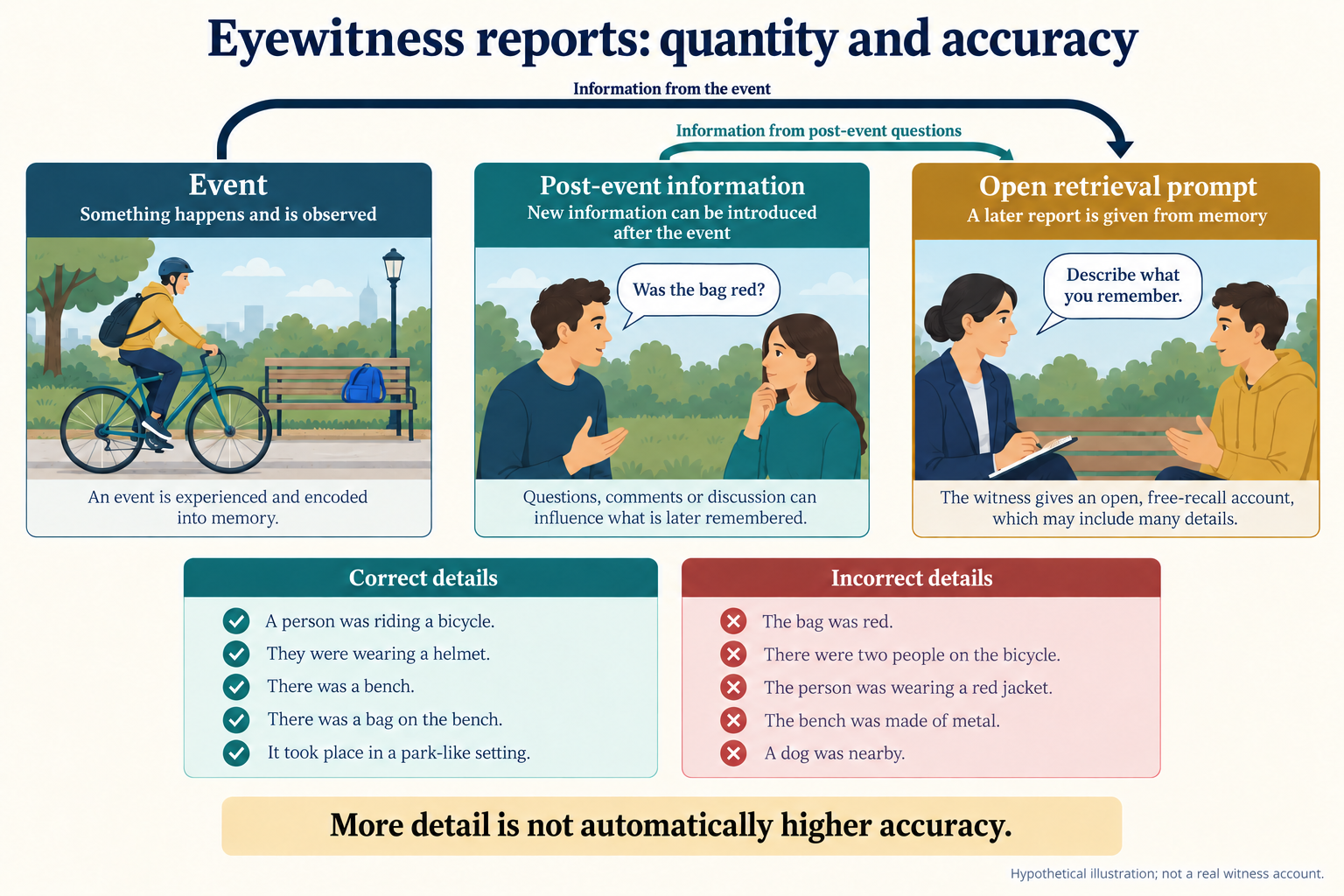
myAudience original rendered educational illustration. Image: illustration, not a documentary photograph. · Generated for this isolated pending curriculum pack; no third-party artwork licence claimed.
Cognitive interviewing: retrieval, accuracy and reasoned evaluation
The cognitive interview uses retrieval principles to elicit a fuller account. The original core techniques include reinstating the event's context, reporting everything, recalling in different orders and considering different perspectives. Context reinstatement aims to reconnect encoding and retrieval cues; reporting everything reduces filtering of apparently unimportant fragments. Order changes can reduce reliance on a fixed familiar narrative. Perspective changes are retrieval prompts, not permission to invent unseen events. A model answer must explain how a technique could help and how inappropriate prompting could also create error, rather than listing mnemonics as guaranteed improvements.
Geiselman, Fisher, MacKinnon and Holland's primary report evaluates cognitive interviewing against comparison procedures using filmed events and subsequent interviews. It reports more correct information under cognitive procedures in the studied comparisons, without an accompanying difference in incorrect/confabulated information in its first experiment. That finding is conditional on those tasks, interviewers and measures; it is not a guarantee that every real interview increases accuracy. The report contains multiple experiments, and its findings must not be collapsed into one invented sample or percentage. Current retains the use of the cognitive interview even though surrounding wording was reduced/reordered.
Quantity and accuracy need separate definitions. Correct details are items matching an independently established event record. Incorrect details conflict with it; uncertain or unverifiable details need an explicit scoring rule. Proportion accuracy is correct/(correct+incorrect) when that is the defined denominator. A procedure may increase correct detail while also increasing incorrect detail, so total speech alone is not evidence of better accuracy. The generated image separates the two boxes for this reason. Inter-observer reliability in coding and scoring blind to interview condition reduce interpretation bias but do not remove all problems in defining what counts as a detail.
An active comparator is preferable when a causal claim concerns the special retrieval techniques. If a cognitive interview takes twice as long, a longer opportunity to speak could explain additional detail. Match duration, rapport and interviewer expertise where feasible, or state that the comparison evaluates a complete practical package including time. Train interviewers and record protocol adherence. A component comparison can ask whether context reinstatement adds value beyond open reporting, while a combined procedure may have effects that are not the sum of isolated parts. This is an original evaluation strategy, not a result attributed to the historical report.
Cost and accessibility also constrain transfer. Extra detail may be valuable but require staff training and longer interviews. A hypothetical cost analysis can count useful accurate details per minute while recognising that not every detail has equal practical value. Fatigue, language needs and misunderstanding can affect participation, so a standardised procedure should not mean ignoring comprehension. These are research-design considerations, not advice for conducting an actual investigation. Ethical teaching uses desk-based hypothetical data or voluntary neutral tasks, avoids sensitive personal recall and does not promise recovery of a person's hidden or traumatic memories.
An extended original retrieval model combines cue compatibility, search flexibility, reporting criterion and interviewer influence. More permissive reporting can increase both correct and incorrect details without improving the trace; better cues can increase correct retrieval with little change in errors; leading suggestions can increase particular false details. Design tests that distinguish those patterns. A coherent evaluative response weighs primary evidence against plausible alternatives, tests accuracy as well as amount, and explains the boundary from filmed events to unfamiliar real contexts. These sixteen reviewed lessons establish a foundation, while full subject depth, practical participation and independently assessed extended responses remain explicitly unfinished.
Original extended evaluation model. Context reinstatement can make previously unavailable information accessible by supplying useful retrieval cues. That supports a retrieval explanation for some failures, but successful recovery does not prove every memory remains intact. The multi-store framework separates stages and control processes, while working memory concerns temporary storage and coordination during searching and reporting. Encoding quality and interference can still restrict later recall. A retrieval procedure can therefore improve performance without uniquely verifying either model or establishing that all forgotten information was stored completely. Perspective prompts also cannot license invention of an event the witness never observed. Firsthand primary evidence is narrower than the claim of universal superiority. Geiselman and colleagues' report compares procedures following filmed events; its first experiment reports more correct information for cognitive interviewing, without a detected difference in incorrect or confabulated information. That supports the studied comparison, but a non-significant error difference does not demonstrate that errors are identical everywhere. Participants, materials, interviewers and scoring constrain transfer. The lesson's separate invented totals deliberately show why yield, proportion accuracy and time rate can diverge: 180 correct details exceeds 120, yet 75% accuracy is below 80%, and nine correct details per minute is below twelve.
Two rivals deserve different tests. More interview time may create more opportunities to recall, whereas a relaxed reporting criterion may increase willingness to mention uncertain details without strengthening their traces. An original low-burden study could randomly allocate consenting participants to equal-duration open reporting with or without non-leading context cues after a neutral recorded event and a stated delay. Match rapport and interviewer expertise, monitor adherence, and predefine correct, incorrect and unverifiable-detail coding. Scorers blind to condition should assess the recordings against the event record, with reliability checked. Analyse participant-level outcomes, not every detail as an independent person. This comparison isolates the added cue component more closely than unequal-duration packages, but it does not measure every cognitive-interview component. Greater correct recall without a comparable error increase would be consistent with improved retrieval; more correct and incorrect reports together would require examining criterion and scoring alternatives. Neither pattern uniquely establishes an intact-trace theory. Test transfer to different neutral materials and delays while reporting uncertainty, fatigue and accessibility, rather than claiming a real investigation or recovered traumatic memory. The bounded conclusion is that particular procedures can improve defined outcomes under studied conditions; always superior is unjustified unless the intended accuracy, yield, time and context criteria are specified.
Worked example: Hypothetical group totals from equal participant numbers: standard interview gives 120 correct and 30 incorrect details in 10 minutes; cognitive procedure gives 180 correct and 60 incorrect in 20 minutes. Calculate total detail, accuracy and correct details per minute. Evaluate three definitions of better.
Standard total=150 and accuracy=120/150=80%. Cognitive total=240 and accuracy=180/240=75%. Correct-detail yield rises by 60, or 50% relative to 120.
Correct details per minute are 120/10=12 versus 180/20=9. More correct information is obtained, but with a lower proportion accurate and lower rate.
Group totals do not reveal participant-level variability, and details from one person are not independent participants. An inferential analysis needs an appropriate unit and underlying data.
For the retrieval-technique claim, use an equal-duration active comparison and blind scoring. For a practical-package claim, explicitly evaluate additional time and consequences of errors.
Answer: The hypothetical cognitive procedure improves absolute correct yield but reduces proportion accuracy and correct yield per minute. The preferred judgement depends on the stated goal; none is identical to the primary study’s reported findings.
Check your understanding: Transfer extended response: a school researcher claims that context reinstatement proves memories remain intact and that the cognitive interview is always superior. Use multi-store/working-memory and forgetting reasoning, one primary evidence claim, a rival explanation and a discriminating design to justify a bounded conclusion.
Answer: A cue benefit is consistent with retrieval failure but does not prove every trace remains intact. Component models describe temporary coordination, while encoding strength and interference can still constrain recall. The primary report supports extra correct information in studied comparisons, not universal superiority. Longer time or a relaxed reporting criterion is a rival. Compare equal-duration open reporting with and without context cues, predefine correct/incorrect scoring and examine delayed unfamiliar material.
Why: Indicative rubric: credit a sustained chain from theory to operational evidence to rival to test to conclusion. Distinguish quantity, accuracy, rate and inference unit; do not use hypothetical totals as study findings. Justified alternative designs are acceptable. These indicative criteria are original teaching guidance, not an mark scheme or grade prediction.