Make a memory claim testable
By UK GCSE Psychology · independent study · myAudience
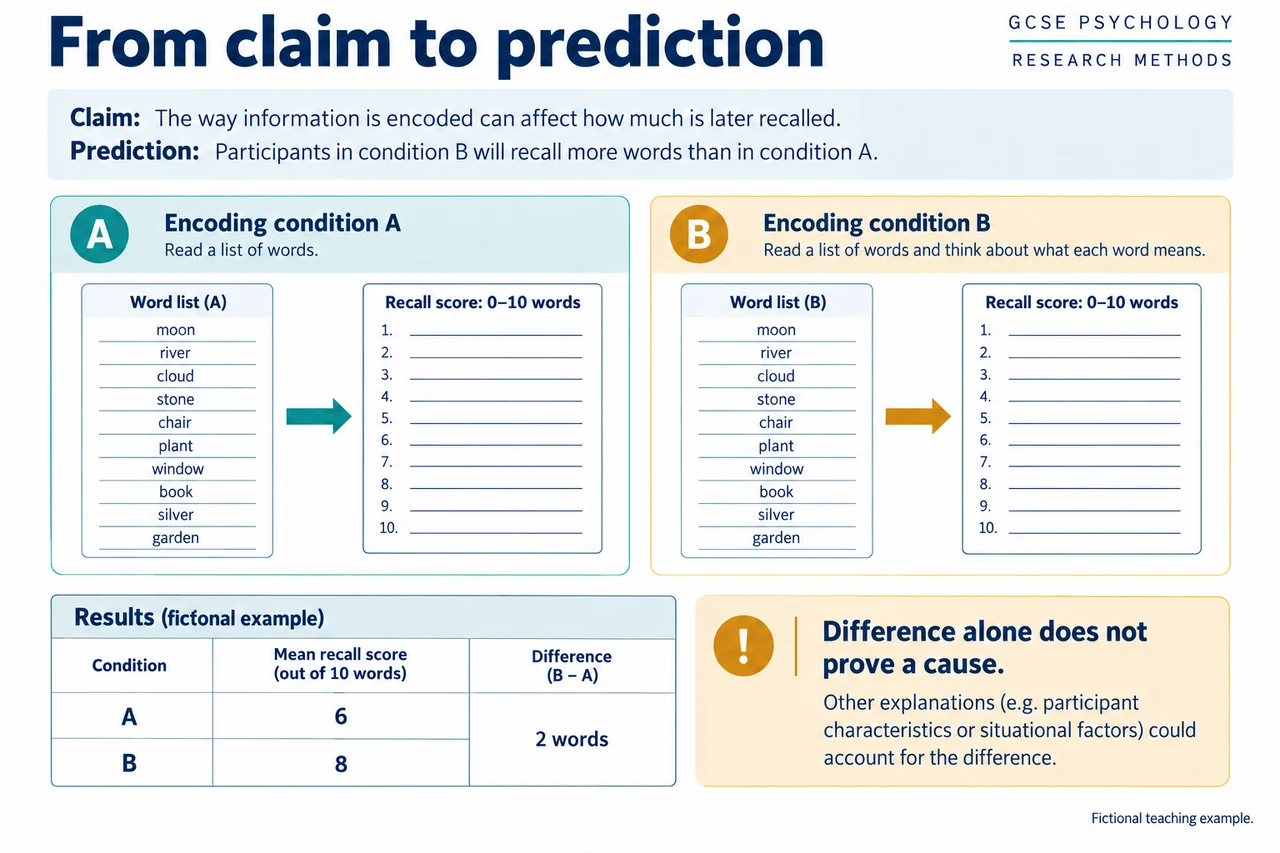
myAudience original generated educational concept illustration; fictional examples. Image: illustration, not a documentary photograph. · Original myAudience illustration; no affiliation or endorsement by an awarding body.
Make a memory claim testable
A claim such as “the way information is encoded affects recall” proposes a relationship but does not yet specify a test. Encoding is the processing of information into a form that can be retained; retrieval is accessing retained information. A recall score is an observable outcome, not a photograph of either process. A useful prediction connects a stated encoding condition to a precisely defined later score. This makes it possible to disagree with the claim using evidence rather than impressions.
In our fictional comparison, condition A reads ten neutral words; condition B reads the same words while considering their meanings. Each record represents one score after the same delay, using the same scoring rule. The alternative prediction is that the mean number of correctly recalled target words will be greater in B than A. The null prediction is that there will be no difference in the population mean recall scores under these conditions. A sample can show a difference even when a population difference is absent; the null does not promise identical samples.
Suppose the fictional sample means are six words for A and eight for B. Calculate B minus A: 8 − 6 = 2 words. The score ceiling is ten, so these means are 60% and 80% of the possible score, a twenty-percentage-point difference. This is not a twenty-percent relative increase: relative to six, two is approximately 33.3%. Neither percentage establishes that the difference was caused by encoding. We have no sample sizes, distributions or inferential calculation from which to declare a statistically significant result.
A prediction should identify what could challenge it. If otherwise comparable conditions produced a lower mean in B, that would oppose this directional prediction. Equal means would also fail to support the predicted advantage. Neither observation automatically refutes every theory of memory: the particular instructions, delay or measure might not engage the proposed mechanism. However, continually inventing excuses after seeing a result makes an explanation hard to test. Specify the comparison and intended interpretation before examining its outcomes.
“B proves meaning is always better” makes two unjustified jumps. First, groups might differ in prior vocabulary, concentration or expectations rather than only encoding instructions. Second, recalling isolated words in this invented situation is not every kind of remembering. A stronger argument would explain how an alternative design reduces competing explanations, then ask whether a different material or retrieval task gives a compatible pattern. No actual participants were studied here, and these numbers are not evidence for a real memory intervention.
The illustration holds the ten words constant and shows two blank score sheets labelled zero to ten. Its arrows organise the intended procedure; they are not measured causal effects. The 6/8 table is an invented result, and the warning is part of the reasoning rather than a footnote to ignore. Notice that both encoding conditions also involve reading: the proposed contrast concerns considering meanings in addition. A score sheet cannot establish what a fictional participant actually thought. That distinction limits the interpretation of the operational measure.
Evaluated model response to the transfer: I would define the altered condition as reading the same ten neutral words and judging each word’s meaning, compared with reading without that additional instruction. My alternative prediction is that the population mean number of correctly recalled target words after the stipulated common delay is higher in the meaning condition. My null prediction is that these population means do not differ. Correct recall must be defined in advance: one point per distinct target word, with repetitions not earning extra points, giving a score from zero to ten. This is more testable than predicting that one group will have “better memory”.
A lower or equal mean in the meaning condition would challenge the stated directional prediction, although sample variation and the adequacy of the manipulation would still need examination. A higher sample mean would fit the prediction without proving its explanation: different prior vocabulary could produce the same pattern, and the materials restrict generalisation. I would therefore treat the proposed comparison as a way of assessing a bounded claim, not as a diagnosis or recommendation to a reader. A defensible evaluation earns its force by stating both the observation that could count against it and the alternative interpretation that remains possible.
Worked example: Fictional conditions use the same ten words, with reading only in A and additional meaning judgments in B. Mean recall is 6 in A and 8 in B. Calculate the bounded comparison and assess its evidential limits.
Identify the outcome as distinct correctly recalled target words, possible score 0–10.
Compute B minus A: 8−6=2 words.
Express scores relative to the possible ten: 60% versus 80%, a 20-percentage-point difference.
No sample sizes or distributions are supplied; do not invent inferential significance or causal proof.
Answer: The fictional B mean is 2 words higher; the difference is consistent with the directional prediction but does not establish its cause.
Check your understanding: In a fictional comparison, both conditions read the same ten neutral words. One additionally judges meanings. Write operational null and directional alternative predictions, identify an observation that would challenge the directional claim, and explain a competing interpretation.
Answer: See the complete evaluated response in the last two paragraphs. Include population mean equality for the null, a higher mean under meaning judgments for the alternative, distinct-word scoring 0–10, an equal/lower mean as challenge, and participant or measurement rivals.
Why: A full response must make the outcome and conditions testable, distinguish sample difference from population prediction, and qualify both supporting and challenging observations.