Follow the variable and the unit
By UK GCSE Psychology · independent study · myAudience
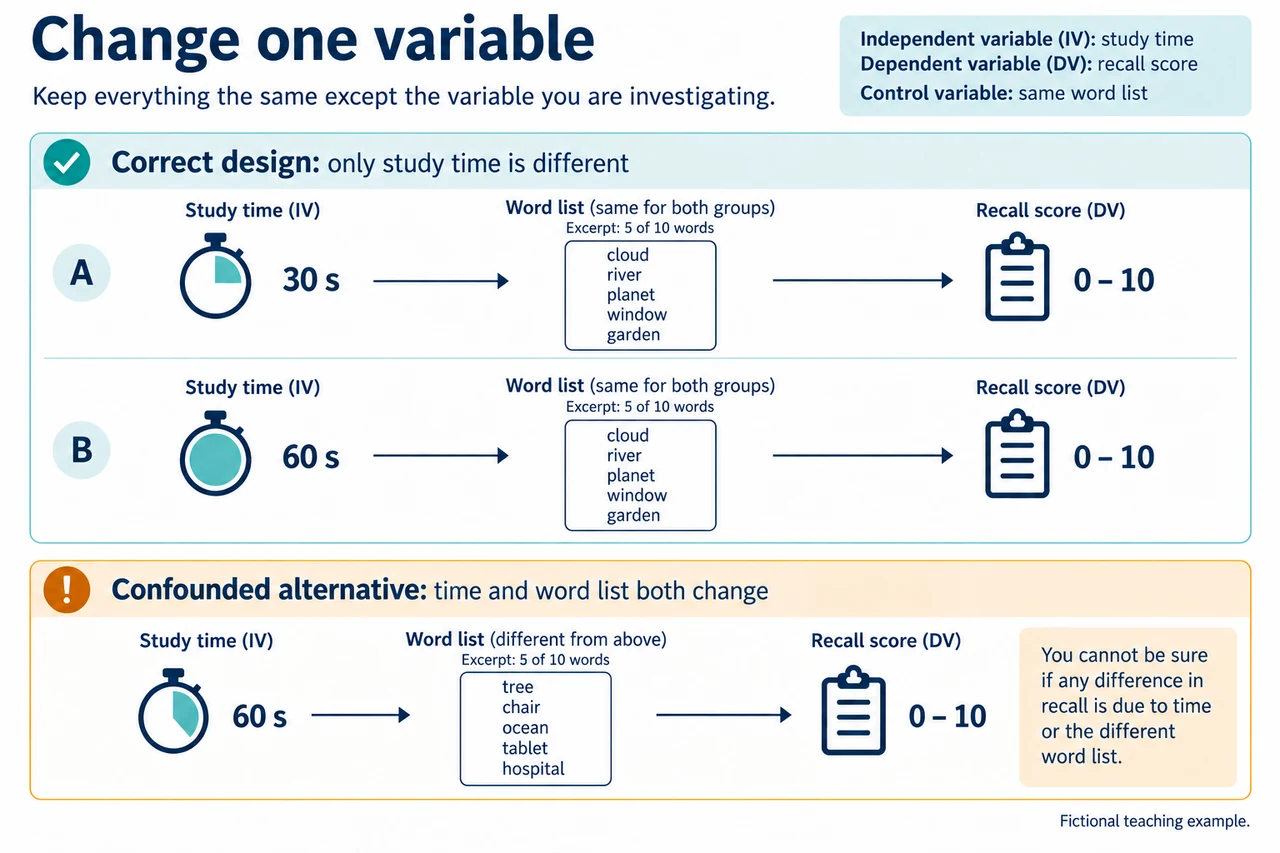
myAudience original generated educational concept illustration; fictional examples. Image: illustration, not a documentary photograph. · Original myAudience illustration; no affiliation or endorsement by an awarding body.
Follow the variable and the unit
A variable is something that can vary, but the label alone does not explain its role. In a proposed experiment, the independent variable is the condition deliberately changed; the dependent variable is the measured outcome. Here, study time is specified as thirty or sixty seconds and recall is scored as the number of distinct target words correctly produced, from zero to ten. Seconds and words are different units. Writing them down prevents a vague claim about “more memory” from becoming a shifting or unrepeatable measurement.
In the flawed fictional design, A receives thirty seconds with one word list, while B receives sixty seconds with another list. Longer exposure and list content vary together. If B recalls more, time may be responsible, or its words may be more familiar and easier to remember. List difficulty is therefore a potential confounding variable: it differs systematically with the intended independent variable and can offer a competing explanation for the outcome. An unrelated source of variation is not automatically a confound.
An extraneous variable is a factor outside the intended manipulation that could affect the outcome. Background noise might vary unpredictably between records; that can obscure a pattern without consistently favouring one condition. If only the sixty-second group is tested in a quiet room, noise becomes a systematic rival to the time explanation. The distinction concerns the relationship to conditions, not whether the factor sounds important. Some variables are partly controlled; a claim that literally every other influence is identical is rarely credible.
A repair gives both conditions the same ten-word list, the same instructions except the stated time, the same presentation format, delay and scoring rule. Standardisation means applying these details consistently, not merely putting people in the same building. It reduces avoidable procedural variation and supports repeatability. It does not guarantee equivalent participants, identical attention or truthful compliance. Random allocation can reduce systematic participant differences in expectation, but chance differences remain possible, especially in small samples. Neither procedure is a magic certificate of causality.
Operational definitions also have consequences. Giving one point for each distinct target word excludes extra points for repetitions. It measures unaided recall of those items, not recognition, understanding or everyday remembering. An explicit rule for spelling variants would avoid different scorers changing the measure after seeing a response. The question is not whether one score captures the whole mind; it is whether the measure addresses the specific claim and whether its limitations are acknowledged. A reliable but irrelevant score would not solve the problem.
The plate contrasts a corrected thirty-/sixty-second comparison with a confounded alternative. Each pictured word card is explicitly an excerpt: five of ten words are shown, while the possible score remains zero to ten. The arrows depict procedural order rather than results, and no numerical advantage is invented. Its slogan about changing one variable states the experimental intention. Realistic evaluation adds the qualification that uncontrolled influences may remain; two visually identical cards alone cannot establish that the groups were otherwise comparable.
Evaluated model response to the transfer: I would retain the thirty-second and sixty-second exposure conditions but use the same ten neutral target words in both. I would specify one point for each distinct correctly recalled target word, with repetitions worth no extra points, after the same stated delay. This defines the dependent variable as a count from zero to ten. Presentation, instructions apart from duration, and scoring would be standardised. The original different-list comparison cannot isolate time because list familiarity could vary alongside it; keeping the list constant directly addresses that rival rather than simply increasing the number of records.
Standardisation does not remove differences in prior vocabulary between participants. Random allocation could make a systematic association between vocabulary and condition less likely, but it would not guarantee balance in a particular small sample. Matching an identified characteristic would also leave unmeasured differences. I would therefore explain an observed advantage as consistent with an exposure-time effect under the defined task, subject to participant and measurement limitations. I would not claim that identical instructions establish identical mental processing, or that a word-recall count measures all memory. The best redesign links each improvement to a specific rival and names a remaining limitation instead of saying “make it fair”.
Worked example: A receives 30 seconds with list X; B receives 60 seconds with a different list Y. Identify the manipulated variable, outcome and systematic rival, then repair the comparison.
Intended independent variable: study time 30 s versus 60 s.
Dependent variable: distinct target words correctly recalled, score 0–10.
List content changes systematically with time; differing familiarity offers a confounding explanation.
Use the same ten-word list and defined scoring and delay; standardise other specified procedures.
Participant differences can remain even with identical procedures.
Answer: The original contrast cannot isolate time; constant list content directly addresses its list-difficulty rival, without proving all rivals eliminated.
Check your understanding: Redesign the 30-/60-second different-list case so the intended contrast is time. Define the scored outcome and identify one rival that standardisation cannot remove.
Answer: Use the same ten words, common delay and scoring; one point per distinct target word. Prior vocabulary may still differ between participants. The final two paragraphs give a complete evaluated response.
Why: Link each control to the particular confound; do not claim all participant influences disappear or that random allocation guarantees identical groups.