Sampling is not assignment
By UK GCSE Psychology · independent study · myAudience
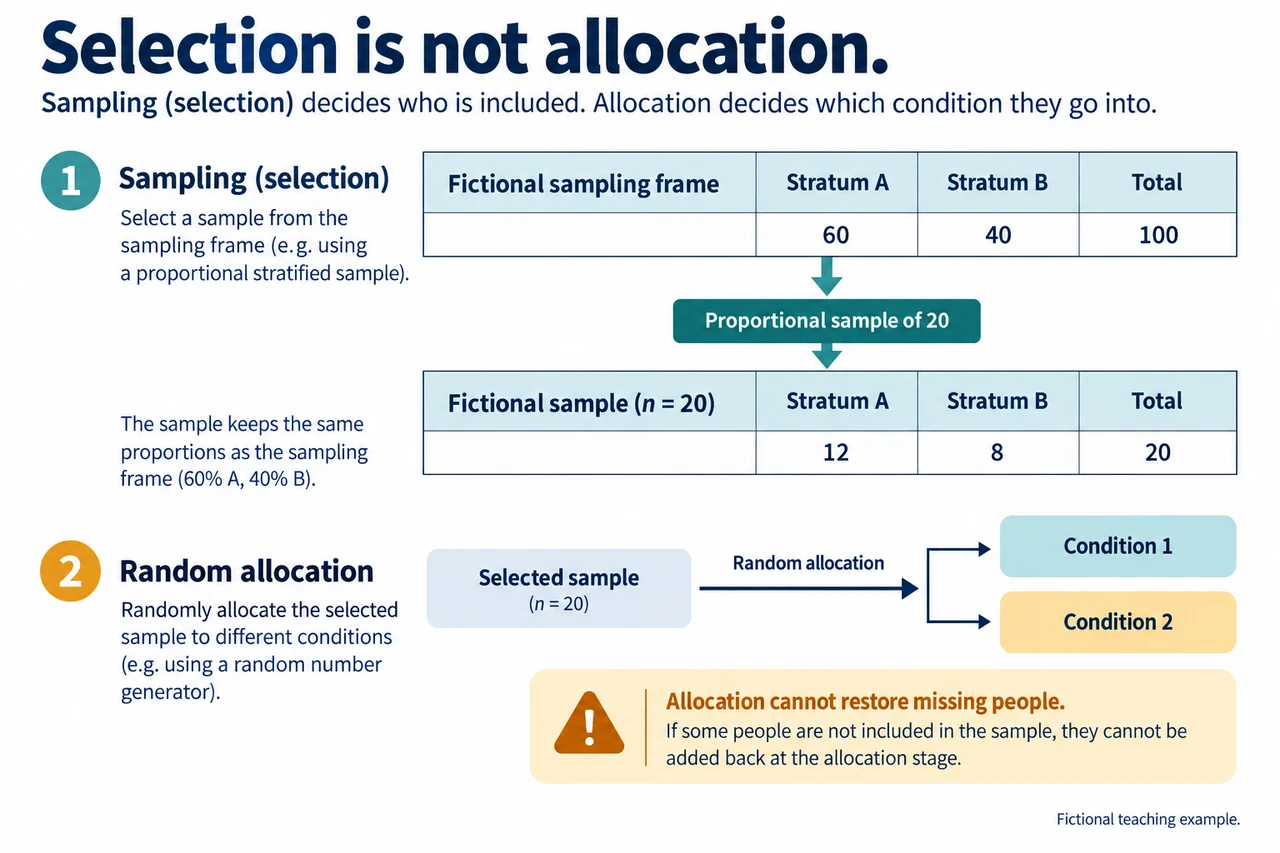
myAudience original generated educational concept illustration; fictional examples. Image: illustration, not a documentary photograph. · Original myAudience illustration; no affiliation or endorsement by an awarding body.
Sampling is not assignment
A population is the group about which a question is asked; a sample is the smaller set included in a study. A sampling frame is the list or other accessible representation from which selection is made. These need not match. A school register, for example, cannot represent all young people if the intended population also includes those outside that school. Our examples use fictional records, not a request to recruit anyone. Selection determines which records enter the sample; allocation determines the conditions given to already selected records.
Random sampling gives members of a defined frame an equal chance of selection, using a random procedure rather than the researcher’s preference. It can reduce selection bias within that frame but does not make missing members available. Opportunity sampling uses those conveniently accessible at the relevant time. It is practical but can favour people whose availability is related to the question. Calling the conveniently encountered records “random” because the researcher did not know their names confuses lack of personal knowledge with a specified selection mechanism.
Systematic sampling selects at a fixed interval from an ordered frame, normally using a randomly chosen starting position. For a frame of one hundred and desired sample of twenty, an interval of five gives twenty selections. Ordering matters: if every fifth entry has a shared characteristic, systematic selection can overrepresent it. Stratified sampling instead divides the frame into relevant groups and selects within them. Proportional stratification preserves chosen group proportions, provided the within-group selection also follows a defensible method. It cannot preserve every characteristic simultaneously.
The fictional frame contains sixty records in stratum A and forty in B. A proportional sample of twenty contains (60 / 100) × 20 = 12 A records and (40 / 100) × 20 = 8 B records. Twelve plus eight equals twenty; both proportions match the frame. That arithmetic does not prove that A and B are the only relevant groups or that selected records will participate. If non-response differs between strata, the achieved sample may depart from the planned composition. Report the achieved sample rather than silently treating the plan as the result.
Random allocation is a second operation. Once records have been selected, a random procedure assigns them to experimental conditions to reduce systematic participant differences between those conditions in expectation. It cannot turn a sample from one school into a population sample of a country. A study can use opportunity sampling followed by random allocation; conversely, random sampling does not require an experiment at all. Specify which stage is random. Otherwise an apparently reassuring phrase conceals the very bias an evaluation should consider.
The diagram uses tables rather than one hundred crowded tokens. The 60/40 frame leads to a 12/8 proportional sample, and a separately labelled arrow then allocates the selected sample to two conditions. No condition counts are supplied: the allocation stage is distinct from the stratum calculation. “Missing people” means members absent from the frame or sample, not an instruction to insert records after the results. The illustration demonstrates an accounting relationship; it does not certify that a real sample would be representative.
Evaluated model response to the transfer: Random selection from a complete frame gives each listed member an equal selection chance, but it cannot reach members omitted from that frame. Opportunity sampling is easier to arrange but favours the people who happen to be available. Systematic selection with a random start is transparent and efficient, yet the ordering of the list can introduce a repeating bias. Proportional stratification deliberately represents named groups: the stipulated sixty-A/forty-B frame would give twelve A and eight B records in a sample of twenty. The allocation is (60 / 100) × 20 = 12 and (40 / 100) × 20 = 8; this checks the sampling composition, not the experimental-condition sizes.
If the frame excludes a relevant group, none of these within-frame methods resolves the coverage problem. Random allocation after selection may reduce systematic differences between experimental conditions; it cannot create evidence about excluded people. My conclusion would distinguish the population intended, frame available, sample achieved and allocation method used. Non-response and the choice of stratifying characteristics remain limitations even after proportions match. Therefore I would favour a selection method for its fit to the question and frame, not label one method universally representative. This explanation connects each advantage to its mechanism and each limitation to an identifiable route by which the sample could differ from the population.
Worked example: A fictional frame contains 60 A records and 40 B records. Determine a proportional sample of 20 and explain what subsequent random allocation can change.
Total frame 60+40=100.
A allocation to sample=(60/100)×20=12.
B allocation to sample=(40/100)×20=8.
Check 12+8=20 and proportions 60%/40%.
Random allocation distributes selected records between conditions; it does not repair frame omissions.
Answer: Select 12 A and 8 B under the stated proportional plan; no experimental-condition counts are specified.
Check your understanding: Compare random, opportunity, systematic andstratified selection for the fictional 60 A/40 Bframe and 20 sample. Identify a coverage limitation and explain why random allocation cannot solve it.
Answer: A proportionate plan gives 12 A/8 B. Explain the selection mechanisms and their distinct limitations; missing-frame members are not restored by assigning selected records to conditions. Full evaluation appears in the final two paragraphs.
Why: A named method without its selection mechanism is incomplete. Distinguish intended population, available frame, achieved sample and condition allocation.