Which comparison can support a causal claim?
By UK GCSE Psychology · independent study · myAudience
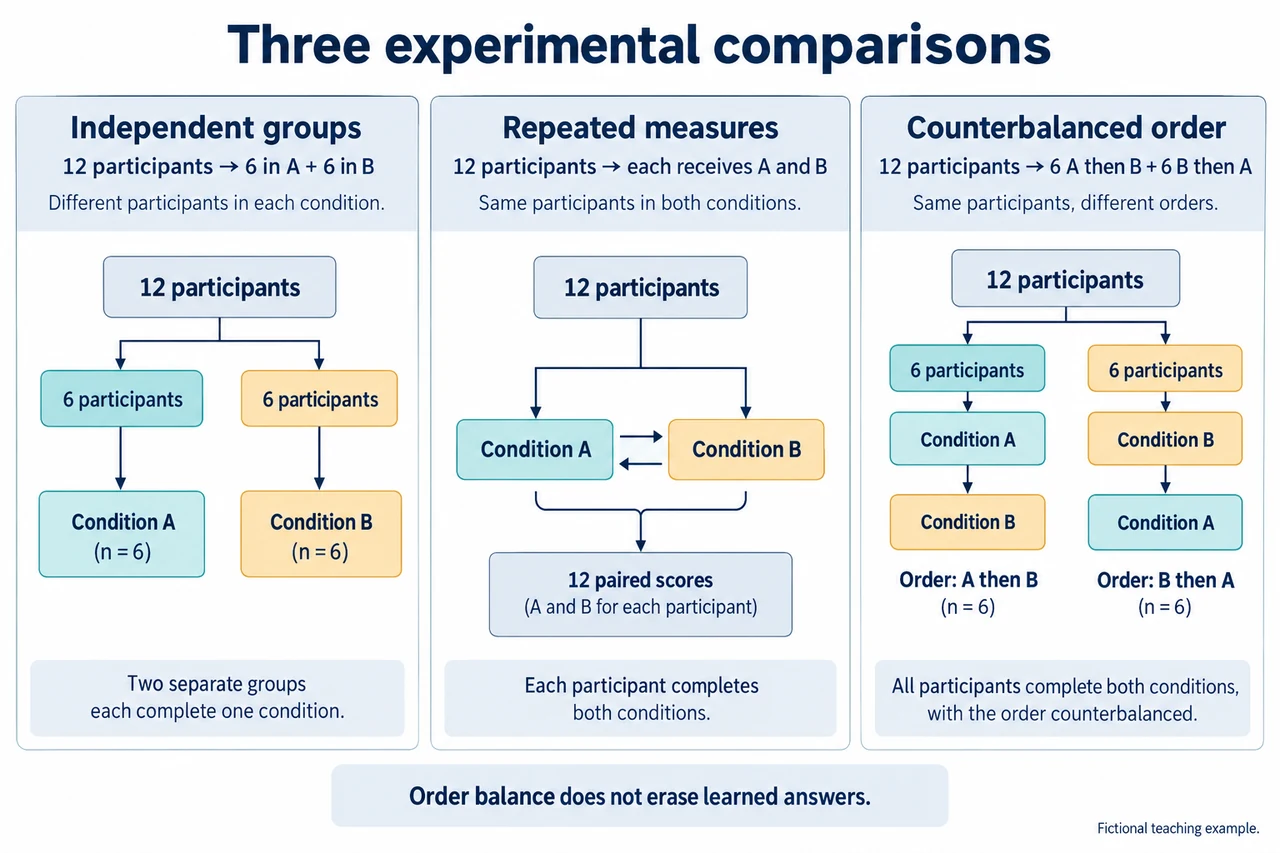
myAudience original generated educational concept illustration; fictional examples. Image: illustration, not a documentary photograph. · Original myAudience illustration; no affiliation or endorsement by an awarding body.
Which comparison can support a causal claim?
An experimental design specifies how participants contribute observations to conditions. Independent groups use different participants in each condition; repeated measures use the same participants in both. Matched pairs place participants with similar values on selected characteristics into pairs, with one member contributing to each condition. These are different ways of addressing participant differences. None is automatically the best design, because reducing one problem can introduce another. The appropriate comparison depends on whether experiencing one condition changes the response to the next.
For twelve fictional records, an independent-groups comparison might allocate six to A and six to B. Each produces one score. Differences in prior skill can then contribute to the condition difference, especially in a small sample. Random allocation can reduce systematic allocation bias but cannot guarantee identical groups. In repeated measures, all twelve produce an A score and a B score: twelve pairs, twenty-four observations. Comparing within-person differences controls stable individual characteristics more directly, although characteristics can change across sessions.
Repeated measures introduces order effects. Practice can improve later performance; fatigue can reduce it; discovering the task’s purpose can alter later responses. Counterbalancing gives six records A then B and six B then A. It balances which condition appears first, potentially preventing a general order advantage from consistently favouring one condition. It does not erase experience. If learning A changes how B is approached in a specific, unequal way, equal numbers in each order cannot guarantee that the intended contrast is clean.
Matched pairs tries to reduce relevant differences without asking the same person to experience both conditions. A fictional symbol-learning question might pair records by a prior, unrelated learning score, then assign one member of each pair to A and the other to B. Matching is only as useful as the chosen measure: equal prior scores do not establish equal concentration or familiarity with the later materials. It can also be difficult to find close matches. Pairing after inspecting the desired outcome would undermine the intended control.
Suppose condition A teaches the exact symbol answers later scored in B. Reusing those symbols creates carryover, not merely a nuisance caused by tiredness. A break cannot make learned answers disappear reliably. Independent groups avoids direct transfer of those exact answers between conditions but retains participant differences. Alternatively, distinct carefully comparable materials may reduce carryover, though equivalence of materials becomes a new issue. Evaluation weighs these tradeoffs; “counterbalance it” is incomplete unless the explanation addresses what counterbalancing actually changes.
The plate has three pathways: six plus six independent records; twelve records contributing paired scores; and six AB plus six BA sequences. The repeated-measures panel’s double arrows indicate the two possible orders, not movement of scores between groups. The third panel explains how order can be balanced within repeated measures. It is not a fourth universal design or evidence that matching has occurred. No fictional scores are shown, because the image teaches the structure of comparison rather than a result.
Evaluated model response to the transfer: For a neutral symbol-learning comparison in which the first condition teaches answers used in the second, I would prefer independent groups to repeated measures using the same symbols. With twelve fictional records, six could contribute to each condition. That prevents the same person carrying the exact learned answers into the comparison condition. It does not prove the groups are initially equivalent, so random allocation and an explicitly justified prior-skill measure would strengthen the comparison. A remaining limitation is that small groups can differ by chance in unmeasured characteristics.
Counterbalancing six AB and six BA sequences would distribute the order of conditions, but it would not unlearn the answers; carryover can depend specifically on the earlier condition. Matched pairs based on relevant prior skill could reduce measured participant differences while keeping each person in one condition. However, matching a score does not match every influence, and the preliminary measure must not itself teach the target answers. I would justify the choice by the mechanism of the learning problem rather than say one design is always valid. Any conclusions remain bounded by the materials, sample and scoring task, and actual ethical approval and methodological execution are not demonstrated by this fictional redesign.
Worked example: Twelve fictional records are available. Contrast independent groups, repeated measures and a counterbalanced repeated design, then identify a limitation when learning is irreversible.
Independent groups may have 6 inA and 6 inB: 12 total scores.
Repeated measures gives 12 A/B score pairs: 24 observations from 12 records.
Counterbalancing can give 6 AB and 6 BA: 12 records, each inboth conditions.
Equal order counts do not erase previously learned answers.
Matched pairs uses separate people similar on measured characteristics, leaving unmeasured differences possible.
Answer: The structures have distinct advantages; irreversible learning can make independent groups preferable despite participant-difference limitations.
Check your understanding: Choose and justify a design for the stipulated neutral-symbol task where conditionA teaches answers later tested inB. Explain what 6 AB/6 BAcounterbalancing cannot remove and the limits of matching measured prior skill.
Answer: Independent groups can avoid direct answer carryover; participant differences remain. Counterbalancing distributes order, not unlearning. Matching addresses measured skill, not every influence. The final two paragraphs fully evaluate the choice.
Why: Credit a reasoned design tradeoff with the exact irreversible-learning problem, not a universal best-design claim.