A setting is not a guarantee of validity
By UK GCSE Psychology · independent study · myAudience
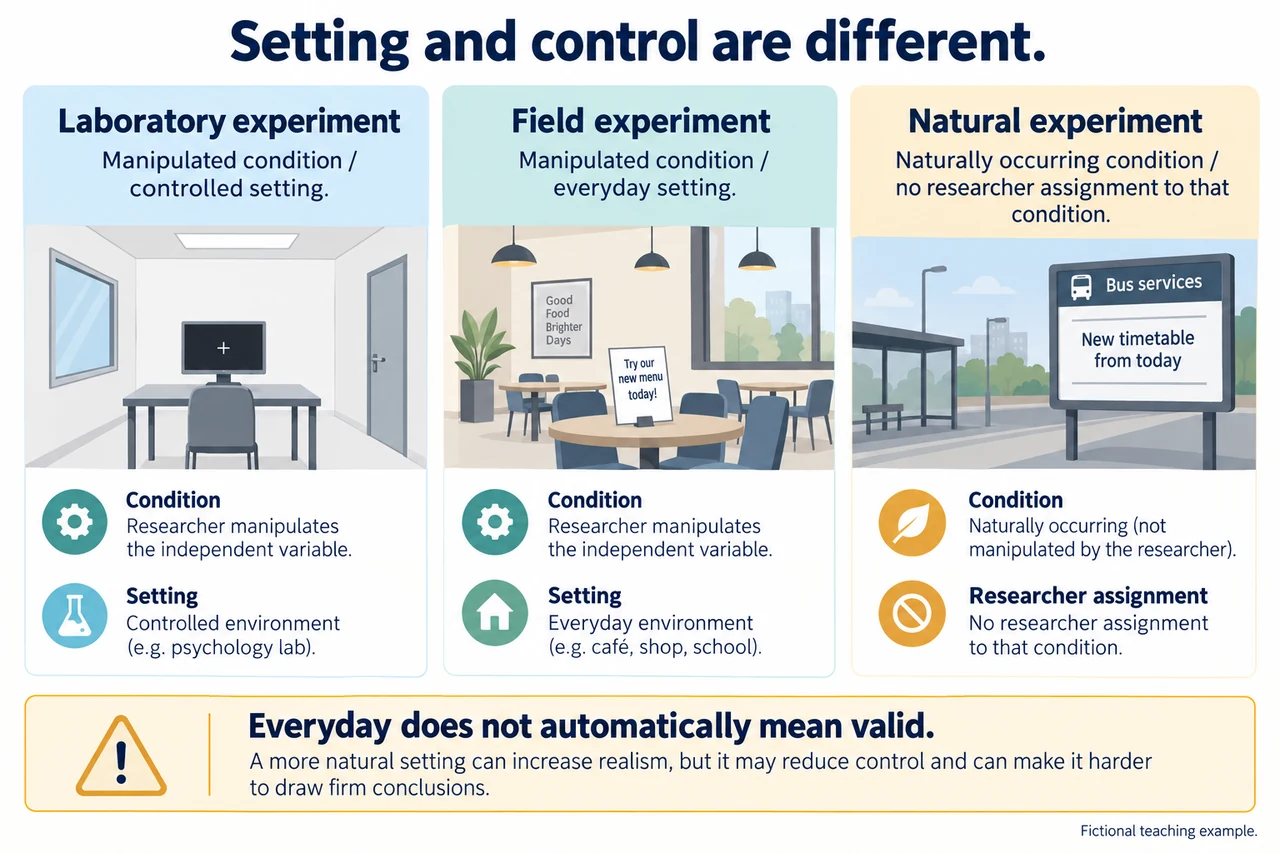
myAudience original generated educational concept illustration; fictional examples. Image: illustration, not a documentary photograph. · Original myAudience illustration; no affiliation or endorsement by an awarding body.
A setting is not a guarantee of validity
A laboratory experiment changes an independent variable in a controlled setting. A field experiment also changes an independent variable but takes place in an everyday setting. A natural experiment examines an independently occurring condition rather than a condition created by the researcher. These distinctions concern manipulation and setting, not a ranking from “fake” to “true”. A controlled room can support a useful question, while a familiar room can contain important rival explanations. Always ask which comparison the design actually permits.
A fictional laboratory task might standardise the display, delay and scoring for neutral word recall. This control can make an intended contrast easier to interpret, but an unfamiliar task or awareness of being observed can change behaviour. A field experiment could compare two researcher-controlled presentation formats in an ordinary teaching setting. Its everyday location may improve realism, yet noise, interruptions or inconsistent delivery can weaken control. Neither definition guarantees random sampling or random allocation; those must be described separately.
In a natural experiment, a timetable or other condition changes independently of the researcher. It can provide an opportunity to examine a contrast that would be impractical or inappropriate to create. But the groups experiencing it may already differ. The naturally occurring condition is not synonymous with a natural outdoor setting: a naturally occurring contrast can be studied indoors. Likewise, a field experiment is not defined by absence of manipulation. Confusing these meanings loses the central distinction between an assigned condition and an observed one.
Consider two fictional classes with different classrooms, teachers and prior attainment. If their later scores differ, the classroom is not isolated as the cause. Teacher explanation or initial attainment can produce the same pattern. Measuring prior attainment helps describe a rival and may improve comparison, but it does not make every unmeasured characteristic identical. An ethical alternative might compare a permitted, low-risk presentation change under consistently defined conditions without disrupting access to ordinary teaching. This is a hypothetical design discussion, not a classroom-research instruction.
Reliability concerns consistency, while validity concerns whether evidence and measurement support the intended interpretation. Repeating an inaccurate scoring rule consistently can produce reliability without valid measurement. Realism in setting can support generalisation to that setting, but the particular task, sample and awareness of observation still matter. “It happened in daily life, therefore it is valid” ignores these routes to error. Conversely, artificiality is a limitation to explain, not a sufficient reason to discard every controlled finding.
The image separates laboratory, field and natural experiments. The café’s manipulated menu and the independent bus-timetable change are conceptual examples, not actual studies or recommendations to alter public services. Their labels identify who creates the condition; there are no effect arrows or numerical outcomes. The laboratory room does not prove complete control, and the natural-condition panel explicitly states that the researcher does not assign that condition. Notice the warning below all three panels: familiar surroundings do not establish a valid causal interpretation.
Evaluated model response to the transfer: An everyday setting can make a task resemble the context to which a claim will be applied, but it does not prove validity. In the stipulated two-class comparison, teacher, classroom and prior attainment differ together. A score difference could therefore have several explanations. I would propose a hypothetical, appropriately reviewed comparison of a low-risk presentation format, with the content, scoring and delay standardised and allocation specified where feasible. It must not withhold ordinary learning opportunities or pressure pupils to take part. That would address identifiable procedural rivals rather than rely on the room’s familiarity.
Even this improved comparison would retain limitations: prior experience can differ, awareness of observation can affect responses, and results from one material or school need not generalise widely. Measuring a relevant baseline can clarify initial differences without proving that all relevant influences were measured. A consistent scoring rule supports reliability, yet its validity depends on whether the score answers the intended question. I would therefore judge the evidence by its manipulation, allocation, measure and competing explanations, alongside setting. The defensible conclusion is bounded, not “everyday equals valid” or “laboratory equals invalid”; a realistic context and a well-controlled causal comparison are related but distinct strengths.
Worked example: Two fictional classes differ in room, teacher and prior attainment; their later scores differ. Assess the inference that the everyday room proves a valid classroom effect.
Room, teacher and prior attainment vary together.
Each could explain part of the score contrast; the room effect is not isolated.
Distinguish a researcher-manipulated field condition from an independently occurring natural condition.
Standardised scoring supports consistency but does not make every causal interpretation valid.
Specify a bounded low-risk hypothetical comparison and remaining sample or task limits, without conducting research.
Answer: Everyday setting alone establishes neither cause nor valid measurement; the inference needs its own design and rival assessment.
Check your understanding: Evaluate the claim that an everyday setting proves validity in the two-class case. Propose an ethical hypothetical comparison and a remaining limitation.
Answer: Room, teacher and prior attainment are confounded. A reviewed low-risk presentation comparison with stated allocation and common scoring could address specific rivals; sample, prior experience and reactivity limitations remain. See the complete final two-paragraph model.
Why: Do not confuse realism, reliability and a justified causal interpretation; no reader recruitment is requested.