Permission is more than a ticked box
By UK GCSE Psychology · independent study · myAudience
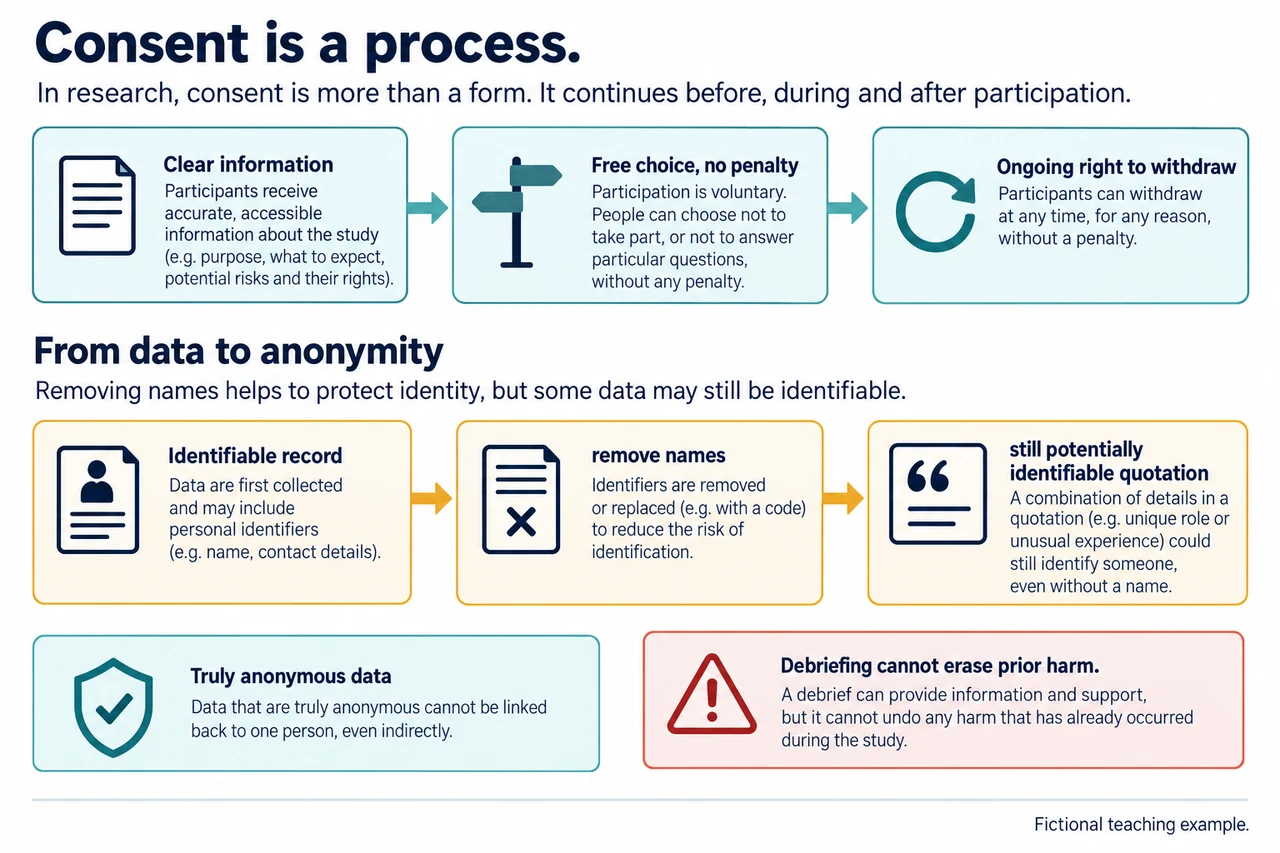
myAudience original generated educational concept illustration; fictional examples. Image: illustration, not a documentary photograph. · Original myAudience illustration; no affiliation or endorsement by an awarding body.
Permission is more than a ticked box
An ethical design explains why a question is worth asking, what foreseeable harms it creates and how participants retain meaningful choice. A consent form is part of that process, not proof that every risk has been addressed. includes ethical issues, safeguards and the BPS’s role in research methods. The direct BPS sources were inaccessible during this preparation; the lesson does not pretend that their full current code was read. Oxford’s current institutional policy provides an accessible primary example of continuing, comprehensible voluntary consent and risk review, not a universal legal rule.
Consent is meaningful only if the information and choice are usable. In a fictional small-class invitation, a teacher says participation is optional while standing beside a register and waiting for answers. Even without an explicit threat, pupils might interpret refusal as disappointing an authority figure. A better hypothetical invitation separates the decision from ordinary assessment, explains that refusal has no penalty and allows time for questions. Removing pressure is not merely replacing “must” with “may”; the setting of the request can communicate expectations that the wording denies.
Privacy requires examining the information, not just removing names. A fictional quotation mentioning a distinctive role and unusual event might identify its speaker to classmates. Replacing the name with a code does not necessarily make the quotation anonymous. The identification risk depends on combinations of details and the audience’s background knowledge. Summarising a theme or removing unnecessary particulars could reduce that risk, but changes must not misrepresent the evidence. This is a paper scenario only; no quotations from real users or pupils are requested.
The right to stop participating and the ability to remove already processed data are related but different. Where records remain linkable, a withdrawal plan can specify how to locate and remove them. Once data are genuinely irreversibly anonymous, an individual record cannot be retrieved by person, precisely because the link no longer exists. That limitation must be explained before agreement rather than discovered when someone seeks withdrawal. Retaining unnecessary identifiers indefinitely is not the only solution; the design needs a transparent, justified processing plan and appropriate review.
A debrief can explain a study and provide an opportunity for questions, but it cannot rewind an experience that caused avoidable distress or exposed private information. Ethical reasoning therefore begins before the procedure, not after its results look useful. In this fictional classroom case, a less intrusive task or entirely synthetic teaching material can serve the educational purpose without recruiting people. No lesson here authorises research, deception or clinical screening. Any real research would need its own appropriate oversight and context-specific safeguards.
The diagram has two distinct paths. The top shows information, free choice and ongoing withdrawal; the lower path shows that name removal can leave an identifiable quotation. The separate anonymous-data box is not the next guaranteed stage of that path: it describes a stronger condition that must actually hold. The withdrawal label concerns participation, and the surrounding explanation qualifies what can happen to data already irreversibly anonymised. These conceptual arrows do not instruct the reader to obtain consent or store personal records through myAudience.
Evaluated model response to the transfer: I would redesign the fictional invitation so the teacher does not collect immediate public decisions or connect participation to marks. The information would explain the purpose, foreseeable privacy risk and voluntary choice in accessible terms, with time for questions and refusal without penalty. The small-class quotation would not be described as anonymous merely because its name was removed: classmates could recognise the combination of a distinctive role and event. I would question whether such detail is needed at all and consider a faithful aggregate summary or an entirely synthetic example for teaching.
The withdrawal explanation would distinguish stopping participation from removing an identifiable record, and clearly state any point after which truly irreversible anonymity makes individual retrieval impossible. This limitation should not be concealed inside a reassuring promise to “withdraw anything at any time”. A debrief would add information and support, but it could not undo avoidable disclosure or earlier pressure, so those risks must be addressed in the design. I would judge safeguards by the specific harm they reduce, not by counting forms. The result is a reasoned hypothetical ethical evaluation, not approval to run a study or a claim that one institution’s policy exhausts every applicable requirement.
Worked example: A fictional teacher requests immediate public decisions in a small class and promises anonymity after removing names from distinctive quotations. Diagnose both ethical problems.
Authority and a visible decision can pressure participation despite optional wording.
Explain voluntarychoice/no penalty and a comprehensible invitation outside assessment pressure.
Removing names does not eliminate recognition from distinctive quotation details.
Distinguish stopping participation from retrieving a record after genuine irreversible anonymisation.
Do not treat later debriefing as undoing avoidable earlier harm.
Answer: The invitation and anonymity promise need specific changes; no real recruitment or data collection is authorised by this teaching example.
Check your understanding: Redesign the fictional pressured classroom invitation and distinctive-quotation anonymity promise. Explain withdrawal after irreversible anonymity and why debriefing cannot erase prior harm.
Answer: Provide voluntary comprehensible choice away from public authority pressure and no assessment penalty. Remove unnecessary identifying detail, explain truthful data withdrawal limits before consent, and prevent avoidable harm rather than rely on debriefing. Full evaluated model follows the illustration paragraph.
Why: Every safeguard must address the stated risk. This is a design-evaluation exercise, not permission to recruit people or collect their information.