Evidence, inference and the limits of a historical claim
By UK GCSE History · independent study · myAudience
Original built-in imagegen teaching model; author inspected 2026-10-04. Not documentary evidence. Prepared immutable candidate WebP and 160/640 variants. · Isolated pending review only. Publication rights and integration acceptance remain for root review; no third-party source graphic copied.
Evidence, inference and the limits of a historical claim
A fact claim asserts something about the past that can be checked against evidence. An inference draws a conclusion from evidence that does not state that conclusion directly. An interpretation selects and explains evidence to answer a question. These categories overlap: an interpretation may contain accurate facts and weak inferences. A normative judgement, such as whether a ruler acted justly, also depends on a stated value or criterion. Evidence cannot by itself decide which moral standard we ought to adopt.
Start an enquiry by specifying its object, period and scale. 'Did conquest change England?' is too broad for a single paragraph; 'How did a castle help an incoming lord maintain local power?' identifies a mechanism. A surviving building may establish that a substantial fortification existed, but its present walls can belong to later rebuilding. Dating the fabric is therefore part of the argument, not a decorative source note. An absence in a surviving record is not automatically evidence that an activity never occurred.
Provenance means the circumstances in which a source was produced and transmitted: authorship, date, audience, purpose and survival. Reliability is always reliability for a particular claim. A boastful ruler's account may exaggerate popular approval while remaining useful for identifying the image of authority the ruler wanted to project. Cross-checking independent evidence can strengthen a claim; several texts repeating one lost account are not several independent witnesses. Ask what could disprove your preferred inference.
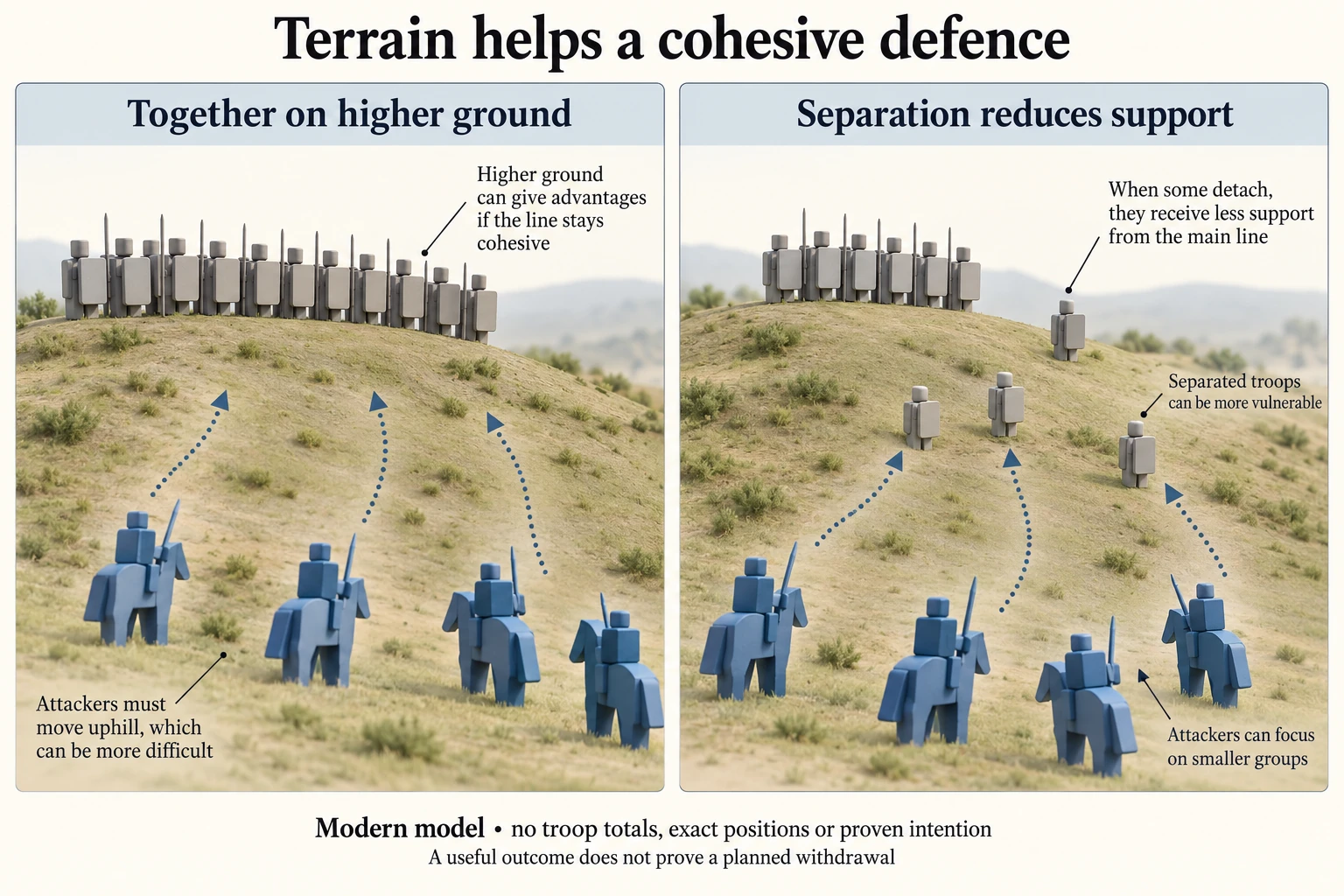
Read the Hastings plate as a modern conceptual reconstruction. The upper ground and closely placed shields illustrate a proposed relationship between position and defensive cohesion. The second panel proposes how separation might create vulnerability. It supplies no contemporary witness, troop count, exact route or surveyed elevation. Its clarity helps explain a mechanism but cannot establish that every movement occurred as pictured. Confusing a vivid illustration with an authentic source turns a teaching aid into false evidence.
Source criticism in action: imagine three constructed records, an inscription praising a ruler, a later narrative repeating it, and a dated enclosure. None is an actual archive extract. Before combining them, separate two propositions: authority was asserted; inhabitants accepted that authority. The inscription addresses the first directly through its public message. The enclosure adds a different kind of evidence about resources and defence. The narrative may add no independent testimony if it borrowed the inscription. Calling the combination corroboration for popular acceptance confuses both the question and the relationship between sources. The reasoning must identify which link each item supports, not merely announce that three sources agree.
Contrasting interpretations, constructed for this bounded enquiry: A argues that visible fortification demonstrates secure local authority; B argues that fortification demonstrates an attempt to secure authority. Their difference is the step from investment to success. A could become persuasive if dated evidence showed sustained enforcement and limited disruption across the locality. B is better supported by the three items alone, because an attempt is compatible with both successful control and resistance. B is not automatically correct about every castle, and a cautious tone is not itself evidence. Our preference follows from the inferential distance, not the personality or nationality of an imagined author.
Build an argument by stating the claim, extracting the relevant feature, explaining the mechanism and testing an alternative. A defended enclosure can shelter personnel, allowing them to remain locally while making demands. That connects a material feature to a capacity. But protection from attack is compatible with vulnerability outside the enclosure; it does not establish obedience throughout a district. Test the capacity against independently dated records of collection, disputes and obligations, if such records survive. Missing evidence should be described as a limit of this enquiry. It is not permission to fabricate an average resident or to replace investigation with a universal verdict.
Demanding transfer, constructed: four manuscripts report the same successful siege; three descend from one text, while the fourth dates the event differently. An archaeological layer shows burning but has a broad date range. Is the siege established? Model answer: the apparent fourfold agreement reduces to at most two textual traditions, whose access and transmission must be examined. Burning supports destruction within its dating range, not necessarily this siege or its alleged attacker. Agreement on a narrower date and independent evidence of cause would strengthen the case. A defensible conclusion reports a possible association and distinguishes uncertainty about dating, agency and independence. This preserves what the evidence can show without turning uncertainty into proof that no siege occurred.
Worked example: Constructed practice evidence, not an archive item: a commemorative inscription calls a lord 'protector of all'; excavation dates a fortified enclosure to his lifetime. What can each establish?
The inscription directly establishes a public claim to protection, assuming its attribution and dating are sound. It does not measure consent.
The enclosure supports investment in defence or control. Function requires its layout and context; defence and coercion can coexist.
Agreement that authority was displayed is stronger than a conclusion that everyone welcomed it. Seek records of obligations, resistance and who paid for construction.
Additional original evaluated transfer model (1, part 1/4): The siege is plausible, but the supplied evidence does not establish its precise date, cause and attacker with equal confidence. The correct criterion is whether independent, appropriately dated evidence supports those particular claims. Four manuscripts are four surviving objects, yet three depend on one earlier text. Their agreement may show successful transmission of a narrative rather than three separate witnesses to the event. The fourth account potentially adds another tradition, but its different date creates a problem that must be investigated rather than hidden by counting a majority of copies.
Additional original evaluated transfer model (1, part 2/4): The textual case could nevertheless be stronger than complete uncertainty. The dependent copies may help reconstruct the wording of their shared source and reveal where later alterations occurred. The fourth account may preserve information unavailable to that tradition. Its date could reflect a different calendar convention, a copying error or a genuinely different event; those are hypotheses requiring evidence, not explanations already proved. Comparing provenance, composition date, access to information and transmission would help decide whether the apparent disagreement concerns chronology alone or the identity of the supposed siege.
Additional original evaluated transfer model (1, part 3/4): The burnt archaeological layer supplies another kind of evidence, but its independence does not make it an exact match automatically. Burning establishes destructive activity within the stated dating range. Accidental fire, another attack or later rebuilding could also produce such a layer. An association becomes stronger if securely dated objects, construction phases and the distribution of destruction fit the textual sequence. It becomes weaker if the archaeological interval excludes the proposed date. No numerical confidence percentage follows from the information given, and invented precision would conceal the uncertainty rather than resolve it.
Additional original evaluated transfer model (1, part 4/4): My judgement is therefore that the records support investigation of a possible siege, while the broad archaeological date and unresolved textual dependence prevent a firm attribution. This conclusion does not mean that no siege occurred: insufficient support for a precise claim is different from evidence that the event was impossible. I would report separately what is supported about destruction, what is disputed about its date and what remains unknown about agency. The most useful additional evidence would narrow those specific gaps, rather than simply supply another copy of the same attractive story.
Answer: Both support a claim that the lord represented and materially asserted authority. Neither proves universal approval. This is a bounded inference whose uncertainty concerns reception, not simply whether a wall existed.
Check your understanding: 1 Identify an inference in the example. 2 Explain why a biased inscription remains useful. 3 Transfer: can ten copied chronicles settle whether a battle tactic occurred?
Answer: 1 Authority was materially asserted is an inference linking the structure to power. 2 The inscription reveals the desired public image even if praise is exaggerated. 3 Ten copies may preserve one testimony; trace their relationships before counting corroboration. Independent material or textual evidence would add more than repeated wording.
Why: These answers distinguish evidence for representation from evidence for behaviour. The misconception 'biased means useless' ignores enquiry purpose; the misconception 'more documents means more independent evidence' ignores transmission. A strong argument identifies exactly what additional evidence would change its conclusion.