Humoural medicine: explaining persistence without endorsing the theory
By UK GCSE History · independent study · myAudience
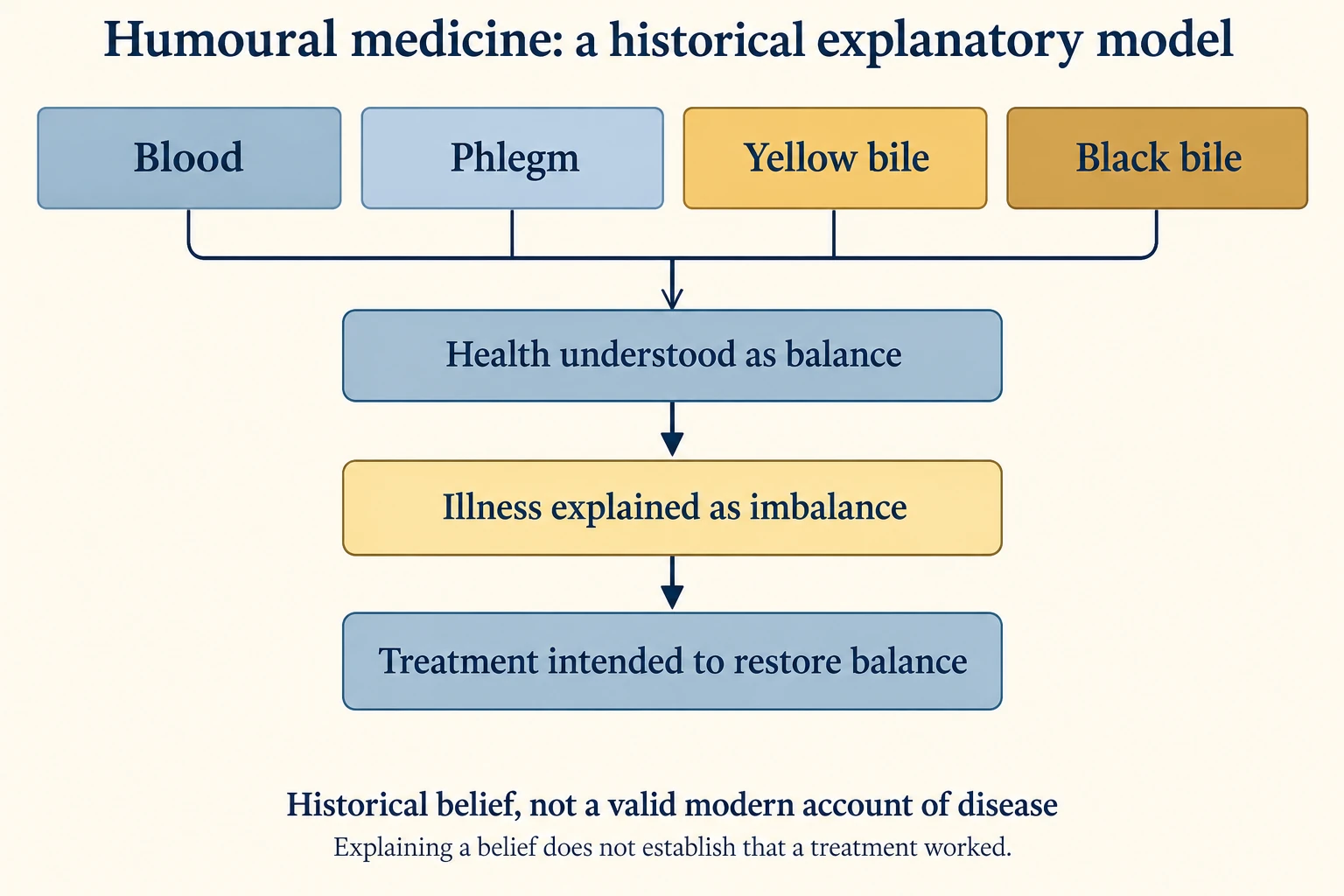
Original built-in imagegen teaching model; author inspected 2026-10-04. Not documentary evidence. Prepared immutable candidate WebP and 160/640 variants. · Isolated pending review only. Publication rights and integration acceptance remain for root review; no third-party source graphic copied.
Humoural medicine: explaining persistence without endorsing the theory
Humoural medicine treated health as balance among blood, phlegm, yellow bile and black bile. This is a historical explanatory theory, not a valid modern account of disease. A theory is a connected account of why observations occur; a treatment is an action intended to alter a patient's condition. Knowing that a treatment followed logically from a theory does not show that the theory was true or the treatment effective. These distinctions let us explain past choices without recommending them.
The humoural plate moves from four named fluids to balance, then imbalance and an intention to restore balance. Follow the arrows as a chain of reasoning within the historical model. They do not show a biological mechanism. The four equal boxes do not imply equal measured volumes or four substances that modern laboratory testing would identify in that form. The warning below the diagram is essential: coherence inside a model differs from successful independent testing.
Persistence needs an explanation beyond calling earlier people ignorant. Established texts could organise symptoms, diet and bodily variation into an intelligible framework. Training, reputation and the cost of challenging authorities could reinforce it. This is a causal hypothesis about institutions and reasoning, to be checked against manuscripts and practices. Different healers and households need not have followed a learned theory in the same way. The British Library's manuscript project demonstrates medical writing alongside religious and other learning, not a uniform national medical service.
Separate three enquiries: what practitioners believed, what they did, and what happened to patients. A prescription can answer the first two only imperfectly; it rarely isolates why a patient recovered. Natural recovery, different illnesses and several simultaneous actions complicate causal attribution. The misconception that every old remedy was either miraculous or wholly useless replaces investigation with a blanket verdict. For the thematic course, changes in explanation, practice, access and outcomes must be compared separately.
A medical text can be strong evidence for a learned explanation and weak evidence for a typical patient's experience at the same time. Establish whether it prescribes an ideal practice, reports an observed case or copies an earlier authority. A prescription uses the author's categories to justify an intended intervention; it does not independently verify those categories. Manuscript survival also selects for institutions capable of writing and preservation. Ownership and repeated copying could suggest circulation, but circulation is still distinct from reading, acceptance and use. Never translate an ambiguous medieval symptom into a confident modern diagnosis merely to make the story sound scientific.
Two constructed interpretations of the persistence of humoural reasoning offer different mechanisms. A emphasises intellectual coherence: balance provided an organising explanation for varied symptoms. B emphasises institutional authority: training and established texts made alternatives costly to adopt. The scope is learned practice, not every healer or household across medieval Britain. Texts displaying explanation could support A; records of teaching, citation and disagreement would help test B. The mechanisms can reinforce each other, so choosing one as the sole explanation is unwarranted here. Neither interpretation says that coherence or authority made the disease theory biologically correct.
Reason from source to argument through a chain with an explicit weak point. A prescription that invokes imbalance supports the claim that its writer used humoural categories. An instruction to change diet connects the explanation to intended practice. To infer actual administration requires a different record; to infer effective cure requires outcome evidence with comparable conditions. Recovery alone cannot isolate treatment from natural course, misclassification or simultaneous care. Modern comparison methods clarify the causal problem, but we must not invent a historical experiment that the surviving record never contained. Understanding past rationality and judging medical effectiveness answer separate questions.
Demanding transfer, constructed: two patients recover after different balance-restoring treatments and a third dies without treatment. Does this establish effectiveness? Model answer: no, because assignment to treatment, initial severity, illness type and other care are unknown. The untreated patient may have been more severely ill, and the two recoveries may reflect natural recovery. The reports may still show how outcomes were interpreted within a learned model. Seek comparable unsuccessful treated cases and surviving practice records, while acknowledging that modern controlled evidence may be unavailable. Explain the belief's operation without recommending its interventions. The model answer is about historical inference, not present medical advice.
Worked example: Constructed case: an account says a sick person recovered after a treatment intended to balance humours. Explain what it supports and what it cannot prove.
It supports a reported sequence and, if the description is accurate, an intention to act within humoural reasoning.
Recovery following treatment does not establish recovery because of treatment. No comparison, diagnostic certainty or exclusion of other changes is supplied.
The writer's purpose may favour a success story. Compare unsuccessful cases and other accounts before inferring typical experience.
Additional original evaluated transfer model (2, part 1/4): The three constructed reports do not demonstrate that the balance-restoring treatments were effective. Effectiveness requires a defensible comparison of outcomes that would otherwise have been similar. Here, the two treated patients recovered and the untreated patient died, but their illnesses, initial severity and other care are unknown. A difference in outcomes therefore exists in the reports without a secure explanation for it. Treating the sequence as proof confuses what followed an intervention with what the intervention caused, especially when the comparison consists of only three selected examples.
Additional original evaluated transfer model (2, part 2/4): The strongest argument for effectiveness is that both recorded recoveries followed treatments intended to restore balance. That pattern would have been understandable within humoral explanation, and it may help explain why practitioners found the theory persuasive. However, the two treatments differed, so even the claimed mechanism is not held constant. Natural recovery, food, rest or differences in illness could account for the results. The untreated patient might have been seriously ill before any decision about treatment was made. None of those possibilities is established, but each shows why the causal conclusion needs more evidence.
Additional original evaluated transfer model (2, part 3/4): Source selection adds a separate problem. Records may preserve striking recoveries while omitting treated patients who died, or classify very different conditions under one broad description. We would need unsuccessful cases, information about who received treatment and comparable accounts of illness before attempting an outcome comparison. In a historical investigation, modern controlled evidence may not survive, so the conclusion must remain proportionate to the records available. That limitation does not license dismissing every practitioner as irrational; a coherent explanatory system can shape observation without providing a correct account of disease or an effective intervention.
Additional original evaluated transfer model (2, part 4/4): The reports are consequently more useful for understanding how illness and recovery were interpreted than for establishing therapeutic benefit. A careful answer can recognise recorded recovery and the operation of a learned theory while refusing to infer effectiveness from their conjunction. Additional comparable cases might strengthen or weaken a treatment claim, but these three cannot support a success rate for a wider population. The historical enquiry is about the relationship between belief, practice and evidence. It is not a recommendation to reproduce historical treatments, nor does explaining their apparent plausibility validate their medical assumptions today.
Answer: The account is stronger evidence for a way of understanding treatment than for its effectiveness. A defensible explanation names alternative causes of recovery and avoids translating historical vocabulary into modern diagnosis.
Check your understanding: 1 Define theory versus treatment. 2 Why could a coherent explanation persist without being correct? 3 Evaluate the claim 'the survival of a medical manuscript proves that most villagers followed its advice'.
Answer: A theory explains causes; treatment acts on a condition. A coherent account can be supported by training and authority while evidence remains unable to test its mechanism. A surviving manuscript demonstrates production and preservation of knowledge, not population-wide access, reading or obedience. Copies, ownership and practice records would help test diffusion.
Why: Persistence is explained rather than excused or mocked. Survival bias favours literate institutions and durable collections. The transfer answer corrects the leap from availability somewhere to use everywhere. Historians must study reception and practice alongside texts.