Care, knowledge and progress: what does a hospital prove?
By UK GCSE History · independent study · myAudience
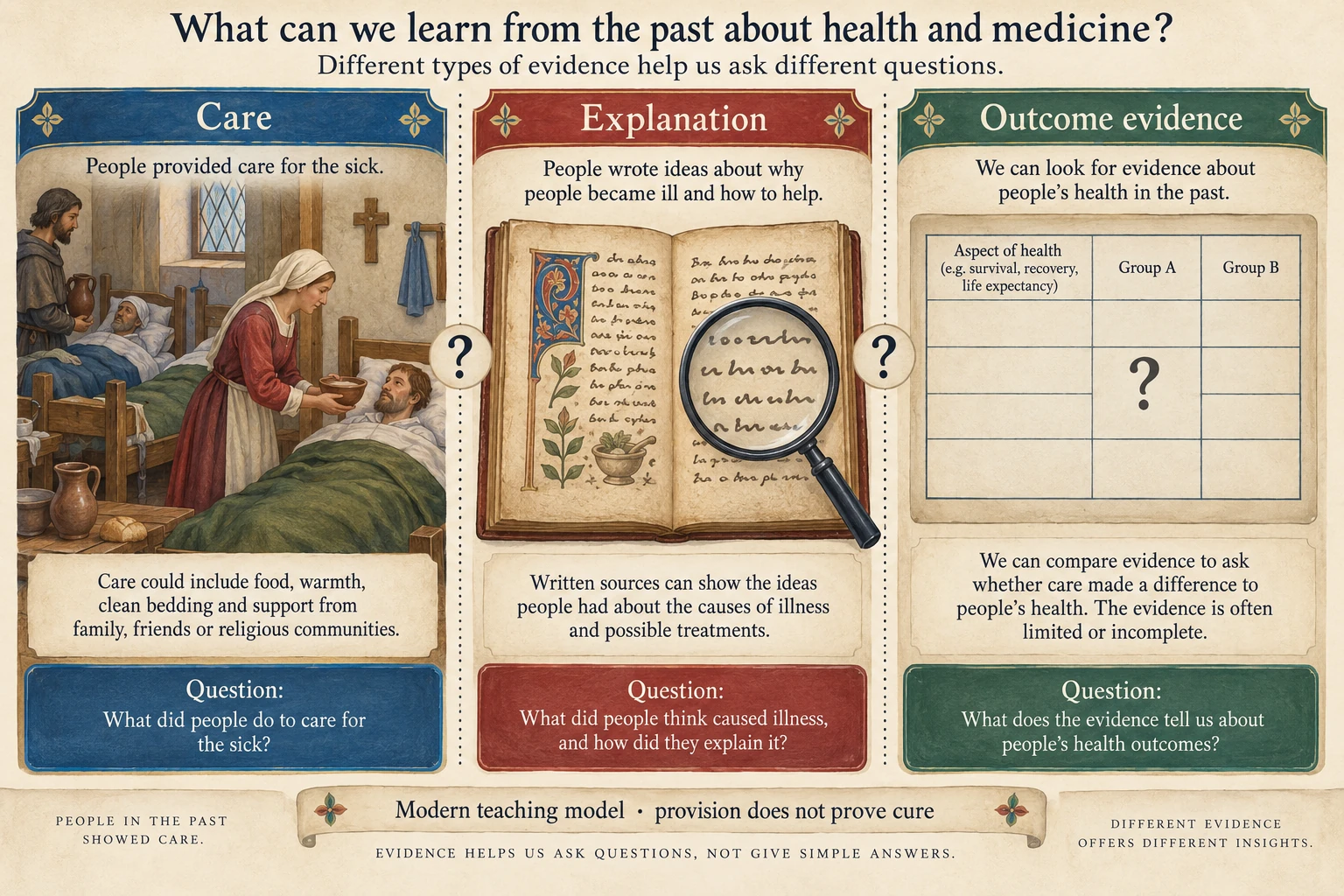
Original built-in imagegen teaching model; author inspected 2026-10-04. Not documentary evidence. Prepared immutable candidate WebP and 160/640 variants. · Isolated pending review only. Publication rights and integration acceptance remain for root review; no third-party source graphic copied.
Care, knowledge and progress: what does a hospital prove?
Care includes feeding, shelter, comfort and attention to people who are ill. Cure means removing or substantially resolving the illness. Progress is a comparative judgement that requires a criterion: improved access, reduced suffering, more accurate causal understanding or better survival may move at different rates. A medieval institution could make a meaningful contribution to care without possessing modern therapies. Calling all care a cure exaggerates achievement; calling care worthless because it was not a cure ignores its purpose.
Religious institutions preserved and produced texts as well as undertaking other activities. The British Library's England-and-France project describes manuscripts spanning theology, medicine, science and history. This is evidence against a simple division in which religious learning excluded every natural enquiry. It does not establish that every monastery offered the same medical services. Institutional resources, rules and local circumstances matter. In the thematic course, religion can enable some developments and constrain others; its effects need examples and defined contexts.
Written prescriptions are particularly visible because literate institutions preserved them. Household and community care may be less well documented. A source collection can therefore distort our picture if we equate the most visible provider with the only provider. When studying ordinary people, consider access, gender, wealth and place, while avoiding an invented average patient. The British Library's work on medieval women explicitly includes healthcare among activities represented by surviving evidence.
A strong comparison holds its criterion steady. If comparing two institutions for access, ask who could enter and who was excluded; if comparing knowledge, ask how claims were investigated and revised. Do not switch from access in the first institution to scientific accuracy in the second and declare a single winner. Islamic medicine and surgery are required by this option, but their specific contributions need their own source-backed lessons; this initial exercise does not complete that assessed requirement.
Read the care plate horizontally as three enquiries, not as successive stages of progress. Beds and food stand for provision; a manuscript-shaped object stands for written explanation; an empty comparison table stands for evidence still needed about outcomes. All objects are modern schematic choices. They do not document a named hospital's interior, its patients or an actual manuscript. The absence of numbers in the final panel matters: capacity and intellectual activity cannot be converted into a survival rate. Even a sound capacity record needs dates, eligibility rules and evidence of use before supporting a conclusion about access.
Constructed Interpretation A judges an institution successful because it met material and spiritual needs; B judges progress principally by accurate explanation and effective cure. Their scope is a comparison of medieval care, and their apparent disagreement partly comes from criteria. Provision records could support A, while treatment and outcome records are needed for B. A cannot infer that every patient benefited, and B cannot infer that comfort was worthless. Neither criterion should be smuggled in as the only possible meaning of progress. State whether the question concerns suffering, access, explanation or survival, then compare like with like.
The source-to-argument chain for institutional records is provision promised, provision available, provision received, and effect on the recipient. An institutional rule directly reveals what ought to have happened; a spending account may show resources purchased; a patient list may show admissions. Each narrows a different uncertainty. Rules alone do not prove compliance, expenditure alone does not prove delivery and admissions alone do not measure cure. Household care may leave fewer comparable records, so a larger archive does not necessarily identify the most important provider. Compare several kinds of evidence while recognising that unequal survival may prevent a numerical national ranking.
Demanding transfer, entirely constructed: Hospital A lists 40 beds but no admissions; household records describe regular food and comfort for six sick relatives; Hospital B reports five recoveries without the number treated. Rank their contribution. Model answer: a single overall rank is unsupported. A shows stated capacity, the households show specific reported provision, and B shows selected outcomes without a denominator or comparable illnesses. For demonstrated receipt of comfort, the household accounts are more direct, subject to attribution. For capacity, A is relevant. For cure, none establishes comparative effectiveness. Explain this bounded judgement and identify missing utilisation, exclusion and outcome evidence rather than inventing percentages.
Worked example: Constructed evidence: Institution A accommodates 20 sick people with food and beds; text B describes a sophisticated medical theory but supplies no patient records. Which shows more progress?
State the criterion. For documented provision of shelter, A provides direct relevant evidence, subject to checking the record.
For sophistication of written explanation, B may be stronger. Sophisticated does not mean experimentally correct.
Neither source supplies comparable survival data. A numerical capacity is not an outcome rate, and absence of patient records is not proof of no treatment.
Additional original evaluated transfer model (3, part 1/4): The sources should be ranked by the question they can answer, rather than combined into one league table of medical success. Hospital A's forty listed beds concern stated capacity; the household accounts concern reported provision to six relatives; Hospital B's five recoveries concern selected outcomes. These are explicitly invented examples, not historical statistics. Capacity, receipt of care and recovery are different measures. A single overall rank would require an agreed criterion and comparable information, neither of which is supplied. Recognising that mismatch is a reasoned judgement, not an avoidance of comparison.
Additional original evaluated transfer model (3, part 2/4): For the narrower question of demonstrated food and comfort reaching sick people, the household accounts are the most direct evidence supplied. Their descriptions connect provision with particular recipients, subject to checking attribution and whether the records describe events accurately. Hospital A may have offered greater potential capacity, but an inventory of beds does not show occupancy, admission rules or how many people received care. The households' smaller number therefore cannot simply be interpreted as a smaller contribution. Different institutions and informal networks may perform different functions for different groups, leaving different kinds of documentation.
Additional original evaluated transfer model (3, part 3/4): Hospital B's five recoveries might appear to offer stronger evidence because recovery matters to patients. Yet without the number treated, the kinds of illness and the initial condition of patients, no defensible recovery rate can be calculated. Five recoveries among an unknown population cannot establish comparative effectiveness, and recovery might reflect natural changes or other care. Likewise, food and comfort can have value without proving a cure. The opposite mistake would be to dismiss their contribution merely because the household records do not describe clinical outcomes. Benefit must be defined before it can be assessed.
Additional original evaluated transfer model (3, part 4/4): My conclusion is conditional: the households best support actual reported receipt of comfort; Hospital A best supports stated physical capacity; none establishes superior cure. To extend the judgement, I would seek admissions, exclusions, utilisation and outcomes alongside evidence of informal care. A fair comparison should also ask whose experience is absent, since surviving institutional records need not represent everyone who was ill. The model corrects both the assumption that the largest building must have helped most and the assumption that care without demonstrated cure was worthless. It preserves useful evidence while stating precisely where the comparison remains incomplete.
Answer: There is no justified overall ranking from this evidence alone. A better judgement is that A demonstrates practical provision and B intellectual activity; their effects on access and outcomes require further evidence.
Check your understanding: 1 Distinguish care and cure. 2 Explain one way source survival can bias an account of medicine. 3 Write a reasoned response to 'religion only held medicine back', using the evidence and limitations taught here.
Answer: Care can relieve needs without removing an illness. Literate institutions leave more visible records than many households, so written evidence may overrepresent them. The word 'only' is too absolute: religious collections preserved medical learning and care could matter even without cures. Yet preservation does not prove freedom to challenge every authority or improved survival. Judge specific enabling and constraining effects against a consistent criterion.
Why: The answer tests an absolute claim with a counterexample while refusing the opposite absolute. It corrects 'no cure means no benefit' and 'a learned text proves effective treatment'. A full thematic argument needs later periods and further sources, not just this initial medieval comparison.