1066: competing claims and the problem of legitimacy
By UK GCSE History · independent study · myAudience
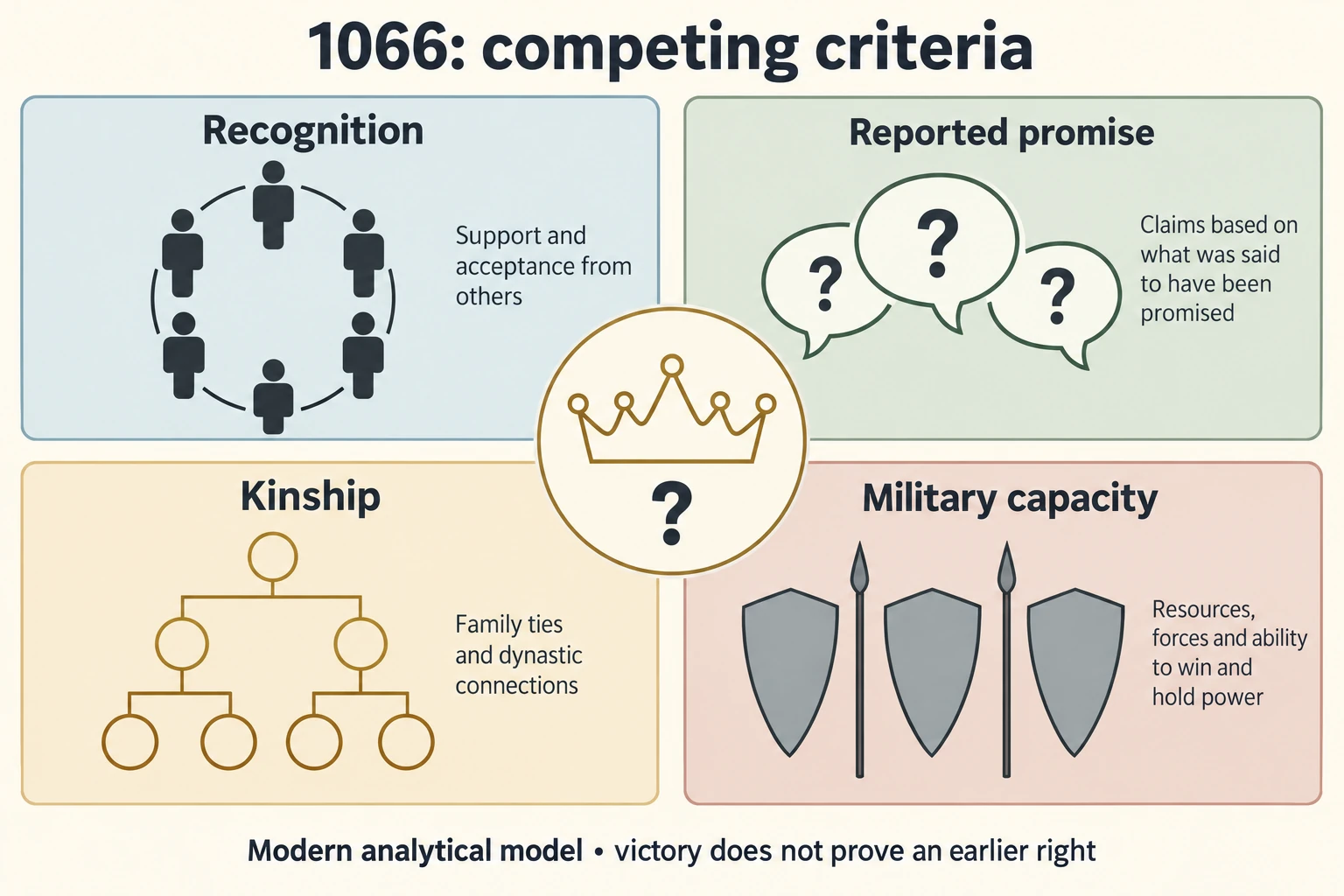
Original built-in imagegen teaching model; author inspected 2026-10-04. Not documentary evidence. Prepared immutable candidate WebP and 160/640 variants. · Isolated pending review only. Publication rights and integration acceptance remain for root review; no third-party source graphic copied.
1066: competing claims and the problem of legitimacy
Succession is the transfer of an office, here kingship, after the previous holder's death. Legitimacy is recognition that a person's authority is rightful; power is the capacity to make decisions effective. These are related but distinct. A claimant can possess a persuasive story about a promise or inheritance yet lack the forces to secure it. Conversely, victory can establish control without convincing every observer that the victor's earlier claim was just. Do not treat the later outcome as proof of an earlier right.
Edward the Confessor's death opened a contested succession. Harold Godwinson became king; William of Normandy challenged his position. Accounts of promises and oaths need close criticism because the stakes of telling the story were high. Ask when a narrative was produced, whose position it made reasonable, and whether its details can be independently established. An author who supports William is not automatically false, but an argument vindicating conquest requires more scrutiny than a neutral list of dates.
Claims were not tested by a single modern electoral or succession rule accepted by all parties. Kinship, designation, elite support, sacred sanction and military capacity could all be invoked. Treating legitimacy as simply 'the oldest son inherits' imports a simplified rule into a situation that did not fit it. Specify which criterion a claim uses before comparing it with a rival. The normative question of rightful rule differs from the factual question of who secured recognition and coercive capacity.
The Hastings reconstruction should not be used to decide which claimant had the stronger legal claim. It illustrates tactical relations after rival claims had become an armed contest. This distinction joins narrative to argument: death created an opening, rival claims supplied reasons for mobilisation, and fighting altered what each party could enforce. That chain explains escalation without making war inevitable or morally justified. It also keeps ordinary people visible as those affected by struggles they did not necessarily choose.
The new plate separates criteria rather than ranking claimants. Anonymous figures symbolise recognition, question-mark speech bubbles signal a contested reported promise, branches stand for kinship and plain shields stand for enforceable capacity. These are analytical categories, not documentary proof of particular events or a complete list of all 1066 claimants. A promise narrative needs its date, transmission and access to information assessed before it supports an argument. Even a securely reported promise would still require explanation of why contemporaries treated it as binding and how that standard related to other claims. A later victory cannot supply that missing authentication.
Constructed interpretation A prioritises recognition at the succession; B prioritises a reported earlier designation. Their scope is the reasoning used to justify kingship, not a comprehensive account of all campaigning. They may disagree because they assign different weight to standards as well as because they accept different evidence. To compare them, first ask whether each alleged event is supported, then whether the argument from event to entitlement is persuasive in its historical context. Modern democratic consent is not interchangeable with elite recognition. Normative preference for broader participation can be stated, but it does not establish the rules that historical actors actually accepted.
A source defending a claimant's right can reveal political mobilisation even where its disputed narrative remains unverified. Its choice to emphasise an oath suggests that the author expected oath language to persuade the intended audience. That is a claim about representation, not proof of what happened at the alleged ceremony. Compare accounts with different purposes and trace dependence before treating agreement as corroboration. Where the evidence remains contested, the strongest argument may explain why the claim was useful rather than pretending to settle every detail. Distinguish a justification offered by supporters from acceptance by opponents or ordinary inhabitants.
Demanding transfer, constructed: a narrative written after a successful conquest reports a promise; a record nearer the succession shows elite support for the rival. Decide whether these sources necessarily contradict. Model answer: not necessarily. They may report different acts at different times and support different criteria. The later account's incentive to vindicate conquest requires scrutiny, while proximity alone does not make the other record exhaustive or representative. Establish authorship, dates, information and meaning before judging the promise or recognition. A cautious conclusion is that the sources can reveal competing justifications without proving a universally accepted right. Military success answers who could impose rule, not which prior claim all parties should have accepted.
Worked example: Original argument exercise: Claim A says elite acceptance made Harold legitimate; Claim B says a prior promise made William legitimate. Can victory decide between these criteria?
Identify different standards: recognition at succession versus an alleged earlier designation.
Assess evidence for each standard separately. An alleged promise requires attribution and corroboration; elite acceptance requires evidence of who participated and what it meant.
Victory establishes military success, not that either criterion was universally accepted. Separate explanation of success from evaluation of right.
Additional original evaluated transfer model (4, part 1/4): The later narrative of a promise and the nearer record of support for a rival need not contradict each other. The relevant criterion is whether they assert incompatible facts about the same act, time and meaning. A promise could have been reported as a basis for one claimant's right while elites later supported another claimant under a different criterion. The two sources may therefore reveal competing justifications rather than a single claim that one account must disprove. That possibility should be investigated without treating either narrative as an authenticated constitutional rule merely because it survives.
Additional original evaluated transfer model (4, part 2/4): The victorious claimant's later account deserves scrutiny because a narrative of earlier entitlement could make conquest appear justified. Its distance from the succession may permit hindsight or selective presentation. Nevertheless, an interest in legitimising victory does not prove that every reported event was invented. The writer could preserve information from participants or earlier records. Establishing composition date, access, transmission and the wording of the alleged promise is therefore more useful than automatically rejecting the source as biased. Its value includes evidence of how rightful rule was represented, even where the promise itself remains uncertain.
Additional original evaluated transfer model (4, part 3/4): The nearer record has a different advantage: it may be closer to the moment when recognition was given to the rival. Proximity can reduce some opportunities for later reconstruction, but it does not ensure complete knowledge or representative coverage. Elite support may concern the people recorded rather than every political community. We would also need to establish whether the account describes recognition accurately and what authority that recognition was understood to carry. Kinship, promises, recognition and military capacity answer related but distinct questions; they cannot be collapsed into a single uncontested ranking without historical support.
Additional original evaluated transfer model (4, part 4/4): My conclusion is that the evidence can demonstrate the existence of competing claims more securely than a universally accepted right. A contradiction would arise only if the accounts actually deny the same event or assign mutually exclusive meanings to it. Additional evidence should test those precise points, not merely reward whichever source supports the eventual winner. Military success helps explain who could impose authority, while legitimacy concerns claims about who should rule. Keeping that distinction prevents the result of conquest from being used retrospectively to authenticate every earlier justification. The judgement remains bounded by the constructed records rather than claiming to settle all disputes about 1066.
Answer: The claims differ in their criteria as well as their conclusions. William's victory cannot independently authenticate a prior promise. A sound judgement explains the contested standards and the limits of evidence rather than reading legal certainty backwards from conquest.
Check your understanding: 1 Define legitimacy and power. 2 Why is a victorious claimant's account potentially valuable and limited? 3 Transfer: if a chronicler reports an oath, what must be established before using it to prove rightful kingship?
Answer: Legitimacy concerns accepted right; power concerns effective capacity. A victor's account reveals a justification and may preserve facts, but has an incentive to present victory as deserved. Establish the text's date, access to information, transmission, the oath's circumstances and the significance attributed to it. Even an authentic oath does not alone settle every competing succession criterion.
Why: The answer rejects both uncritical acceptance and automatic dismissal. It corrects the misconception that a single dramatic story or battlefield result resolves a contested constitutional question. The criterion is explicit, so disagreement can be analysed rather than reduced to personal preference.