Hastings: how terrain and tactics interacted
By UK GCSE History · independent study · myAudience
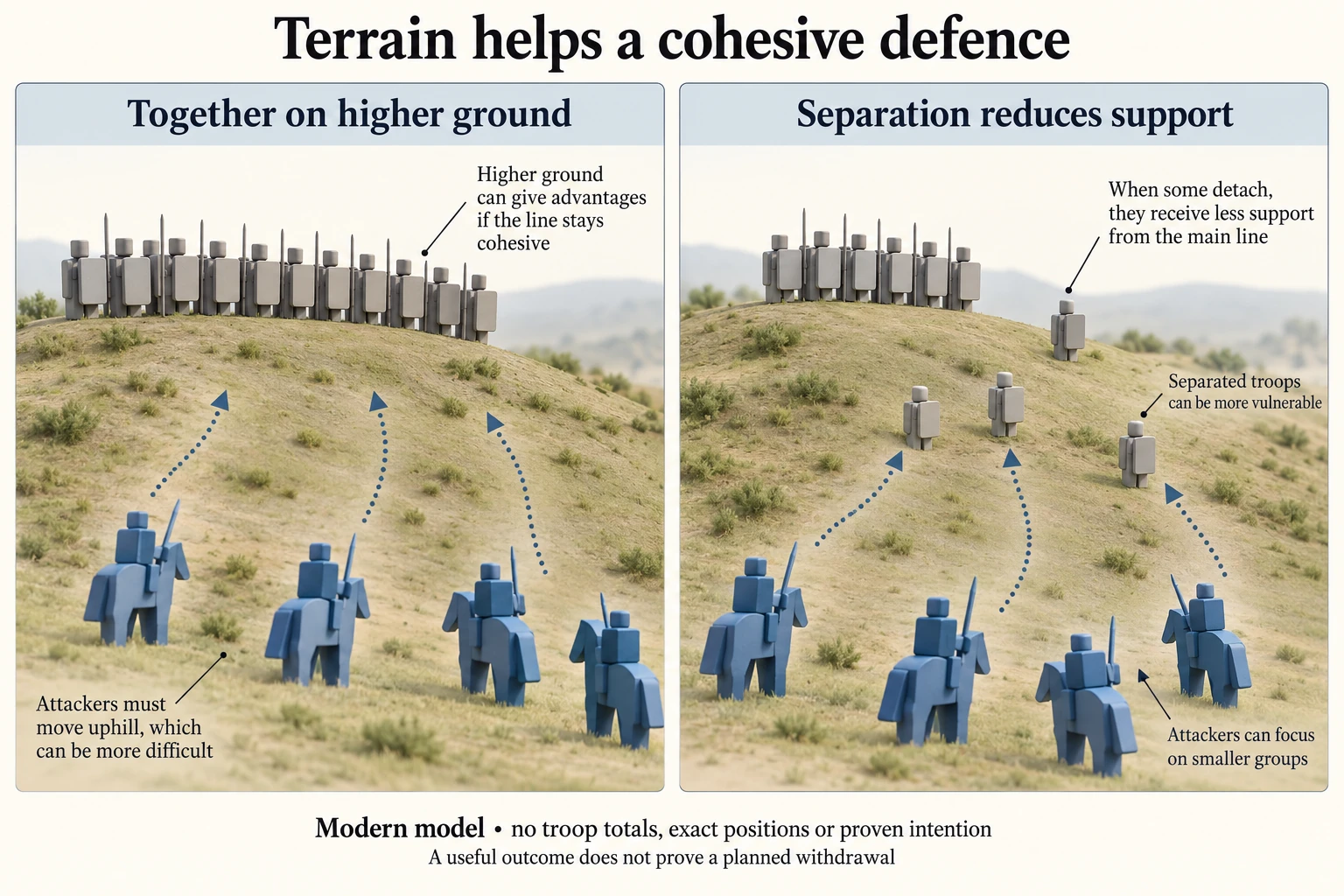
Original built-in imagegen teaching model; author inspected 2026-10-04. Not documentary evidence. Prepared immutable candidate WebP and 160/640 variants. · Isolated pending review only. Publication rights and integration acceptance remain for root review; no third-party source graphic copied.
Hastings: how terrain and tactics interacted
The Battle of Hastings was fought on 14 October 1066. A shield wall is a close defensive arrangement of foot soldiers presenting shields toward an attacker. Cohesion means the formation's ability to remain together and mutually supporting. Higher ground can make an uphill attack harder, but it is not a force that guarantees victory. Terrain creates opportunities and constraints which equipment, leadership and decisions can exploit or waste. Avoid one-factor explanations such as 'horses always defeat infantry'.
The plate contrasts a cohesive line on the ridge with separated pursuers below it. Notice the relation between height, the shield line and mounted attackers. In the second panel, a break in cohesion leaves foot soldiers away from their neighbours. The plate is not a map or an eyewitness record; the chosen number of soldiers, banners and exact arrangement are illustrative. It explains why pursuit could increase vulnerability, not how many soldiers pursued or precisely where each stood.
English Heritage's account places Harold's army on the ridge and describes a shield wall, while discussing differing accounts of details. A tactical explanation can distinguish a well-supported defensive position from disputed sequences of retreat, pursuit and later assault. A retreat may be deliberate or a response to failure; an outcome useful to an attacker does not prove it was intended. Make that distinction before attributing every successful movement to a commander's plan.
An analytical account links stages through changing conditions. An attack meets a cohesive line; a withdrawal or apparent withdrawal presents an opportunity; pursuit can separate defenders; later attacks exploit weaker cohesion. This is a plausible mechanism supported by contextual reasoning, whose exact application requires source comparison. Do not inflate a mechanism into a complete battle narrative. Stamford Bridge and the broader campaign also belong to the requirement and remain to be taught in depth beyond this tactical lesson.
Treat the battle account's confidence as uneven. The defended ridge provides a positional explanation, while the intention behind a particular retreat and the scale of pursuit require more specific testimony. An account with access to participants may preserve valuable information yet still arrange a sequence to praise leadership. A modern synthesis can compare such accounts, but it remains a synthesis rather than another independent witness. Our generated plate is further removed: it explains a tactical possibility and cannot be counted as corroborating testimony. Distinguishing these levels allows an argument to remain firm about a mechanism while qualified about a disputed episode.
Constructed interpretation A gives terrain the greatest weight because an uphill assault faced a cohesive defence; B gives changing cohesion and tactical decisions the greatest weight because the position's advantages had to be maintained. Their scope is battlefield explanation on 14 October 1066, not the whole campaign or conquest. The ridge and formation support A's claim about initial opportunity, while reported changes in fighting would be needed for B's claim about the outcome. The interpretations are partly complementary: a condition can shape the effect of an action. Neither supports a universal rule that cavalry defeats infantry or that height guarantees success.
Explain causal weight by asking what a factor contributed at a specified stage. Higher ground can slow an assault and help a defended line, but its contribution depends on equipment, cohesion and action. Separation can reduce mutual support, but an advantage for attackers does not prove a planned feigned retreat. Keep intention and consequence distinct. To argue that a manoeuvre was deliberately repeated, seek evidence of commands or a reliable sequence, not merely its usefulness after the event. Avoid assigning every movement to one commander's plan when the evidence may also permit confusion, local decisions or an initially unsuccessful attack.
Demanding transfer, constructed: a later account praises a commander's planned withdrawal, while an earlier account describes flight and subsequent regrouping. Both report pursuit. Can their agreement settle intention? Model answer: agreement strengthens the reported pursuit only if the accounts are independent and sufficiently informed. It does not settle whether the withdrawal began as a plan. The same observable movement fits different intentions, and later success may encourage a flattering reconstruction. Compare wording, chronology and access, then distinguish the better-supported sequence from the weaker intention claim. The causal argument may still explain why pursuit weakened cohesion without declaring that the commander designed every stage.
Worked example: Original causal exercise: evaluate 'Harold lost because he gave up the higher ground'. Use the plate as a model, not as evidence.
Specify the mechanism: descending could weaken mutual support and expose foot soldiers to mounted attack.
Challenge the generalisation: it does not follow that the entire army left its position, that Harold ordered pursuit, or that one moment explains defeat.
Distinguish physical advantage from decisions. Sources must establish the scale and sequence; the diagram only clarifies why the proposed sequence matters.
Additional original evaluated transfer model (5, part 1/4): Agreement that pursuit occurred does not settle whether the withdrawal began as a deliberate plan. Intention is the disputed claim, and the same observable movement can result from different intentions. A force might flee, regroup and exploit pursuit without having designed the original retreat. Alternatively, a commander might deliberately encourage pursuit. Since both constructed accounts describe pursuit, they may strengthen that part of the sequence if independent and informed; they do not automatically corroborate the later account's explanation of the commander's mind. Observable action and inferred purpose require different evidence.
Additional original evaluated transfer model (5, part 2/4): The later praise of planning could be valuable because its author may have had access to participants or information unavailable earlier. It could also convert an advantageous result into a story of foresight, especially when writing after success. The earlier account's description of flight might preserve contemporary uncertainty, but earlier composition alone does not prove superior access. Its author could misunderstand regrouping or favour a particular side. The proper comparison examines wording, provenance, composition and information, rather than assigning fixed reliability scores to early and late accounts. Neither chronology nor praise alone resolves the causal dispute.
Additional original evaluated transfer model (5, part 3/4): There remains a defensible explanation of why pursuit mattered even if intention stays uncertain. Leaving a close defensive line could reduce mutual support and expose detached defenders, particularly where the physical setting favoured a cohesive position. That is the bounded mechanism shown by the generic slope illustration, not an exact reconstruction of every movement at Hastings. Terrain created possibilities and obstacles; the actions of forces affected whether those possibilities were retained. A favourable outcome can support the importance of the resulting arrangement without proving that every stage was planned or that higher ground guaranteed success.
Additional original evaluated transfer model (5, part 4/4): My judgement would state the strongest supported sequence first and then qualify the intention claim. Pursuit and weakened cohesion may help explain a tactical consequence, while the accounts as supplied leave planned deception unresolved. More direct evidence of instructions, independently transmitted observations or a consistent sequence could change that judgement, although such evidence may not survive. Uncertainty is not a reason to abandon explanation; it is a reason to distinguish its levels. This conclusion rejects both automatic belief in a brilliant plan and automatic denial of planning, preserving a mechanism that does not depend on pretending to know every decision.
Answer: Loss of cohesion after pursuit could help explain defeat, but the statement is too sweeping about who moved and why. Terrain mattered through its interaction with formations and tactics, and not every reported episode has equal evidential certainty.
Check your understanding: 1 Why might high ground favour defence? 2 Why does a successful outcome not prove a planned feigned retreat? 3 Write a balanced judgement on 'terrain mattered more than tactics at Hastings'.
Answer: Uphill attackers face an obstacle while a close defensive line can retain mutual support. A retreat could produce an advantageous result without having been planned. Terrain gave the defenders an opportunity, but tactics and cohesion governed whether they kept it. A justified judgement therefore treats terrain as a condition and tactical decisions as mechanisms operating within it; precise claims about episodes remain subject to source criticism.
Why: The model ranks types of explanation rather than merely listing factors. It corrects 'high ground guarantees victory', 'cavalry guarantees victory' and 'outcome proves intention'. A longer judgement should test specific accounts and counterevidence; uncertainty does not require abandoning explanation.