From victory to control: why a castle was more than a weapon
By UK GCSE History · independent study · myAudience
Original built-in imagegen teaching model; neutral banners corrected and original/main/160/640 inspected2026-10-05. Not documentary evidence. New immutable pending WebP. · Isolated pending review only. Publication rights and integration acceptance remain for root review; no third-party source graphic copied.
From victory to control: why a castle was more than a weapon
Conquest is the forcible acquisition of rule; consolidation is the work of making that rule durable. A battle can remove a rival leader without supplying routine government across a kingdom. Control requires communication, resources, personnel and responses to resistance. A castle is both a fortified place and a local concentration of authority. Its military use cannot be separated neatly from its political role: a protected garrison can make demands credible while a visible stronghold signals who can enforce them.
Pevensey illustrates why location matters. English Heritage explains its connection with William's landing and its strategic relationship to a continental anchorage. A position controlling communication can receive supplies and reinforcements while denying a rival the same opportunity. These are mechanisms, not merely the statement that a castle was 'strong'. The temporary defences associated with the landing and later medieval structures must be distinguished; present stonework does not all belong to September 1066.
Castles could extend an incoming ruler's reach, but their construction and garrisons required labour, food and loyalty. They therefore depended on relationships as well as walls. A defensive site might be experienced as protection by some people and domination by others. This is an inference about possible divergent experiences, not evidence that every resident felt the same way. To test it, seek records of obligations, ownership, destruction and resistance alongside the building's fabric.
Use a two-stage causal argument: a victory opens opportunities to allocate positions and resources; local strongholds help sustain those allocations; resistance then tests their effectiveness. A castle alone cannot prove the success of every policy or account for all revolts. The Harrying of the North, government under William and William II's inheritance require additional lessons and evidence. This lesson establishes a mechanism for consolidation while keeping those assessed subtopics visibly unresolved.
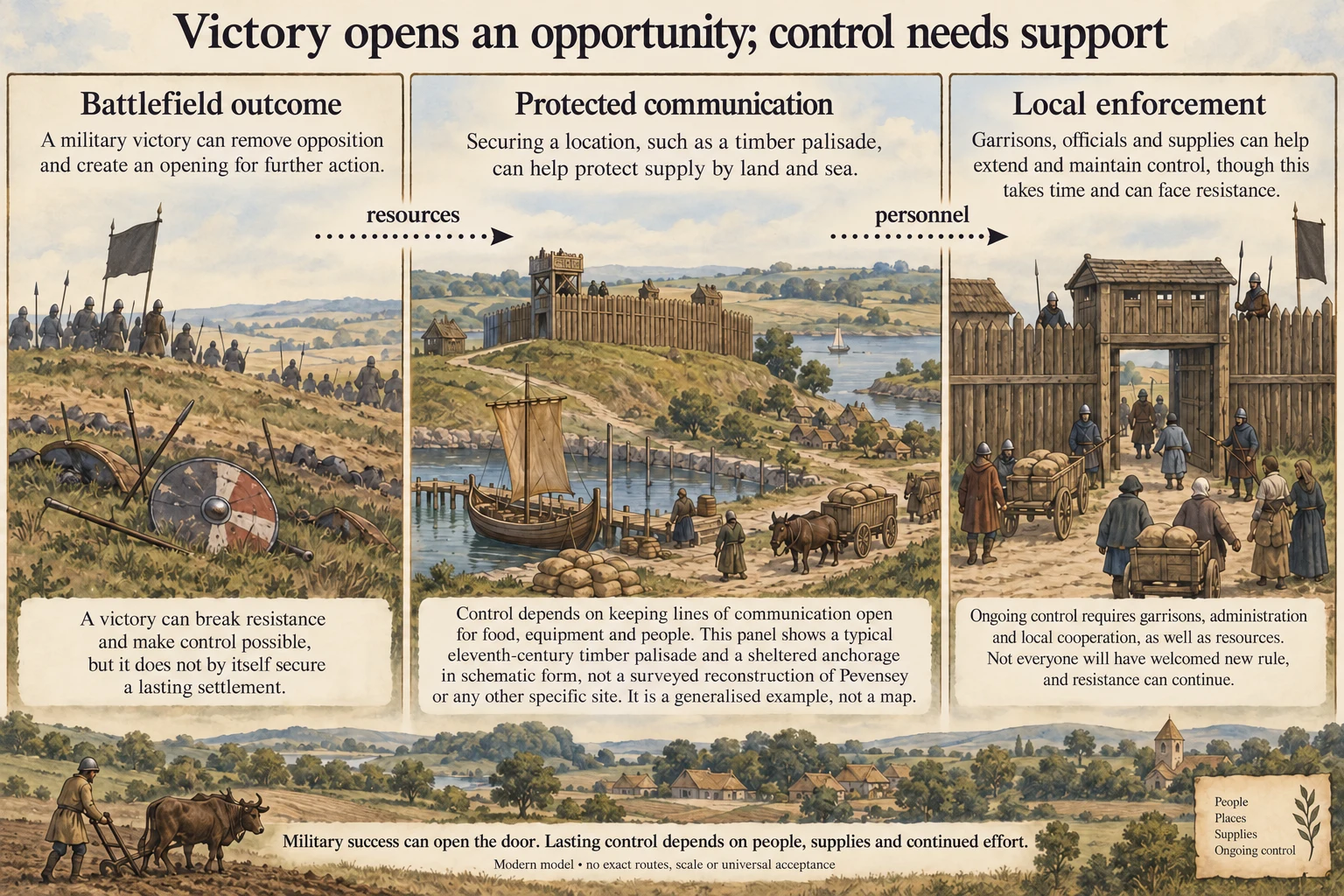
The logistics plate is a generic conceptual anchorage, not Pevensey's surveyed coast or a reconstruction of its precise 1066 defences. Timber, boats and provisions illustrate how defended communication could support continuing authority. English Heritage's account distinguishes the temporary landing fortification and successive phases of development. That dating matters because later masonry cannot simply be read as the invader's original building. The site-specific source supports a strategic relationship; our illustration supplies an accessible model of that relationship. Neither supplies a measured volume of supplies or a national map of obedience.
Constructed interpretation A sees castles chiefly as instruments of coercion; B sees them as infrastructure for sustaining personnel and communication. Their scope is consolidation, especially the anchorage example, not every castle or every resident's experience. A could be tested against demands, resistance and destruction; B against access, provisioning and connections. The functions can coexist: protected personnel can deliver supplies and enforce obligations. A source praising protection may reveal the ruler's desired image rather than popular consent. Conversely, evidence of coercion does not prove that nobody obtained protection. Specify groups and circumstances rather than choosing one universal experience.
Move from location to explanation with three separate steps. Access to an anchorage permits contact; defences can protect the people controlling that contact; those people can use resources to remain and act locally. Each step depends on operation, staffing and relationships. A strong position without food or reliable personnel may fail to deliver its potential. Physical survival of a structure establishes neither uninterrupted function nor acceptance. A dated account of provisions would address operation more directly than a present photograph; records of obligations and resistance would address reception. The argument is therefore a conditional mechanism, not a claim that architecture alone created durable rule.
Demanding transfer, constructed: a ruler holds a coastal stronghold, but records show irregular deliveries and repeated local resistance. Does the stronghold demonstrate consolidation or its failure? Model answer: it demonstrates an investment and a potential strategic advantage. Irregular supply tests whether that potential was realised, while resistance shows contested reception in the documented locations. Neither establishes complete failure throughout the kingdom. Compare dates, duration, personnel and actions taken in response. A refined judgement is that control depended on maintaining the logistical relationship as well as building defences. The evidence changes the strength and geographical scope of the conclusion rather than simply adding another factor to a list.
Worked example: Constructed design problem, not a real surveyed site: choose between a castle overlooking an anchorage and one on an isolated high hill. Which better supports an invader's consolidation?
For supply and communication with overseas supporters, the anchorage site offers a specific advantage.
For local defence, a high hill may help, but isolation can obstruct supply and observation of important routes.
Define the goal and constraints before judging. The anchorage choice is conditional, not a universal rule that coastal castles are best.
Additional original evaluated transfer model (6, part 1/4): The stronghold demonstrates an attempt to consolidate authority and a potential strategic advantage, rather than either complete consolidation or complete failure. My criterion is sustained capacity to enforce decisions in specified places over time. A coastal position could protect communication and supplies, as the bounded Pevensey context illustrates, but possession does not prove that those relationships worked continuously. The constructed delivery records and reports of resistance test the operation of that potential. They should change the strength of the judgement rather than be dismissed because the ruler owned an impressive defensive site.
Additional original evaluated transfer model (6, part 2/4): Irregular deliveries are important because personnel and enforcement depend on resources. However, their meaning requires dates, expected schedules, alternative routes and information about the records' completeness. A delayed shipment might indicate local obstruction, weather, administrative problems or a recording gap. Those possibilities are not facts already established by the scenario. Evidence of responses would help distinguish a temporary disruption from a persistent inability to sustain the garrison. The argument therefore connects supply to control through a mechanism while avoiding an unsupported explanation for each missing delivery. Material infrastructure matters through its use, not merely its existence.
Additional original evaluated transfer model (6, part 3/4): Repeated local resistance challenges a claim of universal acceptance more directly than it proves general failure. Its geographical extent, duration and relationship to the stronghold need investigation. Resistance in the documented area may coexist with regular administration elsewhere, and enforcing rule is not the same as securing willing consent. The fort might enable coercion or protect officials without satisfying the population. Conversely, evidence of opposition does not show that no decisions could be implemented. Comparing actions, reception and outcomes prevents conquest, administrative capacity and legitimacy from becoming interchangeable labels for one simple national condition.
Additional original evaluated transfer model (6, part 4/4): The best conclusion is that consolidation remained contested and depended on maintaining logistical relationships as well as constructing defences. The evidence weakens an absolute claim of settled control but does not establish permanent failure throughout the kingdom. I would specify the documented period and locations, identify the capacity the stronghold supplied and explain where delivery or resistance limited it. Additional dated records of officials, collection and local responses could extend or revise that assessment. This judgement treats the building as evidence of investment and possible enforcement, not a direct measurement of consent, and turns the counterevidence into a qualified causal explanation.
Answer: If continued overseas supply is the main constraint, the anchorage site has the stronger strategic case. Its value lies in protecting a logistical relationship, not just elevation. A complete answer would also weigh construction, access and local resistance.
Check your understanding: 1 Distinguish conquest and consolidation. 2 Explain why present ruins can mislead a 1066 argument. 3 Evaluate 'castle building proves that Norman rule was accepted'.
Answer: Conquest obtains authority through force; consolidation makes it durable. Surviving structures may be later rebuilds, so dating is necessary. Castle building demonstrates investment in authority and defence, but could accompany resistance and coercion. Acceptance needs evidence of reception, not merely the means of enforcement. Compare groups and periods rather than assuming a single national response.
Why: The answer links physical evidence to its proper claim and rejects an unsupported claim about attitudes. It corrects 'one victory equals complete control' and 'all medieval ruins date to conquest'. A reasoned account must explain how a site could work and what it cannot reveal.