Extended judgement: did Hastings itself establish Norman rule?
By UK GCSE History · independent study · myAudience
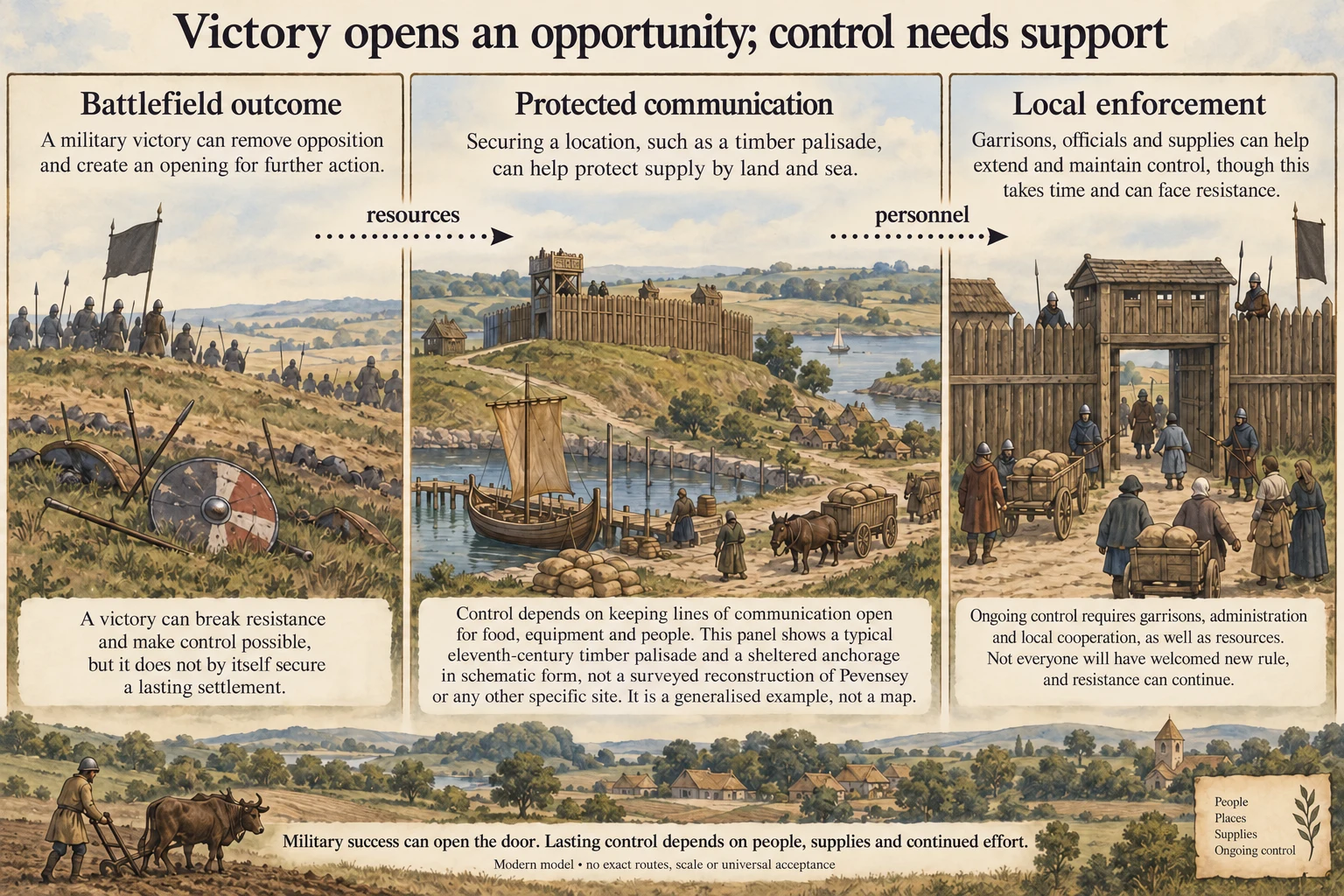
Original built-in imagegen teaching model; neutral banners corrected and original/main/160/640 inspected2026-10-05. Not documentary evidence. New immutable pending WebP. · Isolated pending review only. Publication rights and integration acceptance remain for root review; no third-party source graphic copied.
Extended judgement: did Hastings itself establish Norman rule?
An extended historical argument sustains one enquiry through several connected claims. This lesson's original question is whether victory at Hastings itself established durable Norman rule. Define durable rule as the ability to enforce decisions beyond the battlefield over time. That criterion distinguishes a decisive opening from a sufficient cause. The model below is an original argument, not an attributed historian's interpretation or an specimen answer. Its strength depends on the evidence and limits it states.
Hastings was decisive because William defeated Harold's army in a contest over the crown. The military outcome sharply altered what rival claimants could enforce. The defended ridge helps explain why tactical success was a substantial achievement rather than a simple march into an unopposed kingdom. A cohesive shield wall could exploit higher ground, so the attackers had to overcome a position with real advantages. However, the battlefield result establishes success at one critical contest, not routine obedience in every locality. A decisive event can transform opportunities without completing all subsequent work.
The strongest counterargument to 'victory alone' is the continuing need for control. The strategic role of Pevensey provides a concrete mechanism: a defended anchorage could protect contact with the Continent and prevent its use by another invader. Supply and communication matter because authority needs personnel and resources to remain effective. A stronghold also makes a ruler's presence visible and demands enforceable. This evidence links the battlefield outcome to consolidation, instead of merely placing castles beside battles in a list. It remains a site-specific example; it cannot prove that one castle solved all resistance.
The resulting judgement is conditional but firm. Hastings was a decisive turning point in the observed sequence that produced William's conquest, yet the available evidence does not show that victory by itself was sufficient for durable rule. Its importance lay partly in enabling subsequent actions. Terrain and tactics shaped the opportunity to win; strategic positions and relationships helped turn success into continuing power. A fuller account must test revolts, royal government and changing lordship. Those omissions limit the breadth of this model, not its central distinction between obtaining and maintaining control.
Clarify the original model's phrase about necessity: Hastings was a decisive turning point in the observed sequence, not proof that no imaginable alternative could have produced Norman rule. Counterfactual necessity is a stronger claim than sequence and requires an argument about alternatives. Our bounded conclusion concerns victory's contribution and the further work needed for durable enforcement. The logistics plate therefore fits this lesson as well as conquest/control: it models how an opening could be converted into continuing capacity. It does not document the timing of every stronghold, a uniform national experience or the success of every royal policy.
Constructed interpretation A treats the defeat of Harold's army as the key explanation for William's opportunity to rule; B treats continued supply and local enforcement as key to durability. Their scope differs in time and dependent variable: obtaining an opening is not maintaining authority. To judge importance, specify which outcome the question asks about. Battle evidence supports a major change in military capacity; the anchorage example supports a mechanism for sustaining personnel. Neither alone demonstrates routine obedience throughout England. A sophisticated judgement can give victory greatest weight for the opening while giving consolidation greater explanatory weight for persistence.
An extended argument needs evidence that changes its conclusion. Begin by explaining why defeat of a major rival mattered, then show why that did not remove the need for communication and local enforcement. The counterargument refines decisive into enabling rather than merely opposing it. Present fabric at Pevensey is not a single-date snapshot of conquest; source dating must distinguish phases. The strategic relationship is relevant because resources can support a garrison's continuing presence. To test durable rule more widely, add dated evidence of government, resistance and relationships in different localities. Naming castles without explaining their operation would not establish that wider claim.
Demanding transfer, constructed: a strong military victory is followed by six months of disrupted collection in one district and regular collection in another. Write a conclusion without counting districts as if they represented the nation. Model answer: victory opened a route to authority, while the contrasting records show that administrative consolidation varied in the documented places and period. Collection is evidence for one governmental function, not all aspects of rule or consent. Check record completeness and comparability before assigning the difference to resistance. The evidence rejects immediate universal control but does not show permanent general failure. The best judgement specifies outcome, place and duration, and explains what further evidence could expand its scope.
Worked example: Improve this weak original paragraph: 'William won Hastings. He built castles. Therefore the battle established total control.'
Replace 'total control' with the explicit enquiry criterion, durable ability to enforce decisions.
Explain the link: victory altered rival capacity, while fortified positions protected communication and enforcement.
Use Pevensey as a specific example and qualify the inference: later structures and varied local circumstances must not be collapsed into one moment.
Additional original evaluated transfer model (8, part 1/4): Victory opened an opportunity to impose new authority, but the contrasting collection records show that administrative consolidation varied in the documented places during the following six months. My criterion is durable implementation of decisions beyond the battlefield. Regular collection in one district supports that particular governmental function there; disruption in another challenges a claim of immediate uniform control. Neither district is automatically representative of the nation, and counting one successful district against one disrupted district cannot produce a national success percentage. The scenario supplies contrasting cases rather than a statistically representative sample.
Additional original evaluated transfer model (8, part 2/4): The strongest case for consolidation is that regular collection required some continuing interaction between officials and the people from whom resources were obtained. It suggests more than a battlefield result alone. However, its completeness, recording practices and relationship to older arrangements need checking. Collection might continue through familiar local personnel without demonstrating every aspect of the new ruler's authority. It also cannot distinguish willing compliance from enforcement on its own. The evidence is therefore relevant to administrative capacity but does not establish universal consent, complete institutional change or the durability of all other functions of rule.
Additional original evaluated transfer model (8, part 3/4): The disrupted district provides a counterargument that should refine the judgement, not merely appear in a final list of difficulties. Interrupted collection could reflect resistance, damaged resources, personnel shortages or incomplete records. Those alternatives require dated supporting evidence before disruption is assigned to a specific cause. Comparability also matters: the two records may cover different obligations, starting conditions or intervals. Even if genuine resistance is established, six months of documented disruption cannot prove permanent failure. The distinction between obtaining authority and sustaining it remains useful precisely because the evidence shows different stages and functions developing unevenly.
Additional original evaluated transfer model (8, part 4/4): My conclusion rejects immediate universal consolidation while recognising evidence of functioning administration in one setting. The victory was an enabling turning point in the constructed sequence, not a sufficient demonstration of durable government. I would state the time interval, function and places explicitly, then seek further records of officials, resistance and collection to test wider patterns. No counterfactual about every possible alternative conquest follows from these cases. The argument becomes stronger by narrowing its claim to what can be supported, and by explaining how the opposing evidence changes that claim rather than treating any difficulty as proof that victory achieved nothing.
Answer: Victory at Hastings transformed William's ability to pursue the crown by defeating Harold's army, but durable rule needed continuing resources and local enforcement. Pevensey's anchorage illustrates how a strategic stronghold could sustain communication and deny rivals a base. The battle was therefore decisive in opening the way to conquest, while consolidation explains why the result could endure. It does not establish universal acceptance.
Check your understanding: 1 Identify the model's criterion. 2 Explain why a counterargument should change the judgement rather than be tacked on. 3 Transfer: a battle changes a ruler but tax collection remains disrupted. What conclusion follows, and what evidence is needed?
Answer: The criterion is durable enforcement beyond the battlefield. Continuing control makes victory an enabling turning point rather than a sufficient cause, so the counterargument refines the causal judgement. Disrupted collection suggests that military victory and administrative consolidation diverged. Check dated revenue, local resistance and officials' records; do not infer permanent failure or uniform disruption from one instance.
Why: The model uses evidence to change the strength of its claim. It corrects 'more factors automatically means better argument' and 'decisive means sufficient'. Counterfactual necessity should be treated cautiously: the model speaks about the actual sequence and cannot prove what every alternative history would have produced.