Weimar democracy: representation and emergency power
By UK GCSE History · independent study · myAudience
Original built-in imagegen teaching model; author inspected 2026-10-04. Not documentary evidence. Prepared immutable candidate WebP and 160/640 variants. · Isolated pending review only. Publication rights and integration acceptance remain for root review; no third-party source graphic copied.
Weimar democracy: representation and emergency power
A republic does not have a hereditary monarch as its head of state; democracy concerns participation and accountability. These terms are not interchangeable. After the imperial period ended in 1918, the Weimar Republic developed representative institutions. A constitution defines offices, procedures and rights, but its existence does not guarantee that all political actors will respect them. To explain institutional strength or weakness, distinguish the rule written down from its use under particular pressures.
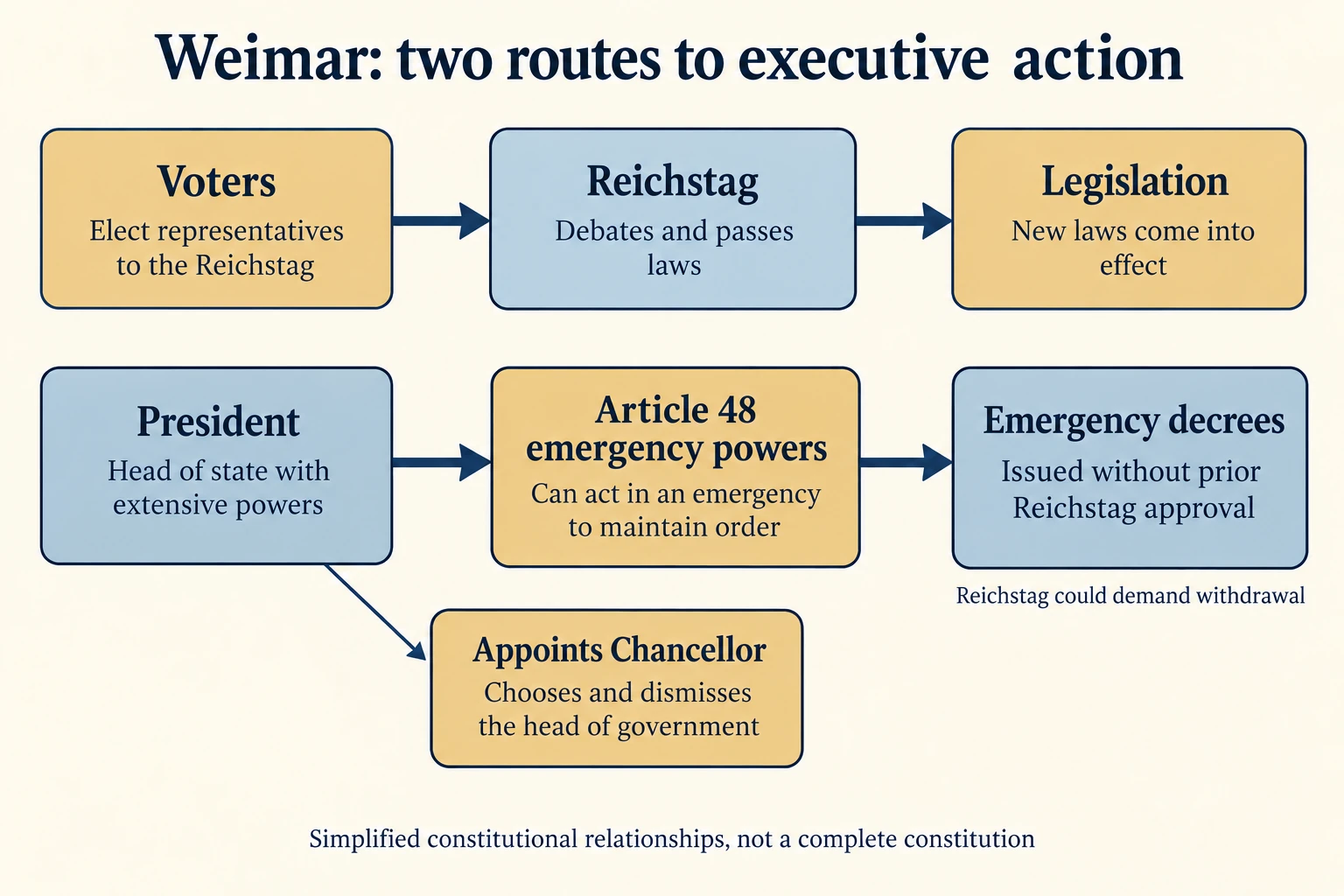
The corrected Weimar plate shows a representative route from voters through the Reichstag to legislation and an emergency route through the president and Article 48. It also shows presidential appointment of the chancellor. The diagram omits many constitutional relationships; it is an explanatory model, not the constitution itself. In particular, the Reichstag could demand withdrawal of emergency measures. The absence of prior approval did not mean that all parliamentary checks were legally absent.
Article 48 gave the president emergency powers, including powers affecting civil liberties. An emergency provision can be defended as a way to act quickly during danger, while criticised for enabling government to bypass ordinary deliberation. These are competing evaluations using criteria of speed and accountability. The historical enquiry asks when and how it was used, which actors benefited and what checks operated. It should not assume that any use was identical to permanent dictatorship.
Institutions interact with choices. A coalition is a governing arrangement between parties; disagreement can complicate decision-making, but multiple parties do not by themselves make democracy impossible. Emergency powers may be temporary responses or become a habitual alternative to obtaining parliamentary support. Explain that mechanism before judging a constitution 'doomed'. An account written after 1933 can overemphasise weaknesses because it knows the later outcome; contemporaries did not possess that hindsight.
The corrected original plate must be read with its simplifications exposed. It identifies offices and two routes, not the complete constitution. A legal power to demand withdrawal is distinct from a practical ability to build the political support needed to use that check. Conversely, a government acting without prior parliamentary approval has not thereby erased every legal safeguard. The local retained primary-document extract supports the withdrawal qualification, while the Bundestag's historical explanation supports the distinction between presidential appointment and dependence on parliamentary confidence. Their source types differ; the modern explanation is not another contemporary constitutional witness.
Constructed interpretation A regards emergency authority as a useful response to paralysis; B regards reliance on it as a threat to deliberation. Their scope is an institutional mechanism, not a defence of every actual emergency action. A uses speed and capacity as criteria; B uses participation, rights and accountability. A dated emergency and timely restoration of ordinary procedures would help test A; prolonged reliance and impaired scrutiny would help test B. The same provision can have different consequences under different conditions. Neither the existence of a check nor the existence of a bypass establishes inevitable success or collapse.
Reason from rule to practice by distinguishing permission, invocation, duration and response. The constitution's provision establishes a route that officeholders could use; a dated decree establishes that they used it on an occasion; records of parliamentary action and political support test whether accountability operated. A count of decrees without context might conceal different purposes, durations and relationships to ordinary legislation. Explanations of vulnerability should identify the interaction between powers, pressures and choices. Calling the republic doomed because one route existed substitutes hindsight for this chain. Calling it safe because one check existed makes the opposite unsupported leap.
Demanding transfer, constructed: a president authorises emergency measures, the legislature demands withdrawal and the measures end. A later occasion lacks an effective demand. Does the first demonstrate safety and the second legal absence of checks? Model answer: neither. The first shows a check operating in the constructed case, not a guarantee for all future cases. The second shows no effective use there, which may reflect political support, timing or other constraints, rather than a nonexistent legal power. Compare circumstances and duration. This model separates constitutional design from operation and cannot substitute for dated investigation of actual Weimar decisions.
Worked example: Original institutional model: a chancellor cannot secure parliamentary agreement; a president authorises emergency action. What has changed, and what conclusion would overreach?
The immediate route to action has shifted from obtaining legislative agreement to executive emergency authority.
Accountability may weaken if this becomes routine, especially where rights are suspended. The effect depends on duration, checks and political response.
Do not infer from one action that the constitution had already disappeared or that every voter supported it. The Reichstag's withdrawal power matters.
Additional original evaluated transfer model (9, part 1/4): The first constructed episode shows a constitutional check operating; the second shows that it did not operate effectively on that occasion. Neither establishes permanent institutional safety or the legal absence of checks. The distinction is between a rule's availability and its political use. Article 48 permitted emergency measures while requiring notification and allowing the Reichstag to demand their withdrawal. The broader constitutional arrangements also included responsibility through countersignature and parliamentary confidence. The simplified plate does not present every relationship. Evaluating the scenario therefore requires attention to both the legal mechanism and the circumstances in which actors used it.
Additional original evaluated transfer model (9, part 2/4): The withdrawal in the first case is meaningful evidence against a claim that emergency action was always beyond legislative challenge. A legislature exercised a power and the measures ended. Yet one successful intervention does not prove that the same result would follow under different majorities, pressures or timing. The president's emergency route could still alter ordinary deliberation, particularly if legislators tolerated its repeated use. The right conclusion recognises an operating constraint without transforming that constraint into a guarantee. Institutional vulnerability and examples of effective scrutiny can coexist, just as formal powers and political choices can coexist.
Additional original evaluated transfer model (9, part 3/4): In the second episode, the lack of an effective demand needs explanation rather than immediate reinterpretation as a missing legal rule. Legislators might support the measures, lack sufficient coordination or face other political constraints; the scenario does not identify which explanation applies. Records of debate, voting, duration and the measures themselves would help test those possibilities. The institutional history of Weimar shows that executive routes operated within changing political circumstances, not that a clause mechanically determined every later outcome. The constructed contrast is a tool for this distinction, not a substitute for dated investigation of actual decisions.
Additional original evaluated transfer model (9, part 4/4): My judgement is that design created both an emergency capacity and a potential legislative check, while practice determined whether that check constrained particular measures. The first case weakens an absolute claim of unchecked power; the second raises questions about implementation without abolishing the legal distinction. To explain later collapse, a fuller account must examine crises, political support and specific actors rather than extrapolate inevitability from one diagram. This answer avoids confusing president with chancellor and avoids treating a legal safeguard as automatically effective. Its conclusion remains bounded to the two invented episodes and the verified constitutional relationships used to analyse them.
Answer: Emergency action can reduce the need to secure ordinary parliamentary agreement. It creates a route by which accountability may be weakened, but its political consequences depend on practice. An institutional possibility is not a prediction that dictatorship must follow.
Check your understanding: 1 Distinguish a republic from democracy. 2 Which important check must be retained when reading the simplified plate? 3 Evaluate 'Article 48 made the later collapse inevitable'.
Answer: A republic describes the head-of-state arrangement; democracy describes participation and accountability. The Reichstag could demand withdrawal of emergency measures. Article 48 created a potentially dangerous route around ordinary deliberation, but inevitability ignores the actors, pressures and decisions that determined its use. A stronger explanation identifies a vulnerability interacting with crises rather than a clause mechanically producing one result.
Why: The model links institutional design with contingent practice. It corrects 'the president and chancellor were the same office', 'emergency measures had no legal check' and 'a weakness proves inevitable failure'. Later dictatorship requires additional lessons rather than inference from this diagram alone.