Crisis and recovery: real value, confidence and different experiences
By UK GCSE History · independent study · myAudience
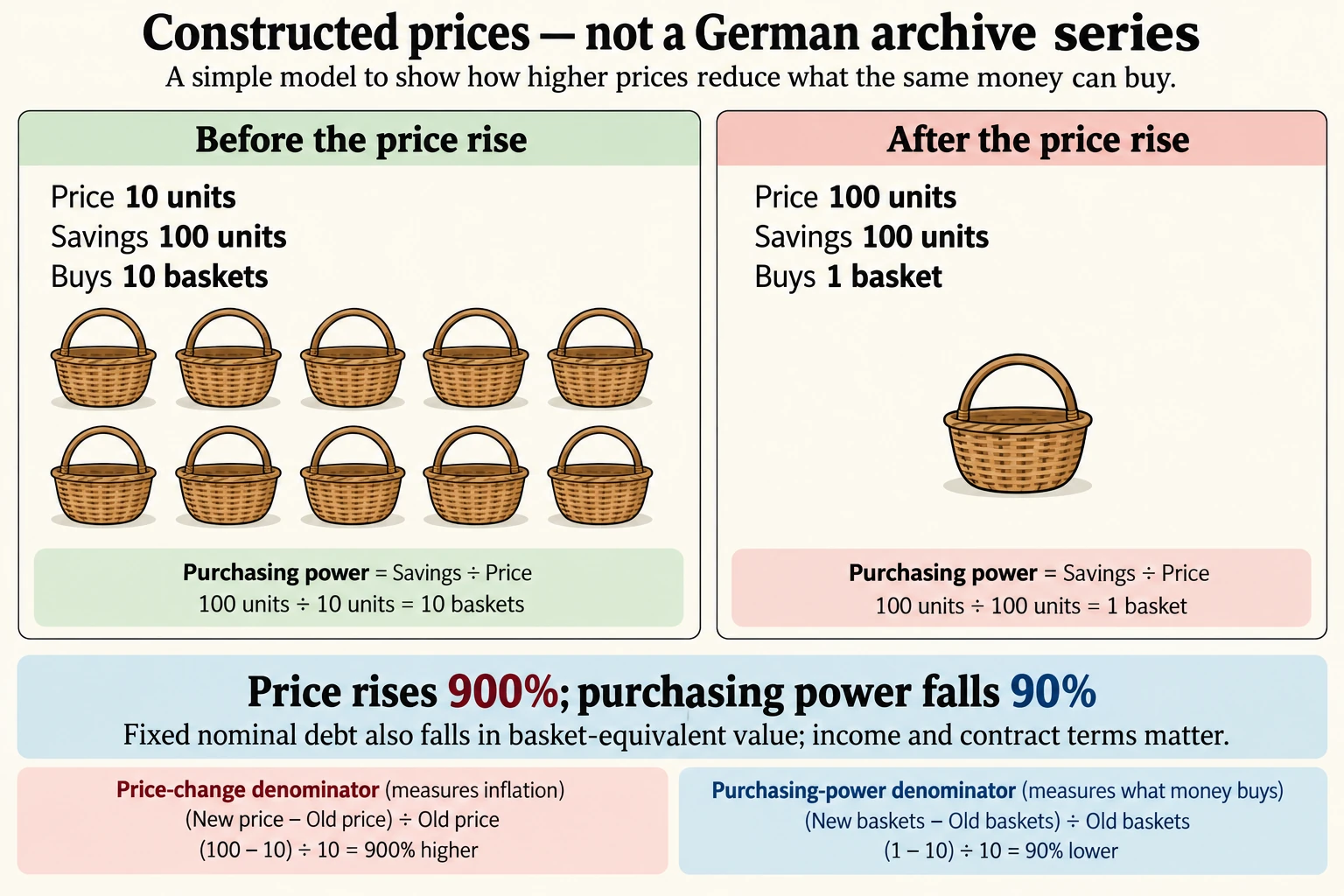
Original built-in imagegen teaching model; author inspected 2026-10-04. Not documentary evidence. Prepared immutable candidate WebP and 160/640 variants. · Isolated pending review only. Publication rights and integration acceptance remain for root review; no third-party source graphic copied.
Crisis and recovery: real value, confidence and different experiences
Inflation is an increase in the general price level; hyperinflation is an extreme and rapidly accelerating case. Nominal value is an amount expressed in money units, while real purchasing power concerns what that money buys. The Weimar years included severe economic disruption and the hyperinflation of 1923. A photograph of large bundles of notes can convey the scale of currency use, but without dates, prices and context it does not measure every person's loss.
An original numerical model clarifies uneven effects without pretending to supply historical price data. If a basket costs 10 units and fixed savings are 100 units, savings buy ten baskets. If the same basket costs 100 units, those savings buy one. A debtor owing a fixed nominal sum could face a reduced real burden, while a saver loses purchasing power. Wages, debts, assets and timing matter; 'everyone became equally poor' is an invalid generalisation.
Recovery must also be measured with a criterion and period. Stabilising money addresses one problem; stable employment, public confidence and resilience to an external shock are different tests. Policies and agreements during the Stresemann era belong to the specification, but a lesson about the meaning of recovery cannot substitute for teaching their detailed mechanisms and limits. An apparent improvement at one date does not demonstrate that the system was immune to later crisis.
Compare experiences without assuming that one remembered story represents the nation. A saver recalling loss, an employer describing activity and an artist celebrating new freedoms may each illuminate a genuine aspect. The question determines which evidence is relevant. An interpretation emphasising turbulence can coexist with evidence of cultural energy; these claims concern different dimensions. A convincing argument establishes scope before deciding whether interpretations truly contradict each other.
The purchasing-power plate reproduces only the lesson's constructed arithmetic. Ten baskets become one when fixed savings of 100 meet a price changing from 10 to 100. The labels do not report German prices, exchange rates or a dated inflation series. A nominal debt's basket equivalent also falls, but a debtor's ability to pay depends on income, indexation and contract terms. A historical account would need comparable dates and goods, not merely impressive bundles of notes. Do not confuse a model that isolates one relationship with evidence establishing all the causes or consequences of 1923.
Constructed interpretation A calls recovery substantial because stable money improves predictability; B calls recovery incomplete because employment, distribution and resilience need separate tests. Their scope is the meaning of recovery, not a complete Stresemann narrative. A could use currency evidence to support a specific improvement; B requires evidence for the dimensions it says remain unresolved. They are compatible if A claims monetary recovery rather than universal wellbeing. To make them genuinely contradictory, show that one asserts complete recovery over the same period and groups. A national average cannot itself erase uneven experience.
A memoir of lost savings can reveal reported experience and remembered meaning, but does not measure national purchasing power. Its date, the writer's holdings and selection of episodes matter. A price series can measure a basket over dates, but does not show how every household's earnings or debts changed. Combine these sources through a specific argument: price change reduced what fixed balances could buy; income adjustments and assets altered the distribution of effects. The mechanism explains why savers and debtors might differ, while evidence about actual contracts determines whether that contrast applied. Do not infer equal impoverishment from a single price movement.
Demanding transfer, constructed: the same basket changes from 20 to 80 units, savings stay at 160, and wages change from 40 to 120. Model answer: savings fall from eight to two baskets, a 75% loss of purchasing power. Wages fall from two to one and a half baskets, a 25% real reduction, despite a 200% nominal rise. Prices rise 300%, using the original price as denominator. This does not supply historical German data. It shows why rising money income can coexist with falling real income and why fixed savings need a separate calculation. To evaluate actual recovery, seek comparable goods, time periods, access and groups rather than treating one indicator as conclusive.
Worked example: Constructed prices, not a German archive series: basket price rises from 10 to 100 units; savings remain 100; a fixed debt is 100. Calculate the purchasing-power changes and explain a limitation.
Savings buy 100/10 = 10 baskets initially and 100/100 = 1 later; purchasing power falls by 90%.
The fixed debt is equivalent to ten baskets initially and one later. This models reduced real burden, assuming the debt is not indexed and income can be maintained.
Actual experiences require evidence about income changes, access to goods and contracts. The model does not prove the historical rate of inflation.
Additional original evaluated transfer model (10, part 1/4): The constructed figures show that nominal increases and real losses can occur together. The basket price rises from 20 to 80 units, so the increase is 60 divided by 20, or 300 percent. Savings remain 160 units, but purchase eight baskets initially and two afterwards: the loss is six divided by eight, or 75 percent. These calculations use different denominators because they measure different changes. They are invented teaching data, not a German price series. Their value is to test a reasoning method, not to establish how much any actual historical household lost.
Additional original evaluated transfer model (10, part 2/4): Wages rise from 40 to 120 units, a nominal increase of 80 divided by 40, or 200 percent. Yet those wages purchase two baskets initially and only one and a half afterwards. The real reduction is half a basket divided by two, or 25 percent. Thus a larger money wage does not necessarily mean improved purchasing power when prices rise faster. Savings and wages also need separate treatment: one is a stock held constant in the model, while the other is an income amount that changes. Combining them into a single percentage would erase the relationships the example is intended to explain.
Additional original evaluated transfer model (10, part 3/4): The strongest objection to drawing a general welfare conclusion is that one basket may not represent every good people needed or could obtain. Access, changing consumption, other income and contractual conditions would matter in an actual investigation. Nor does later currency stability automatically restore what earlier losses removed. Stability can improve predictability, but employment, distribution, confidence and resilience are additional criteria for recovery. Institutional accounts of Weimar's crises and political responses provide context, whereas the fictional arithmetic provides no date-specific evidence about those responses. Keeping their functions separate avoids turning a useful numerical model into a fabricated historical statistic.
Additional original evaluated transfer model (10, part 4/4): My judgement is that both purchasing-power measures worsen as the basket price rises, despite the nominal wage increase, with savings falling more sharply than wage purchasing power. The model disproves the general inference that rising money income necessarily means improvement; it does not establish complete collapse or recovery in historical Germany. A broader judgement would require comparable dated goods, household groups, employment and political evidence, with explanations of how indicators interact. The arithmetic should be shown transparently so a reader can check each denominator. The conclusion is precise about the invented calculation and deliberately limited about the historical claims it cannot support.
Answer: Savings purchasing power becomes one tenth of its original level; the fixed nominal debt's basket equivalent does too. The same price movement can disadvantage a saver and potentially benefit a debtor under the stated assumptions.
Check your understanding: 1 Define nominal and real value. 2 Does a price rise of 900% mean purchasing power falls 900%? 3 Transfer: evaluate 'a stable currency proves complete recovery'.
Answer: Nominal value counts money units; real value measures goods purchasable. The price increases by (100−10)/10 ×100 = 900%, but unchanged savings purchase 90% fewer baskets; a loss cannot exceed all their starting purchasing power here. Currency stability improves predictability but does not prove employment, equal benefits, political confidence or resilience. Complete recovery requires multiple dated criteria.
Why: This independently checkable example guards against a common percentage-denominator error. It also corrects treating one indicator as a comprehensive historical judgement. The data are explicitly constructed; no real prices, exchange rates or living standards are fabricated.