Peacemaking in 1919: aims, settlement and a fair judgement
By UK GCSE History · independent study · myAudience
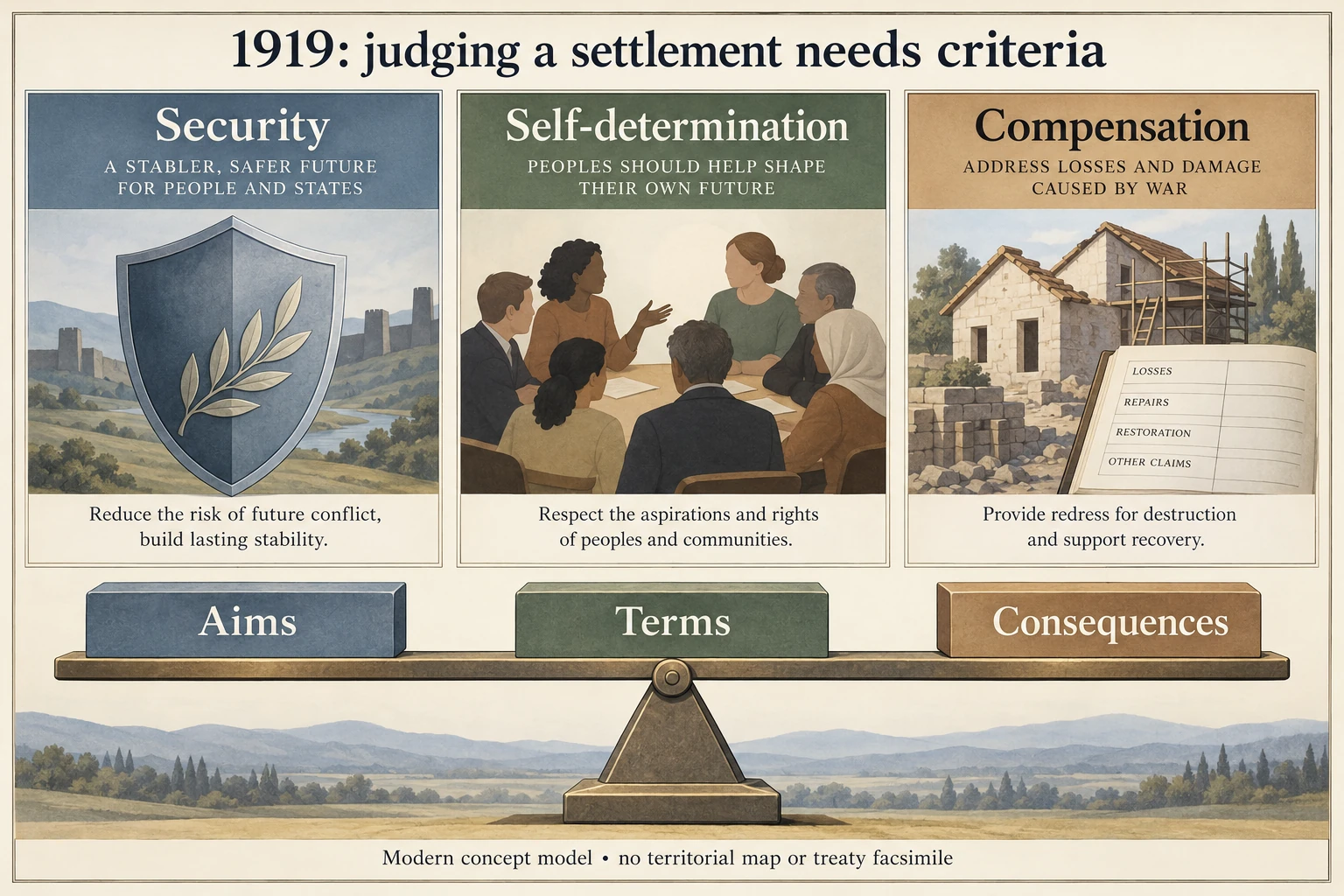
Original built-in imagegen teaching model; author inspected 2026-10-04. Not documentary evidence. Prepared immutable candidate WebP and 160/640 variants. · Isolated pending review only. Publication rights and integration acceptance remain for root review; no third-party source graphic copied.
Peacemaking in 1919: aims, settlement and a fair judgement
An armistice stops fighting; a peace treaty establishes terms for a settlement. They are different events with different purposes. The Versailles treaty was signed on 28 June 1919. The peace process involved competing aims and unequal bargaining positions. Security means reducing the risk of renewed attack; national self-determination concerns a people's claim to decide its political future; reparations are payments intended to compensate for losses. These concepts can conflict when applied to disputed territory and responsibilities.
Aims, outcomes and consequences should be separated. A peacemaker might intend lasting security, accept a compromise and then face an outcome that does not deliver the intended effect. Studying Wilson, Clemenceau and Lloyd George requires evidence about their positions and constraints; attaching a single adjective to each leader cannot explain negotiation. This initial lesson establishes how to assess a compromise. Detailed territorial terms, military restrictions and the financial settlement require further source-backed teaching and are not certified covered here.
'Was the settlement fair?' is a normative enquiry requiring a criterion. Fairness might mean compensation proportionate to loss, equal participation, consistent treatment of national claims or workable future security. These standards can lead to different judgements. 'Many Germans objected' is a claim about reaction; it does not by itself prove fairness or unfairness. Similarly, Allied approval would not settle the moral question. Reactions are evidence of reception and can help explain later political uses of grievance.
The National Archives' study-day description stresses looking beneath the public presentation to the difficult negotiating process. This is a useful direction for enquiry, not documentary proof of every participant's motive. A causal account of later conflict must also avoid assuming that an unpopular settlement automatically caused war twenty years later. Institutions, economic conditions and leaders' later choices require study. Explaining a grievance does not excuse aggression or persecution committed by those who used it.
The criteria plate deliberately supplies no territorial map. Borders need a stated date, legend and verified legal status; a conceptual fairness discussion must not manufacture them. The anonymous discussion group symbolises a self-government criterion, not delegates who participated in the 1919 negotiations. A shield represents security and repairs represent compensation, without specifying treaty terms or amounts. The beam does not declare a fair settlement. Distinguish the armistice ending fighting from the treaty signed on 28 June 1919, then distinguish negotiators' aims, agreed terms and later effects. A public declaration of an aim is evidence of its presentation, not automatic proof of private priority.
Constructed interpretation A judges a settlement principally by the protection it offers against renewed attack; B judges it principally by participation and consistency in national claims. Their scope is evaluation of a settlement, not a complete account of Versailles's terms. Security and self-determination can conflict in a constructed disputed territory. A convincing judgement must explain why it assigns a criterion priority and examine the consequences for affected groups. Popular reaction is relevant to reception and possible revisionism, but does not itself settle justice. The same term can be successful under one test and objectionable under another.
A source-to-argument chain for peacemaking begins with what a participant publicly advocated, compares that with what was agreed, and then tests implementation and response. These are different evidential steps. Negotiation records, if available and attributable, can illuminate constraints and compromise; a later memoir may defend decisions with knowledge of outcomes. An unpopular term could provide material for political mobilisation, but a causal explanation needs evidence of who used the grievance, how and under what later conditions. Do not turn a disliked settlement into a mechanically sufficient cause of war or treat explanation of grievance as justification for aggression.
Demanding transfer, constructed: a buffer zone reduces an immediate military risk but inhabitants were excluded from the decision. Later testimony praises security while a petition protests exclusion. Model answer: the sources address different effects and can both be relevant. The petition supports reported opposition by its signatories, not a census of all opinion. The testimony supports a security assessment subject to context, not proof of equal participation. Judge fairness using an explicit criterion and distinguish that verdict from a prediction of durability. A balanced answer explains the tension and the missing evidence about operation and reception; it does not invent a real Versailles border or attribute a quotation to a delegate.
Worked example: Original argumentative task: evaluate 'a settlement disliked by the defeated country cannot create lasting peace'. Use criteria and a counterargument.
Dislike can weaken acceptance and provide material for revisionist campaigns. State the mechanism rather than treating resentment as a force acting alone.
Counter that acceptance is not the only determinant: enforcement, diplomacy, economic conditions and later decisions matter.
Separate normative fairness from predicted durability. A settlement can be judged unfair yet durable, or well-intentioned yet unstable.
Additional original evaluated transfer model (12, part 1/4): The buffer zone may serve an immediate security purpose while failing a participation-based standard of self-determination. Fairness must therefore be judged against a stated criterion rather than equated with either praise or protest. The scenario is invented and supplies no actual Versailles border or delegate quotation. I would give substantial weight to the inhabitants' exclusion because the decision affects them, while also recognising that reducing a demonstrated military risk can be a legitimate objective. A reasoned judgement explains that tension rather than disguising the chosen balance between standards as a simple historical fact.
Additional original evaluated transfer model (12, part 2/4): The testimony praising security is relevant to the effect its author describes, subject to provenance and access. It does not establish that the zone protected every group equally or that excluded people consented. Likewise, the petition demonstrates reported opposition by its signatories, not a complete census of inhabitants' views. Its wording, date, circulation and representation should be investigated. These sources can both be valuable without being equally informative about every aspect of the settlement. Their different concerns may explain their disagreement more effectively than a rule that one supportive and one hostile source must cancel each other out.
Additional original evaluated transfer model (12, part 3/4): The strongest counterargument to prioritising participation is that an urgent security risk might constrain the time and arrangements available for consultation. That argument could explain the decision, but it would not automatically justify indefinite exclusion. We would need evidence of the risk, alternatives, duration and opportunities to revise the arrangement. Security outcomes should also be tested rather than assumed from the zone's stated purpose. A settlement can meet one aim incompletely and create new difficulties under another. Judging its durability requires additional evidence about operation and reception, rather than treating a fairness judgement as a prediction that future peace or conflict is inevitable.
Additional original evaluated transfer model (12, part 4/4): My conclusion is that the term has a defensible security rationale only to the extent that the reported risk reduction is supported, while its exclusion of affected inhabitants weakens its fairness under a self-government criterion. A more satisfactory arrangement would need a justified account of participation, safeguards and review, although the scenario does not prove which alternative was feasible. This is an evaluated conditional position, not a vote on which source sounds more sympathetic. It distinguishes aims, implementation and consequences, explains why the counterargument changes the strength of the verdict, and keeps the wider historical settlement enquiry open.
Answer: Dislike can make peace harder to sustain, but the absolute 'cannot' is unsupported. A durable settlement requires attention to acceptance and institutions capable of resolving disputes. Later war cannot be derived from resentment alone; the judgement needs evidence about how grievances were acted on and what alternatives remained.
Check your understanding: 1 Distinguish armistice and treaty. 2 Why do objections not settle fairness? 3 Transfer: write a judgement when one term meets a security aim but conflicts with a self-determination claim.
Answer: An armistice halts fighting; a treaty sets terms. Objections establish dissatisfaction, while fairness requires a defended criterion. The term may be effective under a security standard yet inconsistent under self-determination. A reasoned answer identifies both, explains the conflict and states which criterion carries more weight and why, without disguising that value choice as a simple fact.
Why: The model corrects 'fair means popular', 'intentions equal outcomes' and 'Versailles made later war inevitable'. It gives a reasoned structure rather than a guaranteed mark. A full settlement essay needs precise terms and wider evidence beyond this conceptual foundation.