Extended source evaluation: promise, power and historical performance
By UK GCSE History · independent study · myAudience
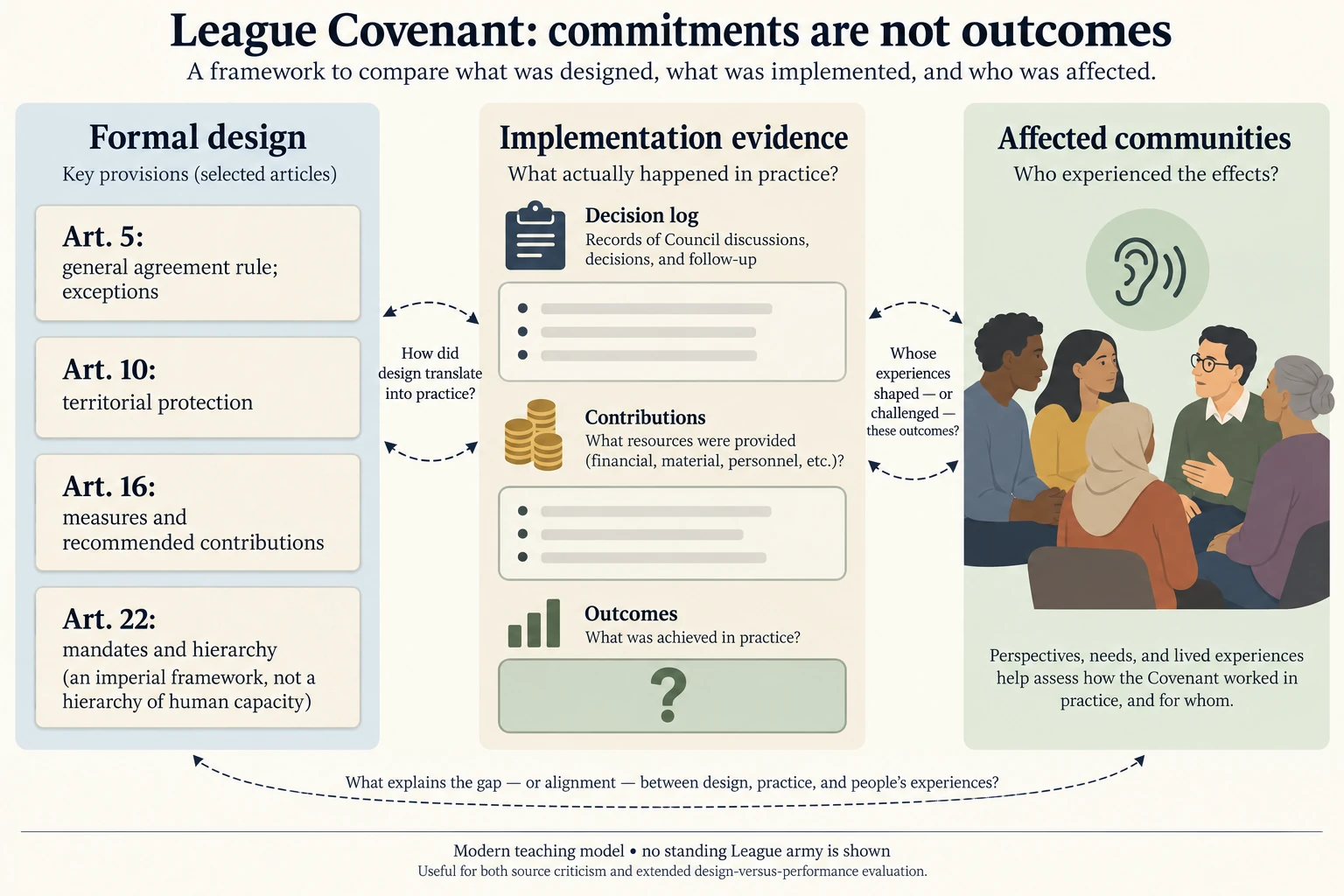
Original built-in imagegen teaching model; author inspected 2026-10-04. Not documentary evidence. Prepared immutable candidate WebP and 160/640 variants. · Isolated pending review only. Publication rights and integration acceptance remain for root review; no third-party source graphic copied.
Extended source evaluation: promise, power and historical performance
Source usefulness must be judged against a question. This original extended model asks how far the League Covenant can establish that its peace system would work. The word 'would' requests a prediction of effective performance, not merely a description of intention. A contemporary legal source has particular authority about commitments, but neither contemporaneity nor legal status supplies observations of every later crisis. An evaluation should explain this difference using the source's content, rather than reciting a generic list of provenance questions.
The Covenant is compelling evidence that the proposed system sought a common response to aggression. Article 10 defines a commitment to protect members' territory and independence, and Article 16 connects covenant-breaking war with economic measures and recommendations for armed contributions. Reading them together reveals both an aim and proposed means. This supports an inference that the system was designed to make an aggressor face costs beyond a bilateral dispute. It does not show that every government would regard those costs as credible or accept the burden of imposing them.
Article 5 complicates confidence in effortless coordination. Its general agreement requirement, with exceptions and procedural majority rules, makes the participation of represented members central to decisions. Such protection can encourage consent, but it can also make timely action difficult where interests diverge. That is an institutional inference, not proof that all decisions failed. Article 22 further reveals unequal authority in mandates. The claim to international peace coexisted with an imperial hierarchy; assuming a universally equal order would therefore misread the source even at the level of design.
Overall, the Covenant is indispensable for investigating intention and the structure against which practice can be tested. It is insufficient to establish that the system would work, because execution requires dated evidence of decisions, contributions and outcomes. Its usefulness survives this limitation: without the commitments we could not clearly identify whether governments implemented, adapted or abandoned them. A fuller judgement needs specific successes and failures, evidence from affected communities and comparison across conditions. The model therefore concludes neither that the text guarantees peace nor that later failure makes it worthless.
A sustained evaluation should compare explanatory levels rather than accumulate a checklist of origin, purpose and content. The Covenant records a design. A dated decision could show interpretation of that design. Contributions would show what governments supplied, and outcomes would show what followed. Those later records would themselves require criticism; an official decision may omit disagreement, while a reported result may reflect several causes. The shared Covenant plate fits because both this lesson and the source-criticism lesson examine the same design-to-performance relationship. Its blank analytical records and equal-dignity community symbols make no documentary or membership claim.
Constructed interpretation A argues that the framework made common resistance to covenant-breaking war possible; B argues that formal promises alone left credibility uncertain. Their scope is capacity implied by design, not a verdict on every League dispute. The common commitments support A's account of possibility, while dependence on member contributions supports B's uncertainty about delivery. A general agreement rule may encourage consent but complicate coordination; exceptions prevent a claim that unanimity was universal. A useful judgement preserves the enabling possibility and identifies the conditions under which it might operate. It cannot award the Covenant a success rate without dated cases.
Build the extended model around an explicit standard: evidence of an intended system is necessary for judging implementation, but insufficient for predicting reliable success. Explain Article 10's protective aim and Article 16's specified covenant-breaking trigger and recommended contributions, then show what remains unobserved. Add Article 5 to explain a possible coordination problem, without declaring every decision blocked. Use Article 22 to limit any claim that the international order treated all peoples as equal participants. This changes the judgement from a simple peace promise into a historically situated design with both cooperation and imperial authority. Its limits point toward evidence, not a dismissal of the source.
Demanding transfer, constructed: two disputes receive the same formal commitment, but one has coordinated contributions and a reported settlement while the other lacks contributions and continues. What conclusion can an evaluator draw? Model answer: the contrast suggests that delivery conditions matter and that design alone cannot predict identical results. Check comparability, membership, trigger, resources, other interventions and the meaning of settlement before assigning the difference to contributions. The result does not prove a universal rule that contributions always succeed. The Covenant remains useful as a baseline against which divergence can be described. A fuller judgement needs dated decisions and affected communities' evidence, not an invented list of successes and failures.
Worked example: Original review task: rewrite 'The Covenant is official, so it proves collective security succeeded' as a substantiated source evaluation.
Replace a status-based verdict with a question-specific claim about commitments.
Use Articles10 and16 for principle and means, and Article5 for the coordination issue.
Specify missing evidence of execution without declaring universal failure.
Additional original evaluated transfer model (14, part 1/4): The contrast suggests that delivery conditions mattered, but it does not prove a universal law that coordinated contributions always produce settlement. My criterion is whether formal commitments were translated into actions that contributed to the observed result. Both invented disputes received the same commitment, while their contributions and reported outcomes differed. That variation challenges an explanation in which institutional design alone predicts identical results. However, identifying a correlation between coordination and settlement is only a starting point: the scenario does not establish that contributions were the sole relevant difference or that the reported settlement endured.
Additional original evaluated transfer model (14, part 2/4): The case with coordinated contributions supports a plausible mechanism because commitments require resources and action to influence events. Article 16's distinction between specified measures and recommended national contributions helps explain why legal design cannot be equated with automatic delivery. Yet the kind, timing and adequacy of contributions matter, alongside the parties' aims and other interventions. The report of settlement also needs a definition: an announced agreement, an end to fighting and lasting compliance are different outcomes. Treating any announcement as final success would reproduce the same design-versus-performance confusion the comparison is intended to correct.
Additional original evaluated transfer model (14, part 3/4): The continuing dispute supplies a counterargument to confidence in the common commitment, but its comparability must be established. Membership, triggers, decision procedures, severity and available resources may differ even where the wording is identical. An absence of recorded contributions might indicate non-delivery or incomplete documentation; those possibilities cannot be resolved by the scenario alone. Evidence from affected communities could also challenge an institution's own account of achievement. A result described as settlement by officials may leave important grievances unresolved. Evaluating performance therefore requires both operational evidence and scrutiny of whose experience defines the claimed outcome.
Additional original evaluated transfer model (14, part 4/4): My conclusion is that the constructed contrast demonstrates why performance cannot be read directly from the Covenant, while offering a testable hypothesis about coordination rather than a proven general rule. I would use the text as a baseline, investigate dated decisions and material action, and compare consequences through clearly defined criteria. Further comparable cases could strengthen or revise the mechanism claim. The judgement recognises evidence of possible success and failure without inventing historical crises or attributing a modern exemplar to an archive. Formal intentions, institutional capacity and actual delivery remain connected but distinct parts of the explanation, with every broader assessment still open.
Answer: As an agreed framework, the Covenant is strong evidence for intended design. Articles 10 and 16 connect protection against aggression with economic measures and proposed military contributions. Yet the document records commitments rather than delivered action, and Article 5 shows that coordination depended on decision rules and participation. It cannot alone establish success. Dated crisis decisions and outcomes are required.
Check your understanding: 1 Which enquiry is the Covenant best suited to answering? 2 Why is official status insufficient? 3 Transfer: if a later record shows no sanctions in a crisis, does that disprove the Covenant's evidence of intention?
Answer: It strongly answers questions about formal design. Official status does not establish execution or full disclosure of difficulties. Absence of sanctions may show non-implementation, depending on the crisis and obligations, but does not erase the earlier commitment. Compare reasons, procedures and other actions before explaining the divergence.
Why: The answer separates intention, capacity and performance throughout a sustained argument. It corrects 'official means true about everything' and 'unfulfilled promises have no value'. No hypothetical crisis is presented as an actual historical event.