An association is not an intervention
By UK GCSE Psychology · independent study · myAudience
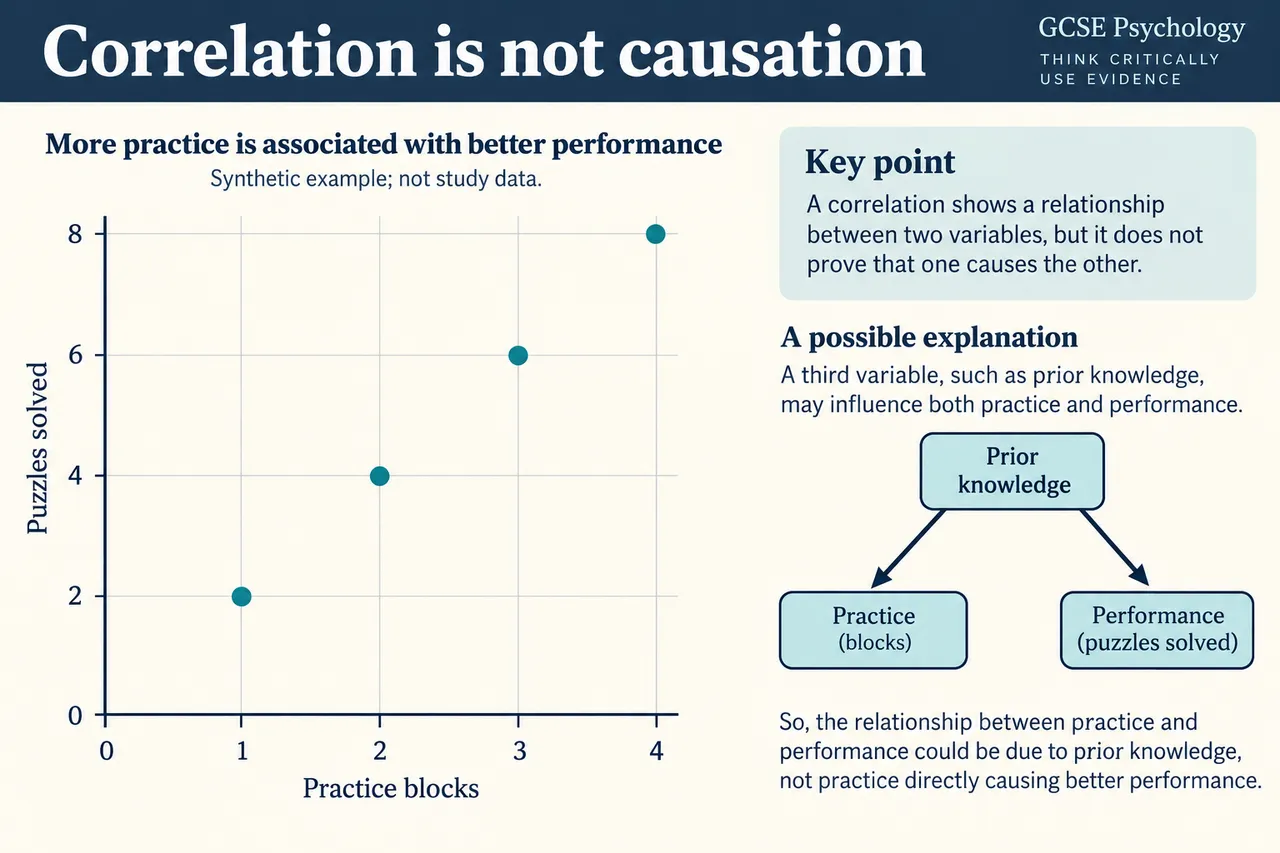
myAudience original generated educational concept illustration; fictional examples. Image: illustration, not a documentary photograph. · Original myAudience illustration; no affiliation or endorsement by an awarding body.
An association is not an intervention
A correlation describes how two measured variables vary together. It does not tell us that one was deliberately changed while other influences were held constant. That distinction matters before any graph is drawn. A researcher can record practice and performance, but recording more practice is different from assigning otherwise comparable practice conditions. The same association may support several explanations. A causal headline therefore adds a claim that the observations alone do not supply.
In a scatter diagram, each point represents a paired observation, not two unrelated scores. Put the explanatory variable named in the example on the horizontal axis and the outcome on the vertical axis, while remembering that this choice does not establish causation. A positive association rises overall; a negative association falls. No clear straight-line pattern is not necessarily no relationship: a curved pattern, restricted range or unusual observation may matter. Keep units and possible values visible.
Our four fictional pairs are one practice block with two puzzles solved, then two with four, three with six and four with eight. The points lie on a rising straight line. Moving from one to four blocks accompanies six more solved puzzles, but this is a difference between observations, not a measured effect of giving one person three additional blocks. The worked numbers are invented for interpretation. No real participant records, uncertainty estimates or significance test are supplied.
Consider prior knowledge. Someone already familiar with the puzzles might choose more practice and also solve more correctly. Prior knowledge then influences both recorded variables, creating an association without practice being the sole cause. Direction can also be reversed: early success might encourage further practice. These accounts are not demonstrated either; they are concrete alternatives that the original evidence leaves possible. A good evaluation states how each rival could generate these particular observations rather than merely reciting “correlation is not causation.”
A conceptual comparison could assign comparable practice opportunities independently of earlier success and use the same puzzles, scoring and time limit. This addresses particular selection and direction problems; it does not automatically make a selected sample representative or measure all aspects of learning. Such a design description is an exercise in reasoning, not permission to recruit participants. Ethical review, voluntary informed agreement and safeguards would remain necessary for any real research. We do not collect personal results here.
The illustration separates the fictional scatterplot from a rival-cause diagram. Read the four labelled coordinate pairs, then follow the arrows from prior knowledge to practice and performance. Those arrows express a possible explanation, not a fitted causal model or an observed psychological mechanism. A neat rising pattern can coexist with poor measurement or selection. Four points cannot establish how a wider population behaves, and a visually exact line is no substitute for information about how observations were obtained.
Full evaluated model. The fictional observations show a positive association: higher numbers of practice blocks accompany more correctly solved puzzles. Specifically, the pairs run from one block and two puzzles to four blocks and eight puzzles. This supports a description of covariation within these four cases. It does not support the presenter's stronger claim that practice alone caused the difference, because practice was measured rather than independently assigned and no competing influences were controlled. Earlier knowledge is a concrete third variable: a person familiar with the puzzle rules may both choose additional practice and perform well. The opposite direction is also possible, because initial success could encourage further practice.
One conceptual comparison would allocate otherwise comparable practice opportunities independently of prior performance, use common materials and scoring, and record an outcome defined before seeing results. Comparing groups with similar initial knowledge would help address the specific rival, although measuring knowledge imperfectly could leave differences. Allocation also does not repair a sampling frame that excludes some learners. If an appropriately reviewed comparison still found a difference under those conditions, the practice account would become more credible for that task and population, rather than universally proven. The current four synthetic observations provide neither uncertainty estimates nor evidence of inferential significance. An ethical design discussion can identify the evidence needed without collecting anything from readers. The justified conclusion is a positive observed association with unresolved direction, third-variable and generalisation limits.
Worked example: Interpret the fictional pairs (1, 2),(2, 4),(3, 6),(4, 8): practice blocks and puzzles solved.
Each point is a pair; the horizontal variable is practice blocks and the vertical outcome is correctly solved puzzles.
Across these four cases both variables increase together: a positive association.
The endpoints differ by 3 blocks and 6 puzzles, but neither difference is an assigned intervention effect.
Prior knowledge and reverse direction remain possible; no uncertainty estimates or inferential test are supplied.
Answer: A positive fictional association is present; the cause remains unresolved.
Check your understanding: Four fictional observations pair practice blocks1,2,3,4 with correctly solved puzzles2,4,6,8. A headline claims practice alone caused the difference. Describe the pattern, explain prior knowledge as a third variable and reverse direction, and state what ethically reviewed comparison could distinguish them.
Answer: The last two teaching paragraphs provide the full evaluated original model response; the worked example supplies the exact numerical/classification steps.
Why: Exact positive association across these four observations Prior knowledge can influence both variables; reverse choice mechanism possible Random allocation to otherwise comparable practice conditions would address direction/confounding, not sampling validity automatically No significance/causal/population conclusion from n4