Processes and kinds of memory are different questions
By UK GCSE Psychology · independent study · myAudience
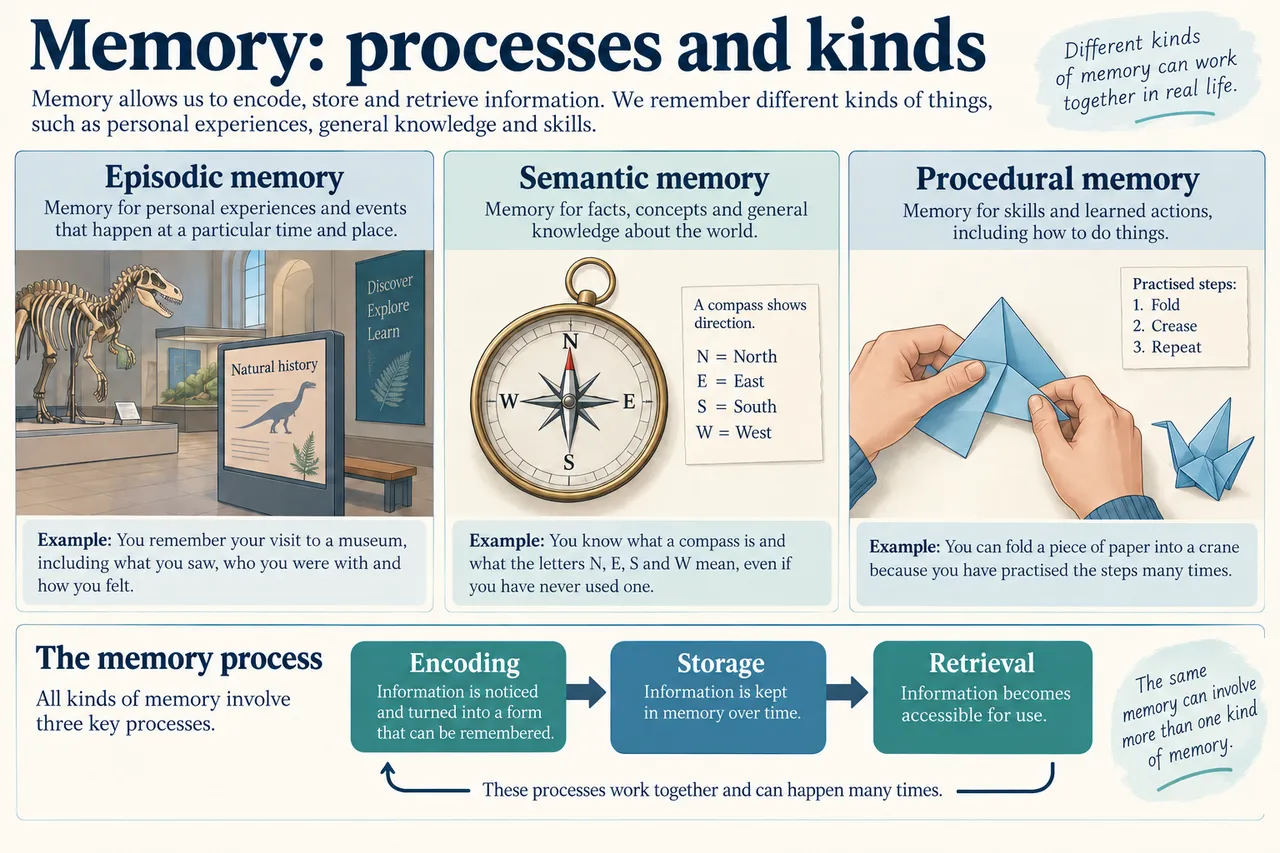
myAudience original generated educational concept illustration; fictional examples. Image: illustration, not a documentary photograph. · Original myAudience illustration; no affiliation or endorsement by an awarding body.
Processes and kinds of memory are different questions
Memory processes and kinds of memory answer different questions. Encoding concerns how information becomes represented; storage concerns its retention; retrieval concerns gaining access when a task calls for it. Episodic, semantic and procedural memory instead distinguish what a memory task involves: an event, meaning or knowledge, and an acquired way of acting. Calling these “kinds” does not make them isolated anatomical containers. One everyday activity can draw on several kinds and processes together.
Imagine an entirely fictional visit to a museum. A guide notices an information board, later retains something about the room, and subsequently tries to recall its name. Attention and interpretation during the visit affect what can be encoded. Retention is not directly visible just because time passes. A later response supplies evidence about access under those conditions, not a transparent view of everything stored. The input–retention–access distinction is useful precisely because one observed response can have multiple explanations.
Remembering that particular visit is episodic because it concerns a situated event. Knowing what a compass means is semantic because it concerns knowledge rather than the remembered occasion on which it was learned. Carrying out a well-practised paper-folding routine can involve procedural memory. Nevertheless, a person folding paper may also verbally describe instructions or recall a previous attempt. The classification depends on what the task requires, not simply whether its illustration shows a place, a word or a pair of hands.
Failure to freely recall the room name could reflect weak initial encoding, interference, an unsuitable cue or difficulty producing the required word. A single failure cannot locate the problem by itself. If the guide later recognises the name among alternatives, some information is accessible under a changed task, but recognition can also involve familiarity or guessing. Stronger evidence would examine responses to plausible alternatives and whether event-specific details distinguish remembering the visit from merely recognising a familiar name.
A model should generate contrasting expectations. An account emphasising poor initial attention predicts little event-specific information even with useful cues. A retrieval account predicts that suitable cues may improve access to information that was not produced freely. These are conditional predictions, not diagnostic rules. Different task demands and response strategies can blur the contrast. No observation here measures an individual's mental health, brain damage or memory capacity. All examples are fictional and invite analysis of inference rather than assessment of the reader.
The plate shows three neutral examples alongside a separate process strip. There is deliberately no exclusive arrow from one kind to one stage: episodic information also needs encoding and retrieval, and semantic or procedural performance is not independent of learning. The diagram makes categories easier to compare without locating them in a drawn brain. Complete explanations should preserve this distinction, acknowledge overlapping tasks and identify what evidence is missing before choosing between accounts of a failed response.
Full evaluated model. Remembering the particular museum visit is an episodic task, knowing the meaning of “compass” is semantic, and carrying out a practised folding sequence involves procedural memory. These classifications concern the information or performance required. They are different from encoding, storage and retrieval, which concern processing that can contribute to each task. Folding is not exclusively procedural if the guide also recites instructions or remembers learning the sequence. Likewise, knowing a room name need not mean remembering the event in which it was learned. The relevant distinction is the task's demand, not a rigid label attached to the person.
Two plausible explanations for failed free recall are weak initial encoding because attention was elsewhere and difficulty retrieving the name without a suitable cue. Later recognition gives some support to accessible information under the changed task, but does not demonstrate that a complete, accurate event trace was retained unchanged. Familiarity with the name or guessing between alternatives could also produce a correct response. A useful conceptual comparison would examine event-specific details and performance with carefully chosen plausible alternatives, rather than treating one recognised name as decisive. Any result would still depend on scoring and task demands. The defensible conclusion is that kinds and processes must be distinguished and that one free-recall failure cannot identify which process failed. This fictional example supports neither diagnosis nor a claim about every learner's memory.
Worked example: Classify a fictional visit, knowledge of compass meaning and practised folding; interpret failure of free recall followed by recognition.
A particular visit involves episodic information.
General word or compass meaning is semantic knowledge.
Carrying out a practised sequence can involve procedural memory alongside other demands.
Encoding/storage/retrieval are processing questions, not competing names for those three kinds.
Recognition may support accessible information but familiarity or guessing prevents proof of a complete unchanged trace.
Answer: Task content and processes must be distinguished, and one failed response cannot locate the failure.
Check your understanding: A fictional guide cannot freely recall a room name, later recognises it from alternatives, knows what a compass means and carries out a practised folding routine. Classify the information/tasks, give two reasons for failed free recall, and explain what recognition supports and cannot prove.
Answer: The last two teaching paragraphs provide the full evaluated original model response; the worked example supplies the exact numerical/classification steps.
Why: Episodic event/semantic meaning/procedural sequence distinction without exclusive task boxes Weak initial encoding versus insufficient retrieval cue Recognition supports some accessible information but guessing/familiarity/source confusion remain No diagnosis or proof intact exact trace