Remembered meaning is not a literal recording
By UK GCSE Psychology · independent study · myAudience
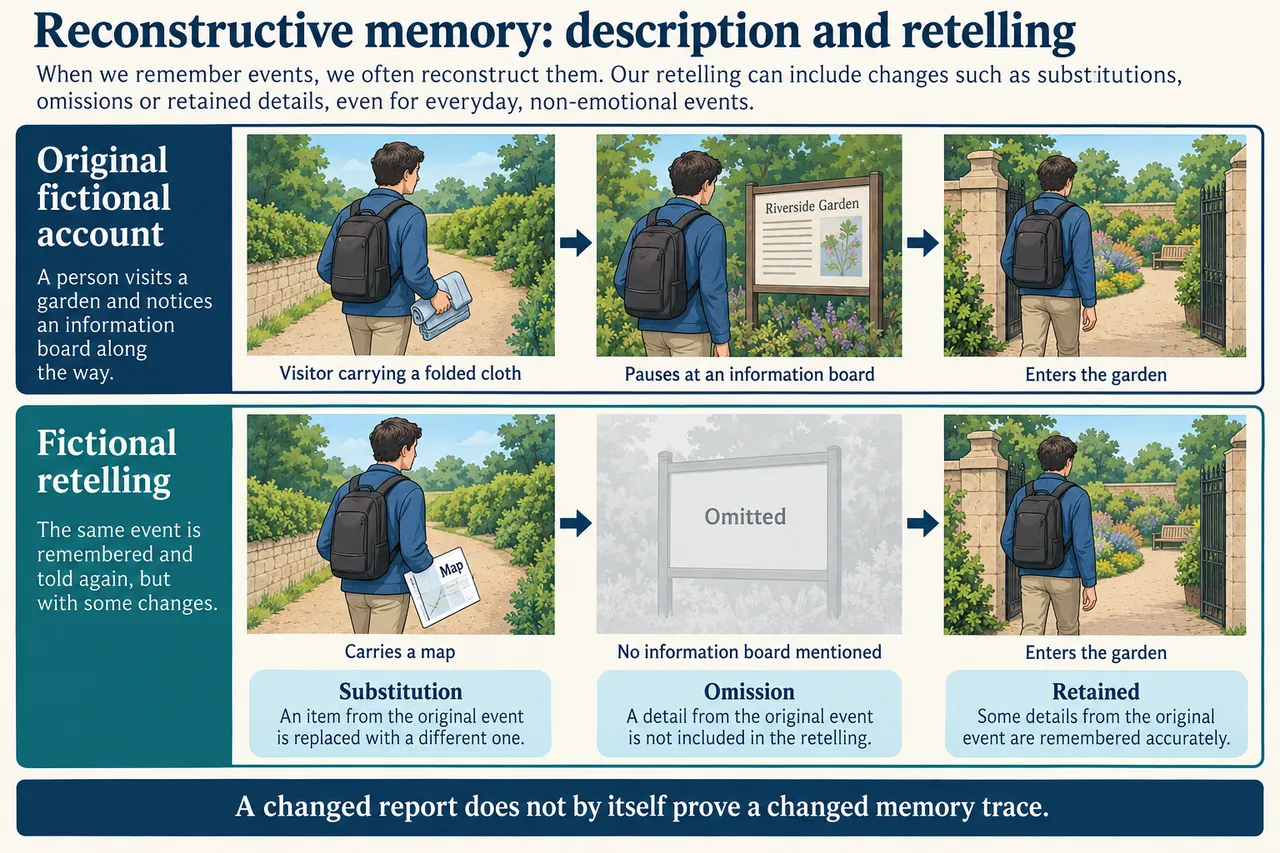
myAudience original generated educational concept illustration; fictional examples. Image: illustration, not a documentary photograph. · Original myAudience illustration; no affiliation or endorsement by an awarding body.
Remembered meaning is not a literal recording
Reconstructive remembering treats remembering as an active process rather than literal replay. Effort after meaning describes the attempt to connect material with an organised, meaningful setting. This is a theoretical account of how knowledge and interpretation can contribute to a remembered report, not a declaration that all memories are false. A changed report is evidence that the report changed; the additional claim that a stored representation was permanently rewritten needs its own support.
Use a new neutral fictional account: a visitor carried a folded cloth, paused at an information board, then entered a garden. A later fictional retelling mentions a map, omits the board and retains entering the garden. The substitution, omission and retained event are separable observations. Replacing cloth with a map might fit a familiar visitor story, but this interpretation must not be confused with a measured schema or a known psychological state. None of these reports comes from a real reader.
Prior knowledge can make an account coherent while also encouraging additions or transformations. Yet pragmatic abbreviation can explain an omission without forgotten information, and uncertainty or guessing can explain a substitution without a lasting memory change. A retelling task may encourage a concise narrative rather than exhaustive retrieval. To evaluate reconstruction, ask what the task demanded, what cues were available and whether an alternative response method changes the result. Naming a theory is not enough to exclude these rivals.
Interference concerns competing information or responses. Context can influence the cues available at retrieval. False-memory claims concern reports of material that was not part of the target event. These concepts overlap with reconstruction but are not interchangeable labels for every error. The map report may be a source error, a guess or an interpretation; the account alone cannot decide. A neutral recognition comparison could help distinguish retained but omitted information from unavailable information, while still requiring alternatives and guessing to be considered.
Bartlett's historical work is prescribed by, including War of the Ghosts. The primary meaning-chapter preview supports the theoretical effort-after-meaning discussion; it does not verify the detailed repeated-reproduction methods or participant counts. Those remain a source gate, and we do not copy the historical story. An unfamiliar cultural narrative also raises questions about task meaning, translation and the researcher's interpretation. Difference from an expected retelling must not be used to rank cultures or imply an inferior capacity to remember.
The illustration places the fictional original and retelling side by side. Its cloth-to-map substitution, board omission and retained garden are explanatory annotations, not evidence that an arrow depicts a physical change inside the brain. Different observation methods may expose different aspects of recall. A convincing account would evaluate both supporting patterns and conditions under which the proposed mechanism fails, while separating exact source findings from invented teaching material and leaving independent practical and assessed skills open.
Full evaluated model. The hypothetical retelling contains a substitution of map for folded cloth, an omission of the information board and retention of entering the garden. A reconstructive interpretation is that a familiar visitor narrative helps organise the account: a map seems plausible in that setting, so prior knowledge might influence the report. That is an explanation rather than a measured fact about this fictional person. It also does not establish that the original information was permanently replaced. The map could reflect guessing under uncertainty, while the missing board could reflect deliberate abbreviation when the task is understood as telling the gist rather than listing every event.
A conceptual comparison would clarify whether an exhaustive report was requested and examine recognition of the cloth and board against plausible alternatives. Recognition of omitted details could challenge the claim that omission demonstrates lost storage, although familiarity and guessing would still need consideration. Asking which information belonged to the original account would help examine source confusion without treating confidence as proof. Bartlett's prescribed theory offers a historical framework, but detailed study procedures and findings must be verified separately; our newly invented garden account is not his study material or data. Historical cultural and instruction differences should qualify generalisation rather than become stereotypes. The evidence therefore supports evaluating meaning-guided reconstruction alongside task interpretation and response rivals. It cannot decide between them from one retelling, certify a complete memory trace, or justify intrusive autobiographical testing. A stronger conclusion requires discriminating observations and transparent task demands.
Worked example: Compare fictional original cloth/board/garden account with map/no-board/garden retelling.
Map replaces cloth: substitution.
Board is not mentioned: omission.
Entering the garden remains: retained detail.
Meaning-guided reconstruction is one interpretation; guessing or abbreviation are concrete rivals.
A changed report alone does not demonstrate permanently rewritten storage.
Answer: The report changes in two specified ways and retains one event; its underlying mechanism is not identified.
Check your understanding: An original fictional account says a visitor carried a folded cloth, paused at an information board, then entered a garden. A retelling mentions a map, omits the board and retains entering the garden. Evaluate reconstruction versus two rival explanations, propose evidence to distinguish them and bound any comparison with Bartlett.
Answer: The last two teaching paragraphs provide the full evaluated original model response; the worked example supplies the exact numerical/classification steps.
Why: One substitution, one omission, one retained event explicitly identified Meaning-guided reconstruction vs abbreviation/guessing or weak cue retrieval Neutral recognition/source-confidence comparison concept only, no actual study Historical theory evidence with cultural/task limits; not exact autobiographical truth test