Separate sensation from interpreted depth
By UK GCSE Psychology · independent study · myAudience
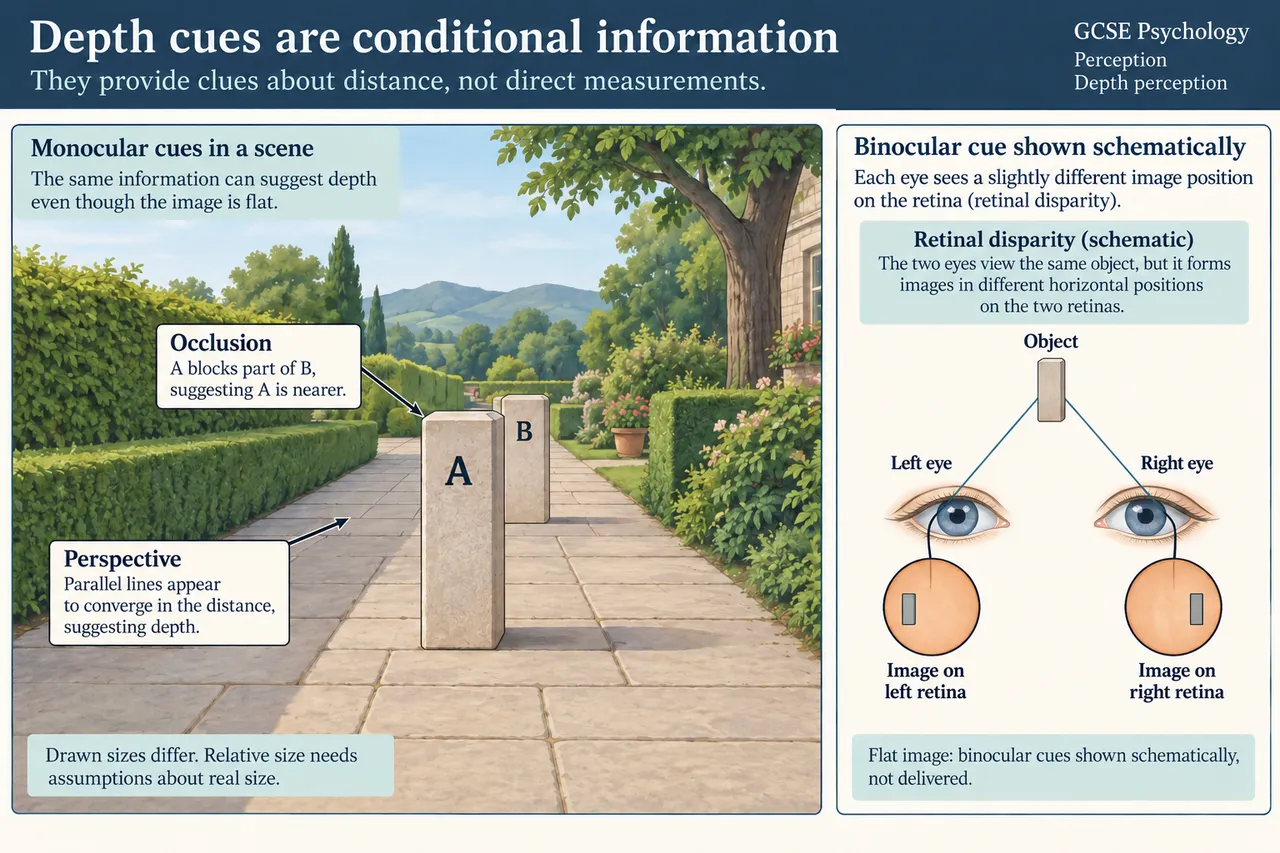
myAudience original generated educational concept illustration; fictional examples. Image: illustration, not a documentary photograph. · Original myAudience illustration; no affiliation or endorsement by an awarding body.
Separate sensation from interpreted depth
Sensation and perception are related but distinguishable: information received through sensory systems is used in interpreting objects and scenes. This distinction does not mean that sensation is an untouched photograph or that perception is arbitrary imagination. For depth, different available relationships can support an interpretation. A cue is useful under conditions, not a guarantee that an object really lies at one distance. Explaining those conditions is stronger than memorising a list of cue names.
Monocular cues can be available from one eye. Occlusion provides information when one boundary interrupts another object's visible outline. Relative size is informative if the objects have comparable real sizes; otherwise a physically small near object may look smaller than a large distant one. Height in the picture plane depends on the scene and surface relationship. Linear perspective concerns how parallel directions project towards a vanishing region. None of these rules can be detached from its assumptions and applied universally.
The illustration uses a simplified path and markers to make perspective and overlap discussable. Any assertion that two drawn objects have exactly equal displayed height must be checked in the actual pixels, not assumed because the generation prompt requested it. Equal drawn heights also do not demonstrate equal physical sizes or distances in a real scene. A labelled image can explain why information conflicts, while withholding any claim that actual observers perceived one particular depth or apparent size.
Binocular information involves both eyes. Retinal disparity concerns differences between the two eyes' images; convergence concerns their inward orientation when fixating nearer objects. A flat illustration can schematically show two eyes, an object and differing projected positions. It does not itself deliver a controlled pair of retinal images or measure the viewer's convergence. Drawing arrows towards an object is explanatory geometry, not evidence of a physiological response. Distance and other information influence how useful these cues are.
Suppose a separately stipulated diagram has A overlapping B but A's drawn height is smaller. Occlusion suggests A lies in front under an opaque-boundary interpretation, whereas relative size suggests A is farther away only if their real sizes are comparable. A may instead be a smaller object nearby. This is not an arithmetic contradiction. The assumptions differ, and the available information may not identify one scene uniquely. Evaluating a cue therefore requires giving a plausible alternative scene, not just labelling its category.
A useful explanation distinguishes the image's actual boundaries from inferred scene properties. It should also separate our illustration from the unfamiliar transfer variant, where the task stipulates a smaller A. The plate is not a vision test and supplies no measure of someone's depth perception. Further assessed work includes other combinations of cues, constancies and prescribed illusions. Independent task performance, uncertainty about physical scenes and source-based evaluation cannot be certified merely by viewing a schematic.
Full evaluated model. In the stipulated transfer diagram, A interrupts part of B's outline. Under an opaque-object interpretation this occlusion supports A being in front of B. However, A has a smaller drawn height. Relative size would suggest A is farther away only if the two objects are assumed to have similar physical heights. That assumption is not supplied, so the cues do not force contradictory truths. A physically smaller nearby object could occlude a larger object behind it while still occupying less height in the picture. A convincing answer gives this mechanism rather than declaring that one cue is simply wrong.
Both overlap and relative drawn size are monocular information: one eye can receive them from the flat image. Actual retinal disparity would require comparing the different images formed at the two eyes, while convergence concerns how the eyes orient to fixation. The two-eye diagram explains those relationships but does not measure the viewer's eyes or supply a controlled stereoscopic demonstration. A single flat illustration therefore cannot establish actual disparity or a particular convergence angle. Additional information about real object sizes, surfaces and viewing position would help distinguish plausible scenes. The answer should remain conditional because images can be ambiguous and observers were not studied here. These are original teaching examples, not diagnoses or measurements of a reader's visual ability. The defensible conclusion is that cues provide useful information through stated assumptions and must be evaluated together rather than treated as universal rules.
Worked example: In a separately stipulated transfer diagram, A occludes B but A has smaller drawn height.
Occlusion supports A in front under the stated opaque-boundary interpretation.
Relative size supports A farther away only with the added assumption of comparable real size.
A physically smaller nearby object could produce both observations.
These are monocular cues; a flat schematic does not measure retinal disparity or convergence.
Answer: The apparent conflict is conditional on assumptions, not contradictory physical facts.
Check your understanding: A diagram shows object A occluding B, but A has a smaller drawn height. Explain what each cue suggests and its assumptions, why the cues may conflict, and why a flat illustration cannot establish actual retinal disparity or viewer convergence.
Answer: The last two teaching paragraphs provide the full evaluated original model response; the worked example supplies the exact numerical/classification steps.
Why: Occluding front boundary condition; relative-size equal-real-size assumption Unfamiliar physical sizes and scene geometry rival Monocular cues available; separate two-eye schematic only explanatory No physiological/observer claim