Make a theory predict rather than merely label
By UK GCSE Psychology · independent study · myAudience
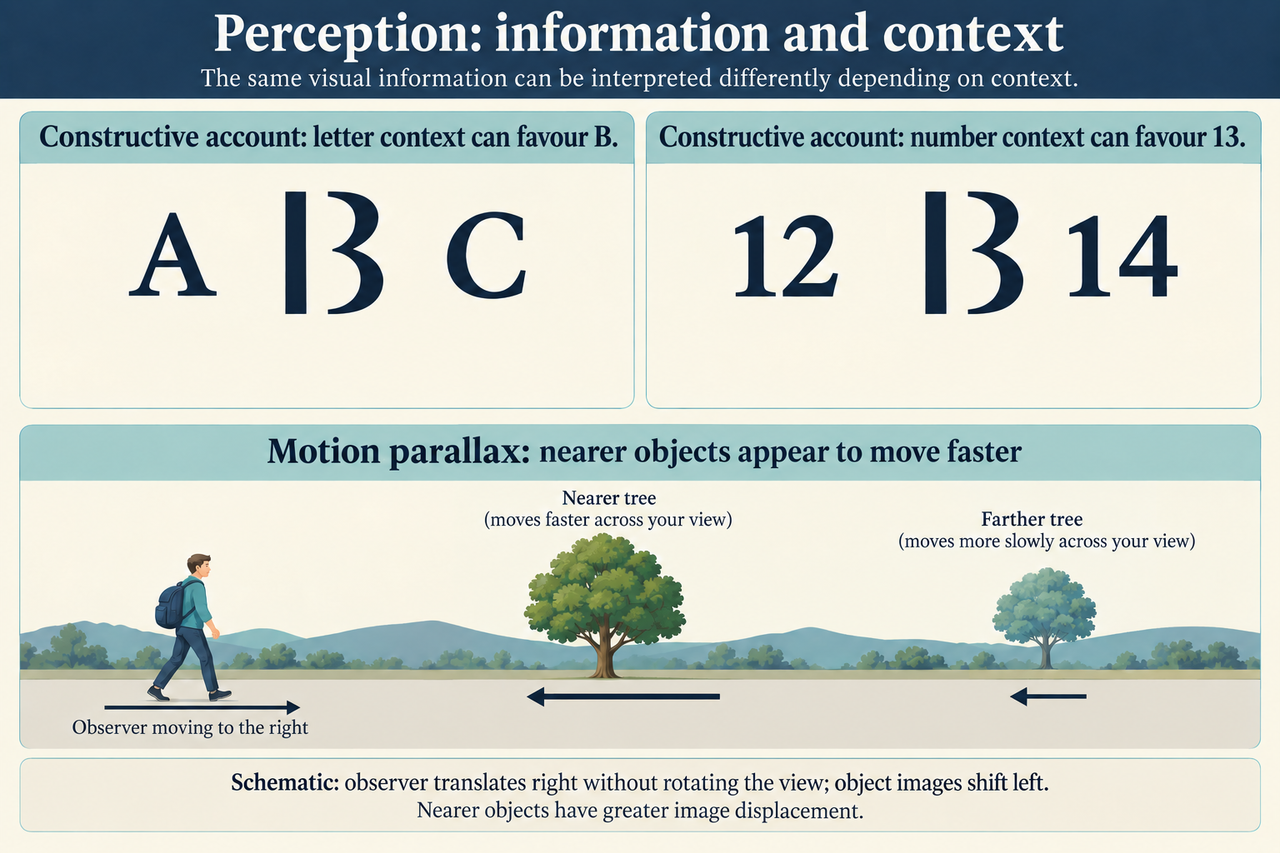
myAudience original generated educational concept illustration; fictional examples. Image: illustration, not a documentary photograph. · Original myAudience illustration; no affiliation or endorsement by an awarding body.
Make a theory predict rather than merely label
A theory of perception should explain how available information supports an interpretation and make predictions that can be challenged. contrasts Gibson's direct account, emphasising information available in the environment, with Gregory's constructive account, emphasising interpretation through cues and past experience. It is misleading to caricature either as entirely ignoring the other side. Our aim is a bounded comparison of explanatory emphasis, not a claim that every perceptual event is settled by one illustration.
Motion parallax concerns changes in the visual field as the observer moves. Under a simple sideways viewing situation, nearer and farther surfaces can move through the image at different rates. The relationship supplies information that a single static picture lacks. The plate's arrows are qualitative schematic indicators, not recorded velocities. Their meaning depends on observer movement, fixation and scene geometry. A moving optical relationship can support depth interpretation without first requiring a deliberately ambiguous symbol.
For context, our original example places an ambiguous centre glyph between letters in one panel and numbers in another. A constructive explanation predicts that prior context can influence its interpretation. This inference concerns the same central stimulus only if its actual pixels are identical; two merely similar generated symbols would confound stimulus differences with context. One genuinely generated glyph region has been copied into both panels as a documented derivative, with decoded-pixel equality checked in all three served sizes. The illustration contains no actual response frequencies or measured observer expectations.
Context-compatible responses would not demonstrate that all perception requires conscious guessing. Rich everyday scenes provide movement and other information that an impoverished static glyph omits. Conversely, a theory emphasising sufficient environmental information must explain why ambiguous conditions leave multiple interpretations possible. Competing accounts should be compared in conditions that distinguish their predictions. Simply presenting a striking illusion and announcing a universal winner substitutes persuasion for evaluation.
names Bruner and Minturn's perceptual-set study. Publisher metadata does not verify its complete method, sample or numerical findings, so those details remain a primary-source gate. Our letter/number example is an original teaching illustration rather than copied study stimuli or a replication. Attention, response framing and familiarity can influence answers as well as the proposed perceptual mechanism. These alternatives matter when designing a conceptual comparison and when deciding how far a result could generalise.
The two plate panels serve different explanatory purposes. The central glyph contrasts context while holding its verified image constant; the parallax panel introduces changing optical information. Neither depicts every aspect of Gibson's or Gregory's work. Prescribed illusions and cultural, motivational and emotional influences remain broader teaching gaps. No reader is asked to provide perceptual responses or personal information. A source-based argument should specify what evidence is needed and retain uncertainty instead of treating an appealing diagram as proof.
Full evaluated model. A constructive account predicts that the identical ambiguous central stimulus may be interpreted differently when it is surrounded by letters rather than numbers, because context and previous experience can help organise incomplete information. This is a prediction, not an observed result in our illustration. The pixel identity must actually be verified; otherwise differences in the glyph itself could explain different responses. Even a context effect would not show that all everyday perception involves the same degree of ambiguity. The letter/number task is deliberately restricted and may amplify influences that are less important when richer information is available. Response framing and attention are also rivals to a simple claim that the perceived object changed. A direct account instead emphasises sufficient information in the environment. The moving-observer schematic shows how changes associated with nearer and farther surfaces can provide depth information absent from a static glyph. It does not give measured velocities or establish an actual observer's interpretation.
A conceptual comparison would vary contextual framing while preserving the stimulus exactly, then separately vary available optical information while holding the intended scene relationship constant. Common response options, balanced presentation order and comparable exposure would address particular procedural rivals. If changing context reliably altered responses even under rich disambiguating information, that would challenge an overly strong claim that environmental information always settles interpretation independently of prior context. If interpreters correctly used new motion information despite misleading prior context, that would challenge an overly strong claim that context inevitably determines the result. These challenges concern simplified predictions, not definitive disproofs of complete theories. No comparison is conducted here, and an ethically reviewed real design would need its own safeguards and evidence. Bruner and Minturn's named study requires verified relevant primary material before procedural or numerical claims are supplied. The strongest conclusion is that context and available information should be investigated with discriminating conditions, rather than selecting a theory because its example looks persuasive. The original diagrams help formulate that reasoning but do not measure perception or complete assessed evaluation.
Worked example: Compare original identical-glyph context and moving-observer schematic.
Verify actual central pixels before attributing a contrast solely to context.
A constructive account predicts context-related interpretation; this is not an actual response result.
Motion parallax adds changing optical information unavailable from one static glyph.
Procedural response framing and attention are rivals; simplified theory predictions require discriminating conditions.
Answer: The diagrams support formulating conditional predictions, not a universal winning theory.
Check your understanding: The exact same ambiguous centre glyph appears between letters in panel1 and numbers in panel2. A second schematic shows nearer surfaces moving faster across a moving observer’s image. Compare constructive and direct accounts, explain what each example supports, and give one result that would challenge a simplified version of each.
Answer: The last two teaching paragraphs provide the full evaluated original model response; the worked example supplies the exact numerical/classification steps.
Why: Prior context interpretation prediction not assumed real response Rich motion information direct account while ambiguity incomplete Counterbalanced neutral response task as hypothetical discriminating comparison, no collection Rivals: changed attention/response framing; static cue not all-world verdict