A changed task can change what is observed
By UK GCSE Psychology · independent study · myAudience
myAudience original generated educational concept illustration; fictional examples. Image: illustration, not a documentary photograph. · Original myAudience illustration; no affiliation or endorsement by an awarding body.
A changed task can change what is observed
Conservation concerns whether a quantity remains unchanged despite a transformation in its appearance. Spreading a row changes spacing but need not change the number of objects. A developmental theory offers an account of how such reasoning becomes available; a task provides one way to observe performance. These are different levels of explanation. A response on one task is not a diagnosis, an exact developmental age or a complete description of what a learner can understand.
Piagetian assimilation concerns interpreting an experience through an existing scheme, whereas accommodation involves adapting that scheme when experience does not fit. For example, a fictional sorting rule may initially classify all round objects together, then be revised when the task requires distinguishing their functions. This is an explanatory analogy, not evidence of a measured developmental transition. Stage theory, its educational applications and the broader prescribed sequence need further teaching beyond a single conservation example.
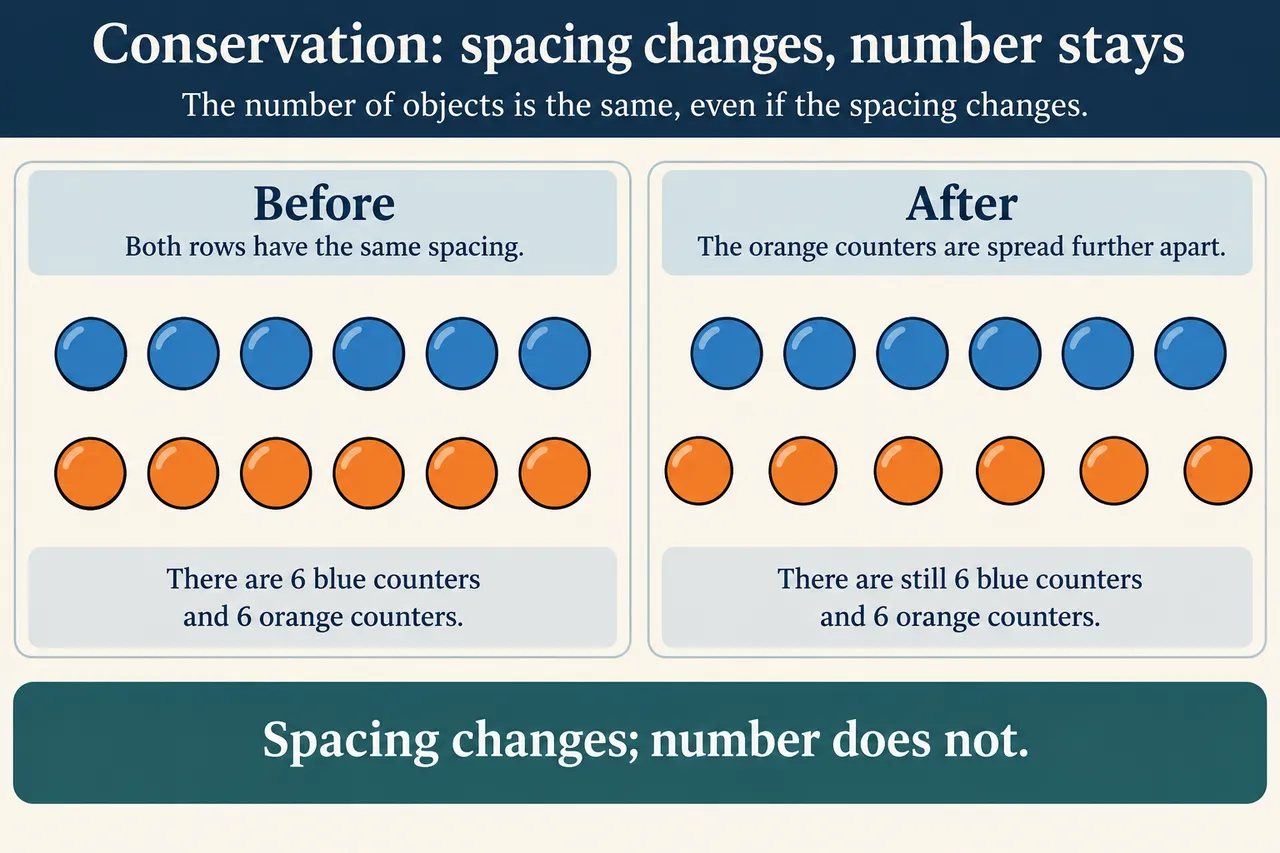
In our counter illustration, each of two rows initially contains six counters. One row is then spread out without adding or removing any. It still contains six. A longer-looking row and an unchanged number can coexist because length and number are different properties. The final count follows the stipulated preservation of objects, not the visual length of the row. Every depicted row must actually contain six counters; an unintended extra mark would undermine the example rather than merely decorate it.
A different answer after intentional versus accidental rearrangement can have several explanations. A stage-related account might emphasise the learner's difficulty coordinating length and number. A social-pragmatic account might emphasise what the adult's repeated question seems to request. Distraction or repetition of an earlier answer is another possibility. A correct response therefore deserves analysis of its reasoning and conditions, rather than automatic classification as general conceptual understanding or proof that a developmental theory is entirely false.
prescribes McGarrigle and Donaldson's naughty-teddy study and Hughes' policeman-doll study. Detailed original methods and counts remain gated by primary retrieval; metadata is not a substitute. An accessible primary abstract of Dockrell and colleagues' 1980 conservation work reports replication while examining small-number and distraction objections. Its revised procedure retained a condition difference even while overall conservation responses declined. This supports careful qualification, not a simplistic story that one changed task abolished every theoretical issue.
The plate demonstrates object invariance under changed spacing. It does not depict actual children's answers or universal age milestones. A stronger conceptual comparison would include cases where number really changes as well as cases where only spacing changes; explanations could then help distinguish tracking quantity from merely repeating a previous answer. This is a design-evaluation discussion, not an instruction to study children. The broader early-brain, four-stage, educational and independently assessed requirements remain explicitly open.
Full evaluated model. Each fictional row starts with six counters, and spreading one row without addition or removal leaves six counters in it. The appearance changes while number remains invariant. If a learner answers differently after deliberate versus accidental rearrangement, the difference does not establish that spacing changed quantity. One interpretation is that the learner's reasoning is sensitive to a stage-related difficulty coordinating number with length. Another is that the adult's deliberate action and repeated question suggest that a different answer is expected. Accidental movement could change this interpretation without demonstrating a general developmental transformation. Distraction and simple repetition of the earlier answer also remain plausible.
A useful conceptual comparison would distinguish an unchanged-number spacing transformation from a genuine addition or removal and consider the learner's explanation. Success only by repeating “six” would fail on changed-number cases, whereas tracking the objects and explaining invariance would provide different evidence. This would still be task-specific and could depend on language, attention or familiarity; no real child assessment is conducted or invited here. The accessible 1980 primary abstract reports replication while addressing methodological objections and retaining a difference between accidental and intentional conditions. That qualified evidence should not be presented as either a total disproof of stage theory or proof that one task reveals every child's competence. The prescribed original studies need their own verified primary details. A defensible answer therefore combines invariant arithmetic with rival explanations for the observed response and identifies discriminating evidence, rather than attaching a diagnostic age or universal ability label to a fictional learner.
Worked example: Two rows each contain 6 counters; one is spread without addition/removal.
Initial counts:6 and 6.
Changing spacing alone leaves number invariant:6 and 6.
Longer extent is a different property from number.
Different answers after intentional/accidental rearrangement have stage-related, pragmatic or repetition explanations.
Changed-number control and reasoned justification are conceptual discriminators, not an invitation to assess children.
Answer: The number remains 6; one task response does not diagnose developmental competence.
Check your understanding: Two fictional rows each hold6 counters. One row is spread without changing number. An invented report says a learner answers differently when the adult intentionally rearranges the row versus when a toy accidentally moves it. Explain invariance, two rival accounts of the answer difference and what evidence would discriminate understanding from response repetition.
Answer: The last two teaching paragraphs provide the full evaluated original model response; the worked example supplies the exact numerical/classification steps.
Why: 6 remains6 under spacing transformation Stage-related explanation vs social interpretation/distraction Changed-number control versus unchanged-number case, justification with hypothetical neutral task, not child study instruction Actual primary replication retains conditional task effect despite objections; no all-children inference