Useful visuals do not prove fixed learning styles
By UK GCSE Psychology · independent study · myAudience
myAudience original generated educational concept illustration; fictional examples. Image: illustration, not a documentary photograph. · Original myAudience illustration; no affiliation or endorsement by an awarding body.
Useful visuals do not prove fixed learning styles
Beliefs about whether ability can change are different from current attainment and from self-efficacy about performing a particular task. A fixed or growth belief is not a permanent child type, a diagnosis or a measure of moral worth. Dweck's prescribed mindset account offers possible motivational pathways, but a theoretical pathway must be distinguished from evidence that an intervention actually changes performance under particular conditions. No belief message guarantees achievement regardless of instruction, resources or opportunity.
Praise can focus attention on different aspects of performance, and feedback can identify a useful next strategy. Nevertheless, more effort alone may not solve a misunderstanding or compensate for inaccessible materials. A belief about improvement, extra practice and better feedback are related but separable influences. Their causal contribution cannot be identified merely because they occur together. Explain the mechanism proposed for each influence and then ask what competing explanation could produce the same outcome.
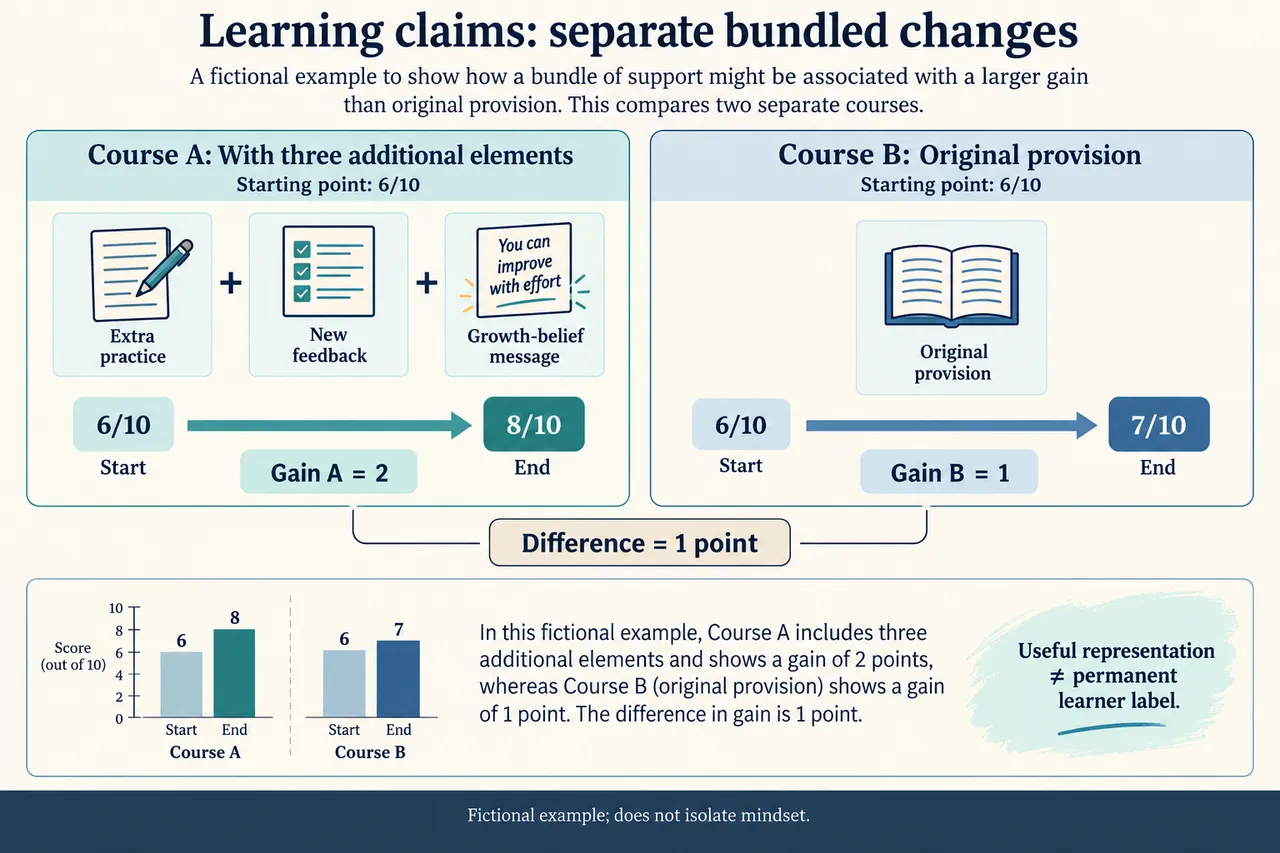
Our fictional courses both start at six out of ten. Course A ends at eight after additional practice, new feedback and a growth-belief message; B ends at seven with the original provision. A's gain is two points and B's one, giving a difference in gain of one point. These are invented summary scores, not published intervention findings. They do not isolate mindset because several conditions changed together. There are no participant numbers, distributions or uncertainty estimates supporting an inferential conclusion.
Modality preference, modality ability and benefits from matching instruction are separate questions. A diagram may make a spatial relationship clearer because it represents the subject effectively, without proving that the reader is permanently a visual learner. Willingham's accessible author explanation contrasts suitable representations of content with fixed modality-matching claims and discusses confounded comparisons. Supporting imagery and explanation can therefore be justified by what is being taught rather than by inferring a brain type from someone's preferences.
Mindset research requires similarly careful evaluation. A retrieved primary review's abstract and introduction challenge large benefit claims through study-quality and bias concerns. Another indexed primary review describes qualified benefits in targeted, higher-fidelity contexts and emphasises variation. Detailed methods and results need further relevant body reading before statistics are attributed. These different conclusions invite comparison of selection and analysis, not selective citation of whichever sounds most encouraging or dismissive. Non-significant findings are not proof that every possible effect is zero.
The plate separates A's three bundled additions from B's original provision and displays the exact fictional gains. It then pairs a useful diagram with explanation rather than assigning a permanent learner category. Both lessons are about identifying evidence, not measuring an individual's mindset or prescribing a psychological intervention. A fair educational proposal should consider access, material support and the costs of alternative provision. Remaining assessed theory, original study evaluation and independent practical performance stay open without promises of grades or diagnosis.
Full evaluated model. The stipulated scores show that course A improves from six to eight, a gain of two points, while B improves from six to seven, a gain of one. The difference in gain is therefore one point. This is a description of the fictional summaries, not evidence that the growth-belief message produced the difference. A also adds practice and changes feedback, either of which could affect learning. Previous knowledge, provision and measurement might differ as well. A fair conceptual comparison would separate the message from those other additions and keep materials, feedback, practice opportunity and scoring comparable when testing its particular contribution. Random allocation could address some selection influences, but would not automatically justify generalisation to every learner or school. Theories about belief pathways should generate predictions rather than replace evidence. Qualified or heterogeneous findings and study-quality objections require attention to relevant research methods, not a guarantee that mindset always works or a declaration that every possible effect is absent.
The permanent “visual learner” proposal makes another unsupported jump. Improvement after seeing a diagram can reflect the suitability of the representation for that concept, clearer organisation or combined explanation. It does not demonstrate that matching every future lesson to a stable visual category will outperform alternatives. The comparison needed would distinguish benefit from a particular representation from a preference-by-instruction interaction, while keeping lesson quality equivalent. Such a design is discussed conceptually only; readers are not asked to collect psychological data. A useful role for imagery is to make spatial or relational information inspectable alongside a reasoned explanation, with accessible alternatives when vision or language presents a barrier. Educational choices should also consider feedback quality, practice time and unequal access rather than blame learners for a supposed deficient belief. The justified conclusion is that both claims exceed the fictional evidence. A modest, evaluated proposal can use appropriate visual explanations and examine mechanisms without permanently labelling people, withholding other representations or promising a grade.
Worked example: Fictional courses begin 6/10; A ends 8/10 after three additions, B ends 7/10 with original provision.
A gain=8−6=2 points.
B gain=7−6=1 point.
Difference in gain=2−1=1 point.
Practice, feedback and belief message are bundled; the contrast does not isolate mindset.
An effective diagram does not establish a permanent visual-learning category or a matching advantage.
Answer: The invented difference is 1 point, with unresolved bundled influences and no guaranteed educational benefit.
Check your understanding: Two fictional courses start at6/10. A finishes8/10 after extra practice, new feedback and a growth-belief message; B finishes7/10 with original provision. A presenter attributes all improvement to mindset and permanently assigns diagram-only lessons to “visual learners.” Evaluate both claims, propose a fair conceptual comparison and explain one useful role for imagery without permanent labels.
Answer: The last two teaching paragraphs provide the full evaluated original model response; the worked example supplies the exact numerical/classification steps.
Why: 2vs1 gain/difference1 point but bundled confounding Separate beliefs, mechanisms and material support; contrast qualified/heterogeneous research findings Matching preference requires discriminating interaction evidence, not any improvement from a diagram Fair feedback/practice matched comparison, accessible multiple representations/uncertainty/no blame