Enterprise: scarcity, opportunity cost and evidence
By UK GCSE Business · independent study · myAudience
Original myAudience educational illustration. Image: illustration, not a documentary photograph. · myAudience educational illustration; no affiliation with any awarding body.
Enterprise: scarcity, opportunity cost and evidence
A business organises resources to supply goods or services. A bicycle is a tangible good; repairing it is a service. Needs are essentials while wants are preferences beyond essentials, but context matters: reliable transport can be essential to reaching work. Land means natural resources and sites, labour means human effort, capital means productive equipment rather than simply money, and enterprise means organising these resources and bearing risk. An entrepreneur might seek independence, income, flexible work or a social purpose. Independence does not mean freedom from customers, creditors or responsibilities.
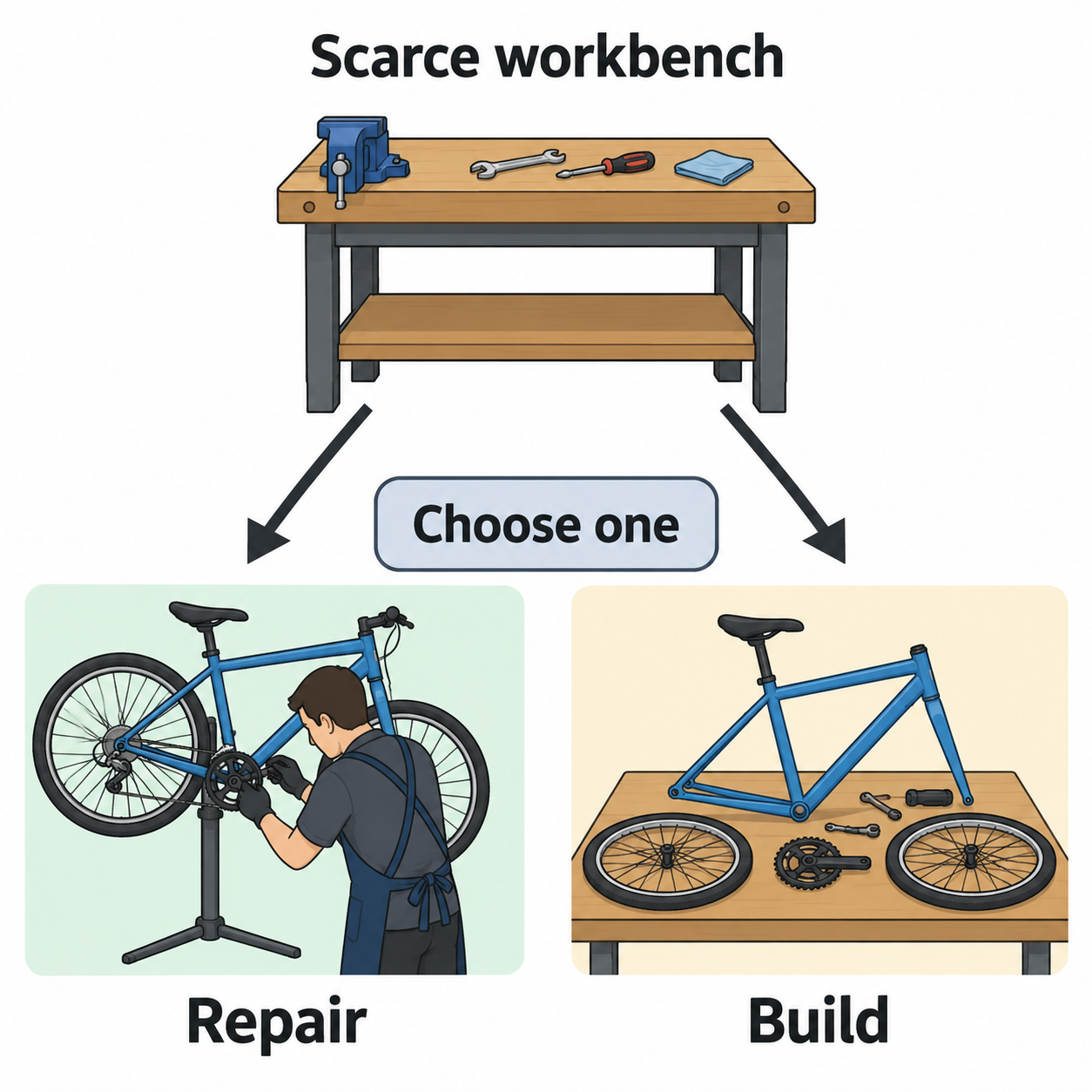
Scarcity forces choice. Opportunity cost is the value of the next best alternative forgone, not every rejected option added together. The workbench image shows one scarce resource with two possible uses. If a mechanic chooses a repair, the forgone build is the alternative; the arrows do not mean simultaneous production. A resource already owned still has an alternative use. Primary businesses obtain natural materials, secondary businesses transform them, and tertiary businesses provide services. A repair enterprise is mainly tertiary but selling rebuilt bikes can add manufacturing activity: classify the activity, not the nationality of its workers.
Enterprise combines initiative with disciplined uncertainty reduction. A survey saying people like an idea is weaker evidence than paid trial orders at the proposed price. Innovation might be a better booking process rather than a new invention. Technology, competitors and customer expectations can change whether an idea works. Trace interdependence: marketing attracts bookings; operations needs tools; human resources provides skills; finance must pay before customers pay. Risk cannot be eliminated by enthusiasm. Transfer criterion: specify a scarce resource, compare two feasible uses and identify what evidence could reverse your choice, including an effect on someone other than the owner.
Worked example: Hypothetical Loop Repairs has one four-hour slot. A repair earns £80 revenue with £20 additional materials; a rebuild earns £140 with £90 additional materials. Both use the same already-paid labour and equipment. Which use is preferable if the immediate objective is extra surplus?
Compare incremental receipts and costs, because common unchanged costs cannot distinguish the alternatives.
Repair adds £80 − £20 = £60; rebuild adds £140 − £90 = £50.
Choosing repair gives £10 more contribution. Its opportunity cost is the £50 forgone contribution from the next best feasible rebuild, not £140 revenue.
Check omitted effects: a rebuild could attract future customers, while repairs could preserve an essential customer relationship. Those effects need evidence rather than invented monetary values.
Answer: Repair is preferable for this immediate objective under the stated assumptions; it is not proof that repairs are always the better business.
Check your understanding: A hypothetical workshop can repair a wheelchair for £55 contribution or a leisure bike for £65 in the same slot. Recommend a choice when its stated aim includes essential community access. What information is missing?
Answer: A reasoned recommendation may prioritise wheelchair repair despite £10 less contribution, if the access benefit is substantial and finances remain viable. Ask about urgency, alternative repair access, customer consent and the workshop’s cash position.
Why: A financial comparison is evidence, not a complete objective. Strong transfer answers name the opportunity cost, connect the community objective to this customer’s situation, and state when the recommendation would change. Neither disability nor place of residence tells us what a customer wants; ask rather than assume.