Objectives: measure success without confusing growth with profit
By UK GCSE Business · independent study · myAudience
Original myAudience educational illustration. Image: illustration, not a documentary photograph. · myAudience educational illustration; no affiliation with any awarding body.
Objectives: measure success without confusing growth with profit
An aim states a direction; an objective makes intended performance specific enough to judge. Survival requires continuing to meet obligations, profit maximisation seeks the greatest surplus feasible, and growth increases scale. Market share is the business’s sales divided by total sales in the same market and period. More sales need not mean more market share if the whole market grows faster. Customer satisfaction, social and ethical goals and shareholder value are also objectives. Shareholder value concerns owners’ investment, not merely this month’s revenue. A not-for-profit still needs financial viability even though distributing profit is not its purpose.
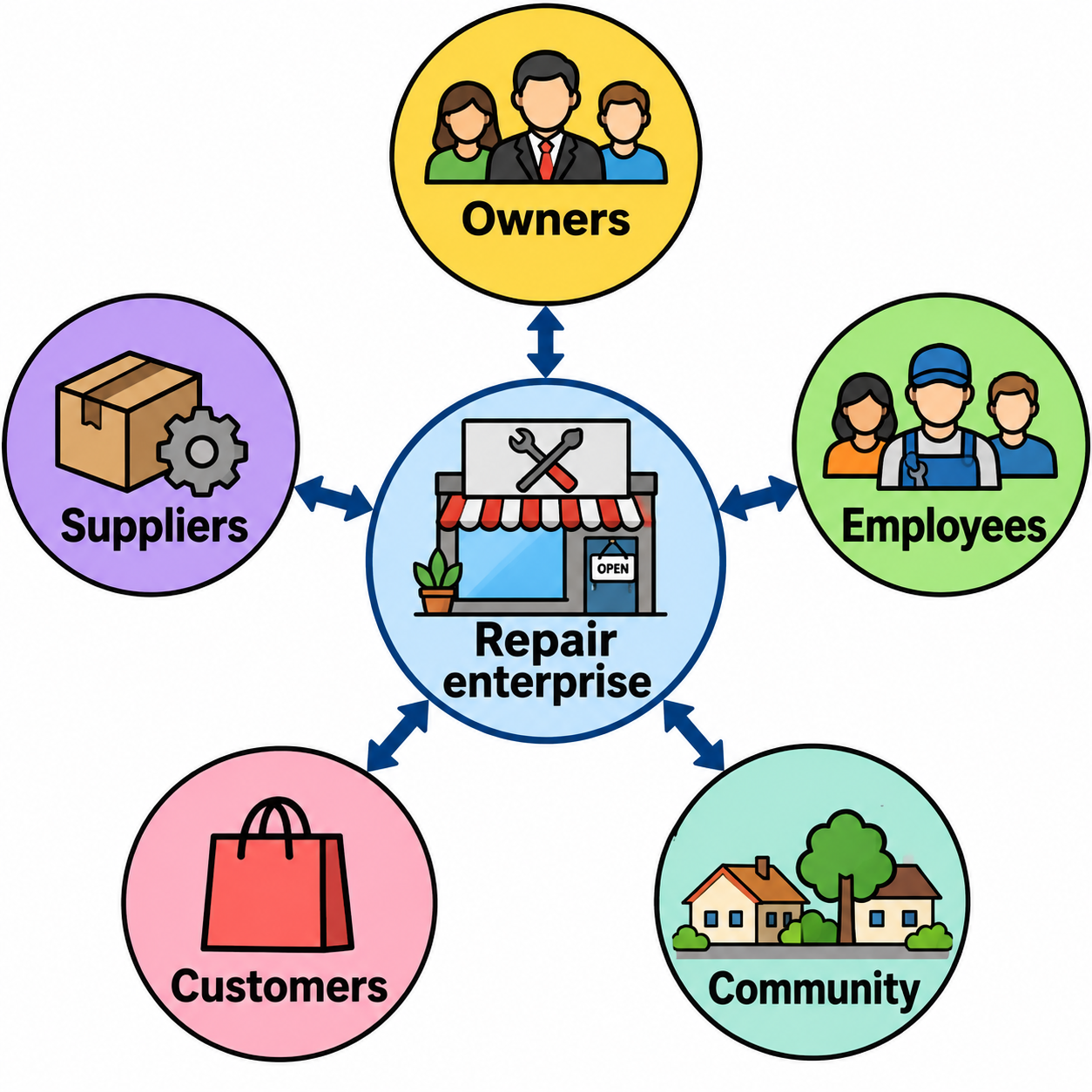
Objectives coordinate choices across functions. A promise of faster repairs requires scheduling, trained staff, realistic promotion and finance for parts. Specify a measure, target, deadline and scope, then identify constraints: increasing completed jobs while allowing unsafe repairs is a badly designed objective. The stakeholder diagram reminds us that a target has consequences for customers, workers and the community. Measurements can conflict. Maximising this month’s profit by cutting training may harm future quality and retention. Profit and customer ratings together still miss whether customers with limited digital access can obtain the service.
A new enterprise may first prioritise survival and positive cash balances; an established business may seek international growth or improved shareholder value. Changes in competition, scale or purpose can change priorities. Do not assume every company must maximise profit at every moment. Compare performance with its actual objectives and with relevant prior periods. Transfer criterion: choose two indicators that illuminate different aspects of success, explain a possible conflict, and give a conditional decision rather than declaring that growth automatically proves success.
Worked example: Hypothetical Loop completes 240 repairs in year 1 in a 2,000-repair local market. In year 2 it completes 300 in a 3,000-repair market. Its objectives were growth and a larger local market share. Evaluate.
Repair volume increased by 60; percentage growth = 60 ÷ 240 × 100 = 25%.
Year 1 share = 240 ÷ 2,000 × 100 = 12%; year 2 share = 300 ÷ 3,000 × 100 = 10%.
Share fell by 2 percentage points even though sales volume rose. The percentage fall in share is 2 ÷ 12 × 100 ≈ 16.7%, a different measure.
Growth was achieved, but the share objective was not. Check profit, cash, service quality and whether both market estimates use the same boundaries.
Answer: The business grew by 25% in repair volume while losing market share. Success is mixed, not established by sales alone.
Check your understanding: A hypothetical social enterprise can double customers by shortening each repair inspection. Recommend whether it should pursue that growth target.
Answer: Reject inspection cuts that compromise safety. Redesign the target around safely completed repairs and access, then investigate scheduling or training. Growth is defensible only if safe quality and cash capacity can support it.
Why: Use the stated social purpose and operational constraint, not an invented universal profit rule. A demanding answer distinguishes a desirable target from the means used, identifies evidence about safe capacity, and explains why another growth method could change the decision.