Stakeholders: analyse conflict, influence and fair decisions
By UK GCSE Business · independent study · myAudience
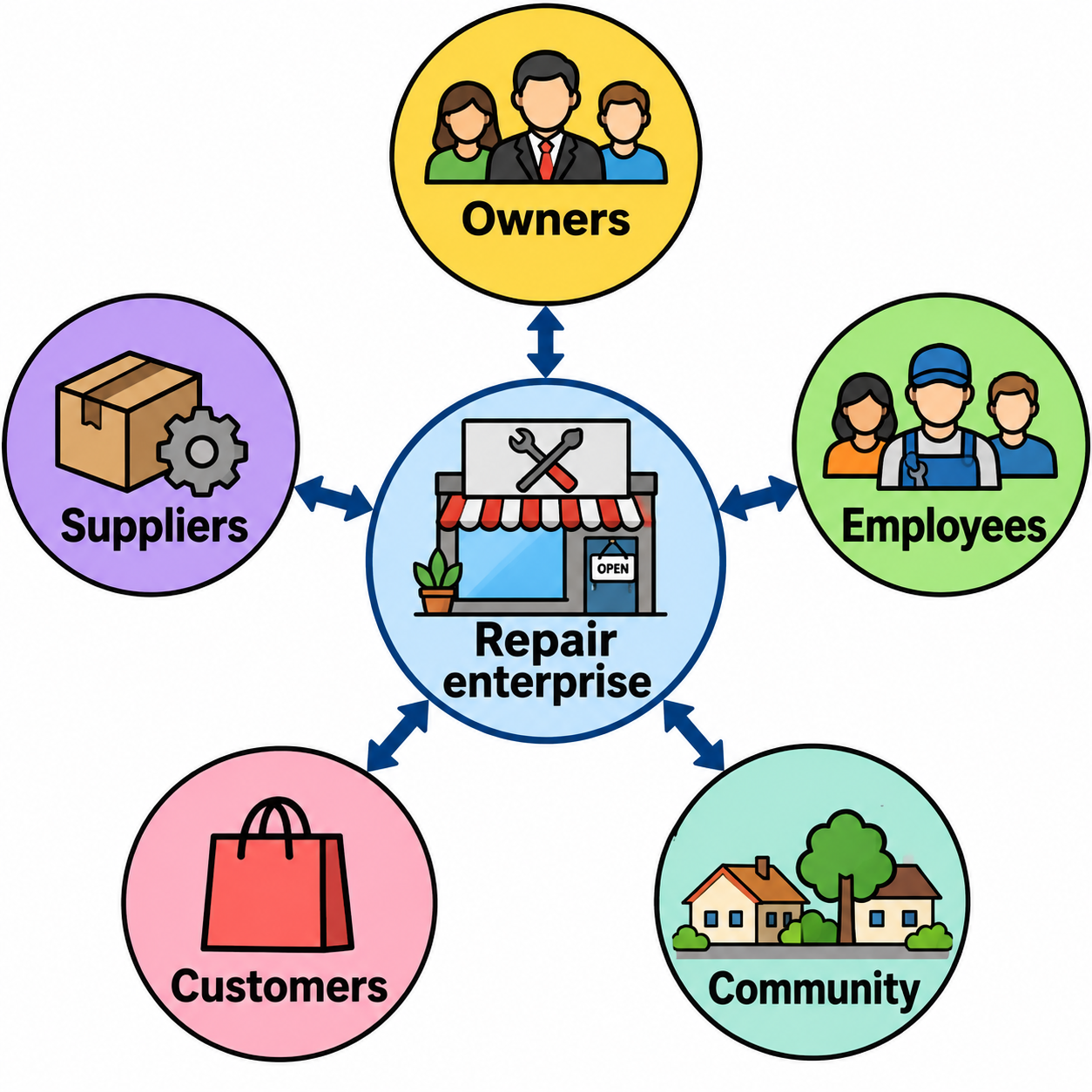
Original myAudience educational illustration. Image: illustration, not a documentary photograph. · myAudience educational illustration; no affiliation with any awarding body.
Stakeholders: analyse conflict, influence and fair decisions
A stakeholder affects or is affected by a business. Owners may seek dividends and secure investment; employees may want fair pay, predictable hours and safety; customers value price, quality and access; suppliers want reliable payment and repeat orders; local communities may want jobs without excessive waste or noise. An owner is a stakeholder but most stakeholders are not shareholders. Groups are internally diverse. A customer might also work for a supplier. State whose interests a decision affects and how, rather than treating a stakeholder list as analysis.
The diagram’s two-way links distinguish impact from influence. A community can be heavily affected yet have less direct bargaining power than a large customer. Employees influence quality and retention; suppliers influence availability; customers influence revenue through buying and feedback; owners control investment. Short-term conflict need not mean permanent opposition: better training costs money now but can reduce defects and improve customer retention later. Claims about future savings require evidence. Consultation helps reveal effects but does not automatically remove conflict or make all preferences compatible.
Evaluate alternatives by tracing a decision through cost, service and human consequences. For a hypothetical UK importer working with a Kenyan sewing cooperative, assess payment timing, worker safety and contract reliability rather than assuming country labels predict quality. The ILO child-labour topic page, checked 4 October 2026, distinguishes harmful child labour from all work undertaken by children; no national prevalence statistic is asserted here. Fair procurement requires listening to affected workers and checking conditions, not a vague “ethical supplier” badge. Transfer criterion: develop two conflicting causal chains, recognise unequal influence and justify a decision with safeguards and a condition for revisiting it.
Worked example: Hypothetical Loop has £600 available surplus. Employees request £400 for training; owners want a £600 distribution; the community asks for quiet equipment costing £300. Decide a feasible package, assuming cash obligations and safety requirements are already met.
All requests total £1,300, so the £600 budget cannot satisfy them in full.
Training plus quiet equipment costs £700, exceeding the budget by £100; delaying payment is not a free solution.
A feasible choice is £400 training with £200 retained for future quiet equipment, with no distribution now. Another is £300 quiet equipment and £300 retained, postponing training.
Recommend training first only if current skills are a material quality problem and noise is within acceptable limits. If noise is causing serious harm, the priority can reverse; obtain evidence and explain the trade-off to owners.
Answer: The £400 training/£200 reserve option is feasible, conditional on skill needs and noise evidence; it does not claim universal fairness.
Check your understanding: A large buyer asks a hypothetical cooperative for lower prices and quicker delivery. Analyse effects on the buyer, workers and supplier; propose one responsible response.
Answer: Lower prices can help the buyer’s margin, but compressed lead times can create overtime pressure or quality failures. Negotiate realistic schedules and payment terms, consult workers, and verify safety and quality. Accept only if the supplier can fulfil responsibly without shifting unmanageable costs to workers.
Why: A strong decision traces who bears costs, recognises bargaining power and states what evidence is needed. Do not invent company wages or treat exploitation as an inevitable feature of a country. Ethical concerns can constrain an option even when its accounting profit looks higher.