Ownership: control, liability and access to finance
By UK GCSE Business · independent study · myAudience
Original myAudience educational illustration. Image: illustration, not a documentary photograph. · myAudience educational illustration; no affiliation with any awarding body.
Ownership: control, liability and access to finance
A sole trader owns an unincorporated business alone; a partnership shares ownership and responsibilities. Ordinary sole traders and ordinary partners have unlimited liability, so business debts can expose personal assets. A limited company is a separate legal person; shareholders normally risk their investment rather than all personal possessions. Limited liability does not erase the company’s debts or guarantee an individual against a personal guarantee. This is a curriculum explanation, not guidance on forming a company. Special partnership structures and incorporation procedure are beyond this first lesson.
A private limited company can bring in shareholders but cannot offer shares to the general public in the way a public limited company can. A plc is not automatically government-owned, and not every plc is stock-exchange listed. Sharing ownership can provide finance but dilute control and change how surplus is distributed. A sole trader has direct control yet may find finance and workload limiting. A partnership combines skills but can suffer disputes. Not-for-profit organisations use surpluses for their purpose; that description alone does not specify one legal form. They still face staff, customer and creditor obligations.
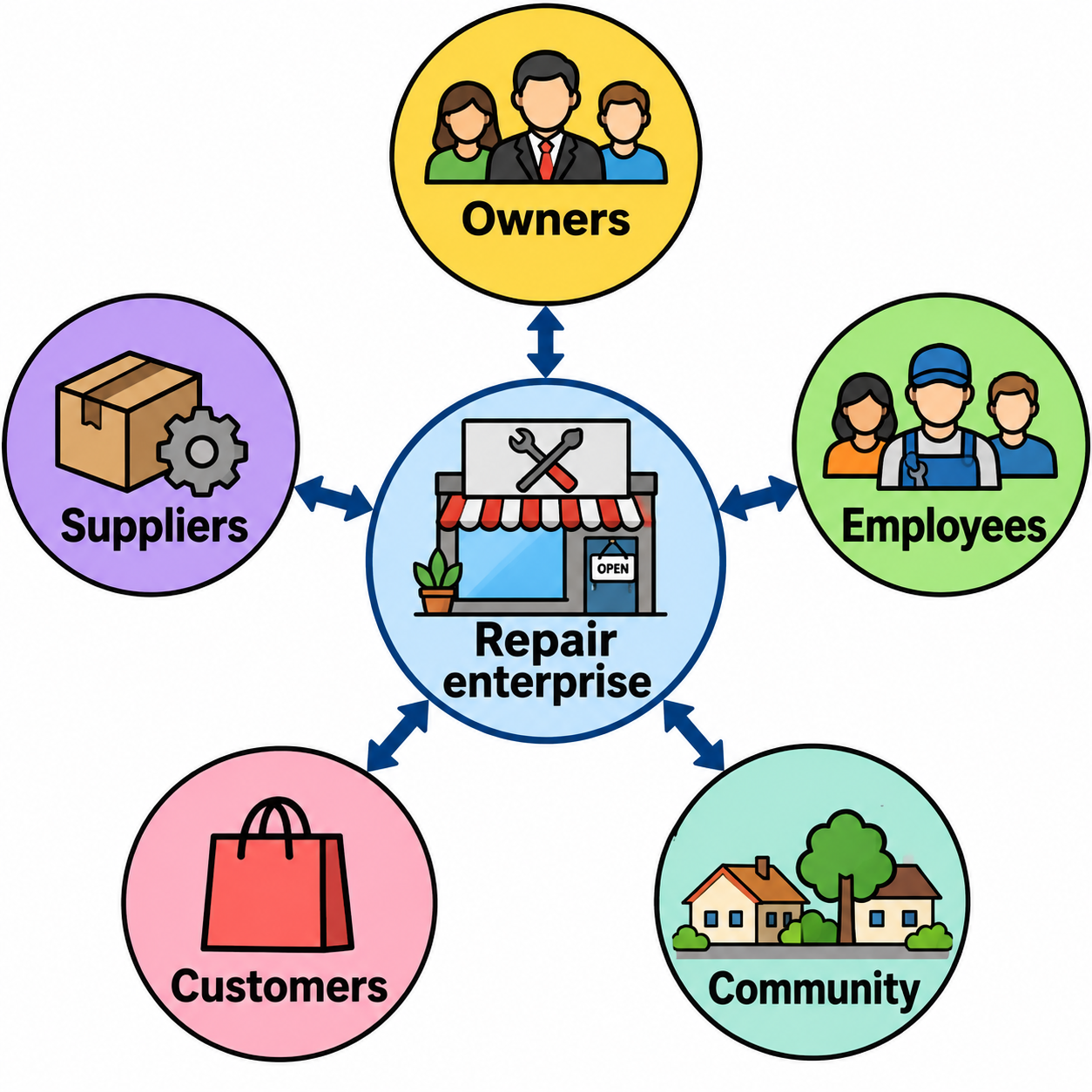
Use the stakeholder image to ask how a change of ownership affects voting power, income expectations and continuity. The best structure depends on risk, capital needs, owners’ skills and desired control, not size alone. A company structure cannot replace safe operations or a credible business model. Transfer criterion: compare at least two structures against this venture’s financing and risk needs, then identify a drawback of your chosen structure. Legal claims requiring detailed application need current official advice; this draft does not promise personal protection.
Worked example: Hypothetical Loop needs £20,000 for expansion. An investor offers £20,000 for 25% of a private company. The founder wants finance without regular loan repayments but values control. Evaluate the offer.
The investment brings £20,000 cash; it is equity, not sales revenue or earned profit.
The founder retains 75% ownership in this simple model, but actual voting rights and agreements must be checked.
The investor normally shares risk and may expect future dividends and influence; no fixed annual interest is implied.
Compare a loan’s repayments and possible guarantees with equity’s permanent ownership dilution. Accept only if the agreement, business outlook and control terms are suitable.
Answer: Equity can fit uncertain cash receipts, but 25% dilution is a lasting cost. A 75% stake is not a guarantee of unrestricted decision power.
Check your understanding: Does becoming a limited company make a hypothetical risky workshop safe to expand? Give a reasoned answer using owners and creditors.
Answer: No. Limited liability concerns exposure to debts, while operational safety, demand and cash remain separate. Creditors may require guarantees or refuse credit. Compare the expansion plan and contractual terms before recommending it.
Why: A structure changes ownership and risk allocation rather than removing risk. Transfer requires connecting a contractual limitation to this business’s situation and evaluating control as well as finance. Avoid implying that a legal label guarantees either success or freedom from responsibility.