Planning and location: test a feasible promise
By UK GCSE Business · independent study · myAudience
Original myAudience educational illustration. Image: illustration, not a documentary photograph. · myAudience educational illustration; no affiliation with any awarding body.
Planning and location: test a feasible promise
A business plan links the opportunity, objectives, customers and competitors, marketing, operations, people and financial forecasts. Its purpose is to test feasibility, organise work and explain a finance request. A plan can expose contradictions: advertising next-day repairs is unreliable if parts take a week to arrive. Forecasts are conditional estimates, not promises. Updating a plan after evidence changes is sensible; selecting only optimistic figures to impress a lender is not. The assessed requirement is to understand and evaluate planning, not to produce a complete business plan.
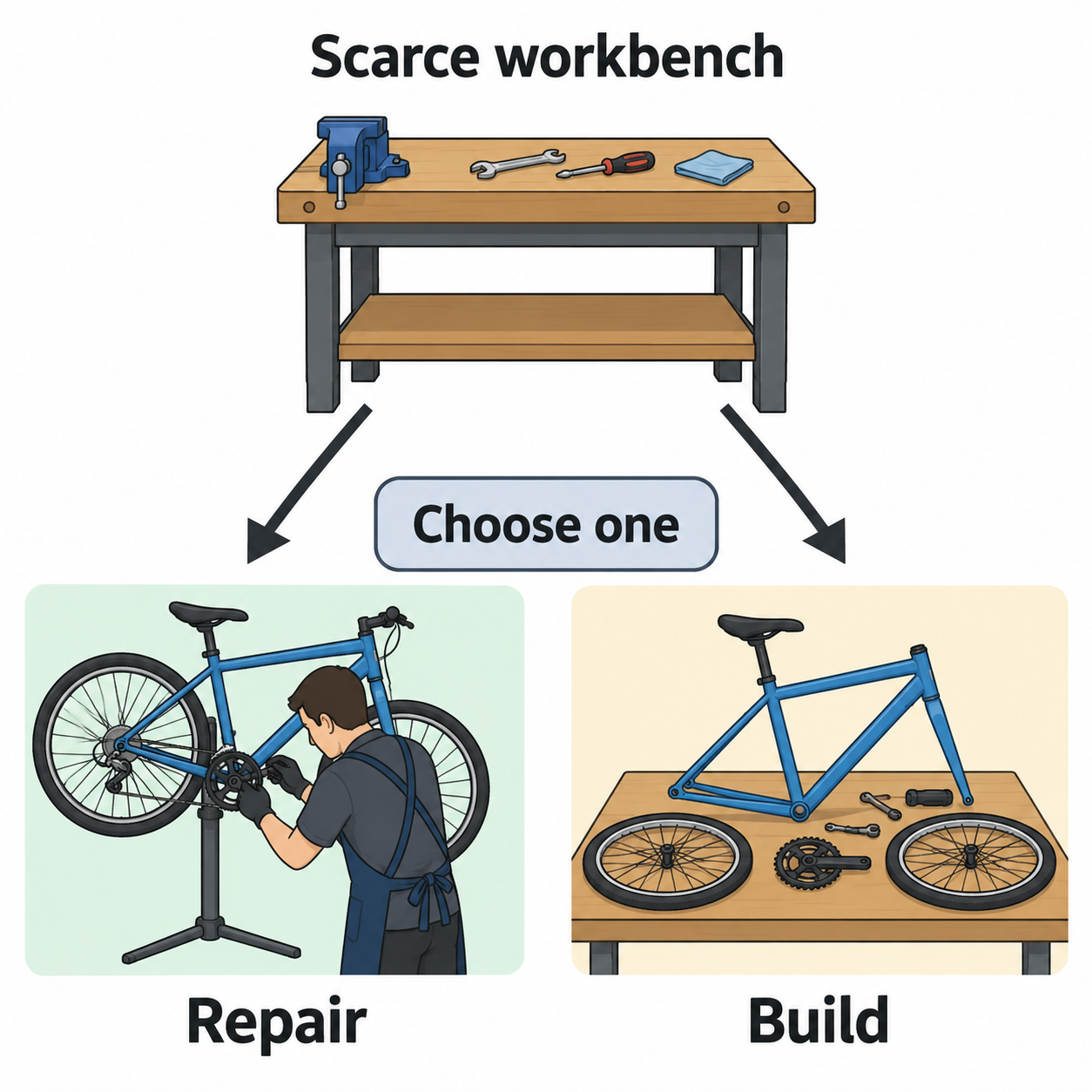
Location affects access to customers and raw materials, available labour, nearby competitors and costs. A cheap site may require more advertising and delivery; an expensive site may generate more passing customers, but footfall is not the same as paid demand. For services, customer travel and accessibility can matter more than proximity to raw materials. Online sales reduce some physical-location constraints while leaving storage, dispatch and returns costs. The scarce-workbench image reminds us that space constrains capacity: a busy site cannot sell unlimited repairs with one mechanic.
Compare like periods and distinguish fixed commitments from uncertain benefits. Scenario analysis asks how a recommendation changes with demand or costs; it is not a prediction of probabilities. Planning consumes time and can become obsolete, but that does not justify guessing. Transfer criterion: recommend a location using one quantified comparison and two relevant qualitative factors; identify a demand threshold or capacity limit, and describe a small evidence-gathering step that would reduce uncertainty without pretending it eliminates it.
Worked example: Hypothetical Loop compares monthly sites: A rent £600 and expected 100 repairs; B rent £1,000 and expected 130 repairs. Each repair contributes £20 before rent. Other costs are equal; capacity is 140 repairs. Choose.
A contributes 100 × £20 − £600 = £1,400 after rent; B contributes 130 × £20 − £1,000 = £1,600. These are not final profits because other costs remain.
B adds £400 rent, so it needs more than 20 additional repairs to outperform A at £20 contribution.
With A at 100 repairs, B at 120 ties A at £1,400; B at 110 gives £1,200 and loses the comparison.
B’s forecast is within capacity, but allow for accessible travel, recruitment and uncertainty. A short trial or comparable bookings is stronger than assuming every passer-by buys.
Answer: B gives £200 more under the forecast. Choose B only if evidence supports at least 121 whole repairs while A remains at 100, and other relevant factors are acceptable.
Check your understanding: A hypothetical online retailer chooses a low-rent remote warehouse. Analyse why this could increase rather than reduce total cost.
Answer: Higher delivery distances or poor transport reliability can raise logistics costs, delay orders and increase returns or refunds. Scarce skilled labour may add recruitment costs. Compare total delivered cost and service reliability against rent savings.
Why: Apply the location decision across operations, marketing, people and finance. A good answer explains a mechanism, not a generic “it depends”, and names evidence such as delivery quotes and order geography. No real regional wage, rent or transport statistic is asserted.