Cash flow: reconcile opening balances, timing and profit
By UK GCSE Business · independent study · myAudience
Original myAudience educational illustration. Image: illustration, not a documentary photograph. · myAudience educational illustration; no affiliation with any awarding body.
Cash flow: reconcile opening balances, timing and profit
Cash flow records money entering and leaving the business during a period. Net cash flow = inflows − outflows; closing balance = opening balance + net cash flow. The next period normally begins with the previous closing balance. A positive net flow can still leave a negative balance after an earlier deficit, while a negative flow can be manageable with adequate reserves. A forecast estimates future timing and amounts; it is not a record of guaranteed receipts. Include actual payment dates, not merely order dates.
The timeline image separates earning revenue in January from receiving customer cash in February. Expenses may be due before customers pay. A loan inflow increases cash without being sales revenue or earned profit; repaying principal reduces cash without itself being an operating expense. A profitable business can fail to meet obligations if cash arrives too late. Conversely, owner investment or borrowing can produce a positive cash balance while trading makes a loss. The simplified example ignores tax, interest and asset accounting explicitly so the timing distinction remains visible.
Constructing an entire forecast is not required by this specification; completing and interpreting parts is. Check the arithmetic across months, distinguish balances from flows and question collection assumptions. Forecasts help identify the maximum shortfall and when it occurs, allowing a finance discussion before wages or suppliers go unpaid. Transfer criterion: reconcile a multi-month schedule, explain a profitable-but-short-of-cash situation and identify the specific receipt or payment assumption that makes the forecast fragile.
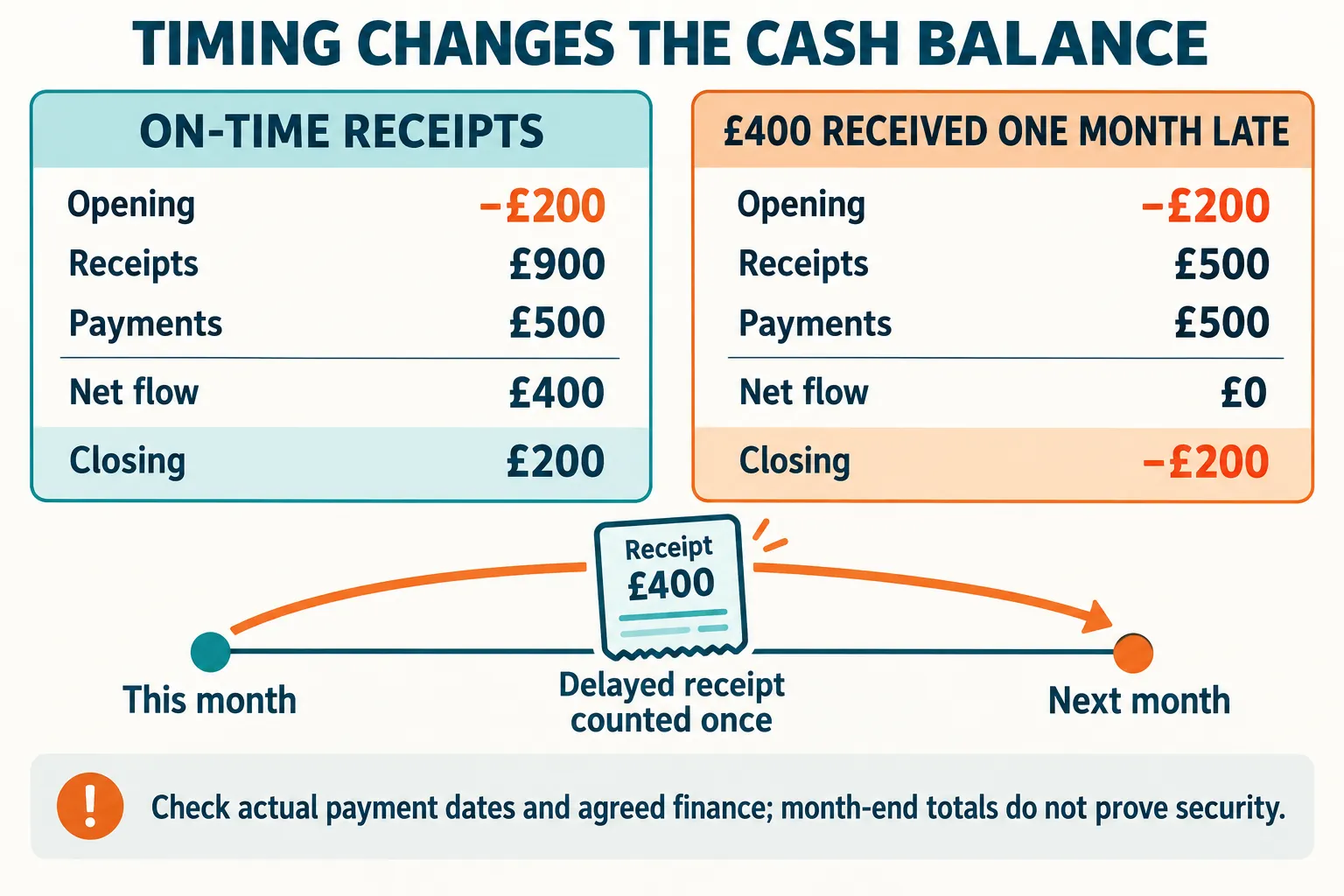
A balance is a stock at a particular date; net cash flow is the change over a period. The closing balance is opening balance plus receipts minus payments, and becomes the next period's opening balance. A negative opening balance is not erased by starting a new column. If it represents an overdraft, permission and a limit matter; otherwise the schedule describes a funding gap rather than feasible completed payments. In the illustration, compare the two closing balances and follow the single £400 receipt into next month. A coloured positive closing figure is not proof that every earlier payment can be made.
A forecast can conceal a problem within the month. If wages are due before a customer receipt, a positive month-end balance cannot pay the earlier bill. Rearrange the same monthly totals by due date to test this. Nor can a late receipt be moved into a convenient column without evidence: postponement changes both the current period and the future period in which collection is expected.
The illustration and original worked example separate earning revenue from receiving cash. A loan is a financing receipt with an obligation, not a customer sale or free profit. Evaluate a bridge against later repayments and interest as well as its immediate effect. A reliable business forecast includes alternative collection timings and a minimum operating reserve, while acknowledging that no finite set of scenarios proves security against every possible disruption.
Evaluated model for the original delayed-receipt question. On the initial forecast, net cash flow is £900 receipts minus £500 payments, or £400. Adding this to opening cash of −£200 gives closing cash of £200. That is an improvement in the balance, but it does not establish that the enterprise is cash-secure. The opening deficit already needs an agreed funding arrangement, and receipts may arrive after important payments are due. We know monthly totals, not the dates or a facility limit. If £400 of the receipts arrive a month late, this month's receipts fall to £500. Net cash flow then becomes £500 − £500 = £0, and closing cash remains −£200. The late receipt must not be counted in both months. It may improve a later schedule if actually collected, but cannot pay this month's bills before arrival. This comparison shows that a £400 positive net flow and a £200 closing balance depend on the original collection assumption. It also distinguishes cash from profit: none of the figures establishes the period's revenue, accounting costs or net profit.
I would first prepare a dated payment and collection schedule, identify the largest funding need before each due date, and verify any agreed overdraft or other available finance. This could reveal a greater temporary deficit than the month-end −£200. If the customer can confirm a reliable later date, a suitable affordable bridge may be reasonable, provided the later cash schedule covers repayment and preserves enough funds for ongoing operations. An application or an assumed extension is not an available facility. Negotiating an explicit reschedule with a supplier might help, but simply delaying payment transfers the problem to someone else and risks deliveries. Collecting earlier or taking a deposit may improve timing, yet any discount, customer response and resulting later receipts must enter the revised forecast. My recommendation is to treat the original positive closing figure as conditional and plan for the stated delay before committing to payments. Evidence of dependable collection dates and a sufficient approved facility could support proceeding. If collection remains uncertain or later obligations prevent repayment, reducing or postponing discretionary expenditure may be safer. Neither a profitable trading forecast nor the existence of a positive monthly total removes the need to check timing, finance availability and the consequences of a second delay.
Worked example: Hypothetical Loop starts January with £500. January service revenue £1,500 is all received in February. January expenses of £900 are paid in January. February has £1,500 receipts and £1,200 outflows. A £2,000 loan is received in January; calculate with and without it.
Without loan, January net cash flow = £0 − £900 = −£900; closing balance = £500 − £900 = −£400.
January simplified trading profit = £1,500 − £900 = £600, despite the £400 cash shortfall.
Without loan, February opens at −£400, net flow is £300 and closes at −£100; this assumes a permitted overdraft, otherwise payments cannot all occur as forecast.
With the January loan, January inflows £2,000, net flow £1,100 and closing £1,600. February closes at £1,900 before later repayments or interest. The loan does not add £2,000 to profit.
Answer: Timing creates a January funding gap despite profit. Borrowing bridges cash temporarily but adds future obligations.
Check your understanding: A hypothetical forecast shows opening cash −£200, receipts £900 and payments £500. Is the business cash-secure? Recalculate if £400 of receipts arrive one month late.
Answer: Forecast net flow £400 and closing £200. With delay, receipts £500, net flow £0 and closing −£200. A positive original forecast does not prove security; check payment dates and available agreed finance.
Why: A schedule must be feasible at each due date, not only at month end. Negative cash is an unmet funding need unless an agreed facility exists. A strong answer challenges collection timing and distinguishes the account balance from revenue and profit.