Cash shortfalls: bridge timing without hiding an unviable model
By UK GCSE Business · independent study · myAudience
Original myAudience educational illustration. Image: illustration, not a documentary photograph. · myAudience educational illustration; no affiliation with any awarding body.
Cash shortfalls: bridge timing without hiding an unviable model
A shortfall caused by late customer receipts differs from repeated trading losses. A temporary overdraft can bridge timing but cannot turn a structurally loss-making offer into a viable one. Start by identifying the due dates, maximum funding need and reliability of expected receipts. The timeline image shows why waiting for a customer’s February payment does not remove January’s wage obligation. A forecast that postpones a payment without agreement describes a missed obligation, not a successful solution.
Possible responses include asking for agreed deposits, collecting overdue receipts fairly, negotiating payment dates with suppliers, reducing non-essential outflows, obtaining new finance or using an agreed overdraft. Each has a cost or constraint. Discounts for early payment bring cash sooner but reduce revenue; demanding deposits may deter customers who cannot pay in advance. Delaying supplier payments can transfer the shortfall to a smaller partner and damage trust. Selling an unused asset can raise cash once, but selling essential equipment can undermine future capacity. Cost cuts should preserve safe quality and fair treatment.
Choose a package using numbers and relationships. A larger closing balance is not automatically a better long-term outcome if it was purchased through unsustainable debt or sacrificed customer access. Stress-test late receipts and ask whether the facility is agreed, adequate and affordable. Transfer criterion: quantify how a solution changes the funding gap, develop its stakeholder cost, compare an alternative, and distinguish a temporary timing fix from a change that improves the underlying trading model.
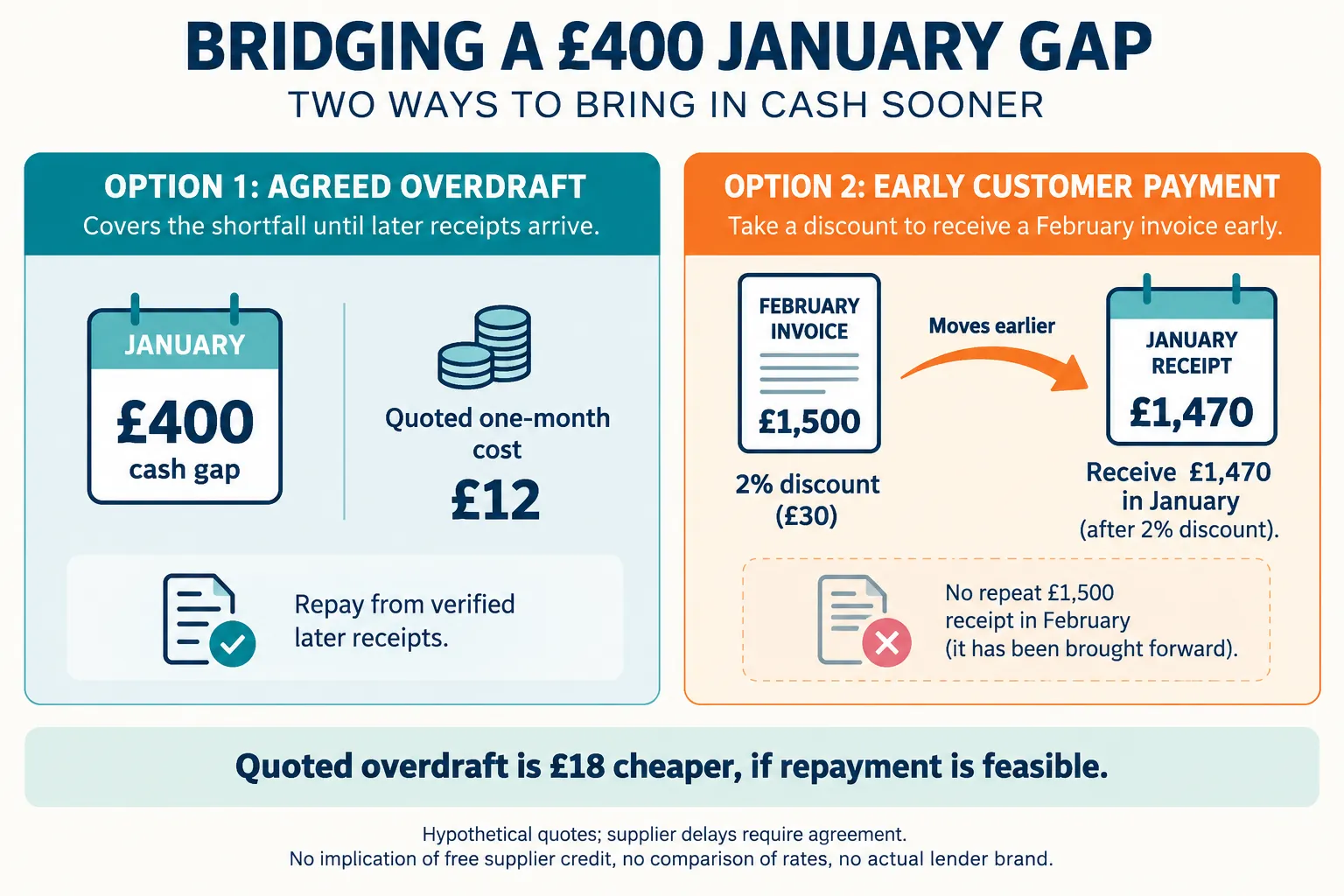
A timing gap and a recurring trading loss require different diagnoses. Borrowing may bridge a collectible invoice, but repeated borrowing to cover an operation that never generates enough cash can enlarge future obligations. Trace the cause and both periods before comparing finance prices. A quoted fee is only useful if the facility is available for the required amount and duration and repayment remains feasible. The illustration compares a £12 fee with a £30 discount cost, not two interest rates. Notice the crossed-out repeated February receipt: moving one invoice earlier cannot create a second collection.
Moving a customer payment earlier changes timing; discounting it also changes the amount. In the original example, £1,470 enters January instead of £1,500 entering February. The £30 reduction is the price of earlier payment and cannot be ignored when comparing it with £12 financing. Do not add the early receipt to January while leaving the same invoice in February: that creates imaginary money.
Payment terms distribute a timing burden between businesses. An agreed reschedule can allocate it transparently; an imposed delay makes the supplier absorb uncertainty without consent. The supplier may need those funds for its own wages and materials. Evaluate cash continuity, relationships and operational dependency alongside the immediate fee saving, while avoiding unsupported statements about the legal consequences of an unspecified contract.
Evaluated model for the original supplier-payment question. Avoiding interest is an understandable objective, but withholding a small supplier's payment for another month is not free finance. The supplier would be carrying the workshop's funding burden without an agreed change to terms. It may have wages or materials to pay and less capacity to absorb a delay than the owner assumes. That could damage trust, interrupt deliveries and make future purchasing less dependable. Any contractual consequences depend on the actual terms; we should not invent a penalty or claim that every delay has an identical legal outcome. Against this, an agreed overdraft makes the timing and cost of finance explicit. In the separate worked comparison, the one-month facility is quoted at £12, while a 2% discount on a £1,500 customer payment costs £30. The overdraft is £18 cheaper under those stipulated conditions, but this is not proof that it is always the best option or that those terms are available in the supplier case. Availability, the size of the gap and an affordable repayment date must be checked first.
I would favour a verified, affordable agreed facility over an unannounced supplier delay when a reliable forthcoming receipt can repay the borrowing. This protects continuity as well as the supplier's ability to plan. However, borrowing could be a poor response if the owner's difficulty comes from persistent losses or unreliable collections: interest and repayments would then add to the problem. A transparent discussion with the supplier about a mutually agreed reschedule is a legitimate alternative, especially if the supplier can accommodate it without harm. It may involve a charge or different terms and must be reflected in both parties' planning; consent cannot be assumed. Earlier customer collection or postponing non-essential spending could also reduce the gap, with any discount or lost opportunity included. I would inspect a dated cash forecast, written facility terms and the effect on essential supplies before deciding. If the supplier voluntarily offers a workable extension cheaper than borrowing, that evidence could reverse the financing preference. Without such agreement, the small apparent interest saving does not justify transferring risk silently. The strongest recommendation resolves the timing need on transparent terms, considers later repayment and protects a relationship on which the workshop's ability to earn revenue may depend.
Worked example: Hypothetical Loop has a £400 January shortfall and a reliable £1,500 February customer payment. The customer offers £1,470 in January for a 2% early-payment discount. An agreed one-month overdraft would cost £12 including fees. Compare if repayment is feasible.
Discount cost = £1,500 × 0.02 = £30; early receipt becomes £1,470.
Early receipt changes January closing cash from −£400 to £1,070, but February no longer receives the £1,500 and revenue is reduced by £30.
The overdraft funds the £400 gap at £12 cost under the stated quote, £18 cheaper than the discount. Neither quote is a real market offer.
Prefer the overdraft for cost if February collections can repay it. If the receipt is unreliable or borrowing unavailable, the discount’s certainty can outweigh £18, subject to the later cash schedule.
Answer: The overdraft is cheaper in this hypothetical model, but only a feasible repayment schedule makes that comparison useful.
Check your understanding: A hypothetical owner proposes not paying a small supplier for an extra month to avoid interest. Evaluate this against an agreed overdraft.
Answer: Unagreed delay can harm the supplier, interrupt deliveries and breach terms. Seek an explicit negotiated reschedule or affordable agreed finance. Compare costs and reliability, and reject presenting withheld payment as free finance.
Why: A sound decision follows cash through both periods and considers who finances the delay. An early receipt cannot be counted twice, and an invoice discount changes both timing and amount. Ethical responsibilities and supplier continuity can outweigh a small apparent saving.