Sources of finance: match duration, control and obligations
By UK GCSE Business · independent study · myAudience
Original myAudience educational illustration. Image: illustration, not a documentary photograph. · myAudience educational illustration; no affiliation with any awarding body.
Sources of finance: match duration, control and obligations
Internal finance includes retained profit and selling unwanted assets. Retained profit means past profit kept in the business, but it may already be invested in stock or equipment and need not equal spare cash. Asset sales are finite and can sacrifice future capacity. External finance includes family or friends, new shares, loans, mortgages, overdrafts, trade credit, hire purchase and government grants. These are categories to evaluate, not guaranteed sources. Family funding can strain relationships; grants can have eligibility conditions and no availability should be assumed without a dated scheme check.
A loan supplies money now with repayment and interest obligations; a mortgage is secured on property. An overdraft allows agreed short-term borrowing through a bank account and may carry variable interest or withdrawal risk. Trade credit postpones a supplier payment rather than putting cash directly into the account. Hire purchase spreads payments for an asset, normally with ownership transferring after the terms are met; evaluate total cost and default conditions. New shares exchange finance for ownership and influence, without treating future dividends as a fixed interest payment. Only suitable company structures can issue shares.
Match duration to the need: unpredictable short-term receipts may suit a bounded agreed facility, while a multi-year machine may need finance lasting long enough for benefits to arrive. The cash-timing image asks when funding is needed and when repayment becomes possible. Compare amount, total cost, cash timing, collateral, control and risk. A start-up cannot fund itself from profits it has not earned. Transfer criterion: recommend a feasible source, rule out one attractive but unsuitable alternative, and name a contractual or forecast uncertainty that could change the choice.
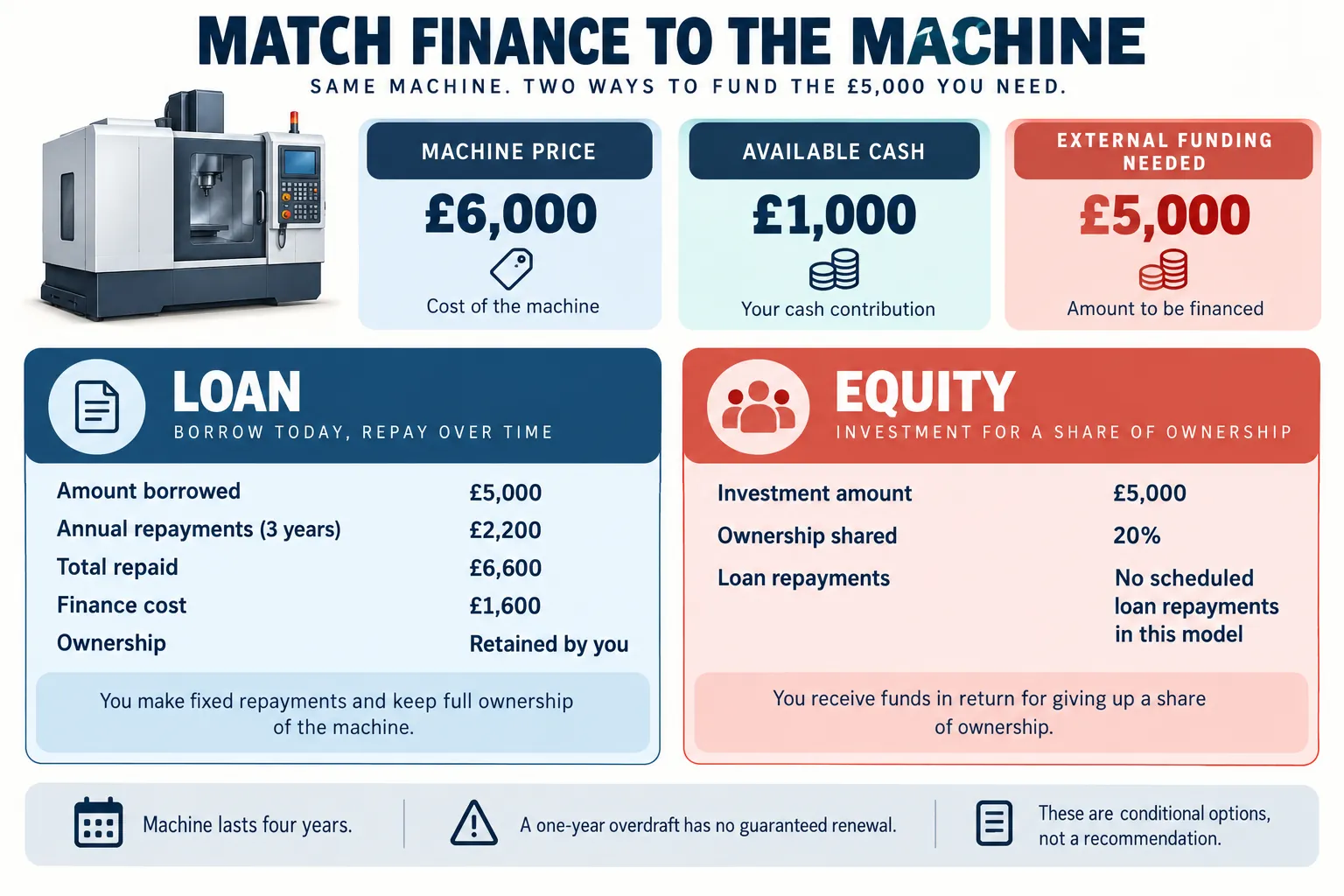
Distinguish a source's name from evidence that funds are available. Retained profit comes from profit previously earned and kept by the business; a projection does not create it. An owner can contribute personal savings, but that is a different source and should be labelled honestly. A grant application has conditions, an award decision and a payment date, any of which can prevent it meeting an immediate funding need. In the illustration, the £1,000 contribution plus either £5,000 external option funds the same machine. The loan and equity cards are alternatives, not funds to add together.
Match the duration of finance to the use of funds without turning this into an absolute rule. A four-year machine financed by an unrenewed one-year facility exposes the enterprise to refinancing risk. A longer loan may reduce that mismatch but creates fixed payments even if demand disappoints. Equity avoids scheduled debt repayment in this model, yet shares ownership and possible future returns. Legal structure and actual terms determine availability.
In the machine illustration, £1,000 available cash leaves a £5,000 funding need against a £6,000 price. The three £2,200 repayments total £6,600, including £1,600 above principal. This total is not an annual interest rate: payment timing and the reducing outstanding balance would matter to any rate calculation. Compare complete payment schedules and control, not a misleading percentage inferred from an aggregate difference.
Evaluated model for the original start-up funding question. I would challenge both the existence and the timing of the listed funds. A new enterprise cannot retain £4,000 of its own profit before it has earned that profit. The figure might be a sales projection, an owner's savings or profits from a different activity, but none should be silently relabelled as retained profit of this start-up. The reviewer should ask what the money actually is, who owns it and when it will be available. An unverified grant is also not a confirmed cash balance. Eligibility, an award decision, any conditions and payment timing need evidence before the funds can support a commitment. Removing the unsupported entries may reveal a funding gap even if the idea is commercially promising. I would rebuild the opening plan using evidenced sources rather than replace the missing numbers with another optimistic label. This requires a dated schedule of spending, available cash and later receipts. The question does not supply the full investment cost, the grant amount or a lender's terms, so a precise replacement funding total or a guaranteed loan would be invented rather than calculated.
Owner savings could provide a genuine contribution if available and appropriate, while an approved loan or outside equity might fund a remaining need. Each has a trade-off. Debt preserves ownership but requires feasible repayment and may involve conditions; equity shares control and future returns, while an owner's contribution uses funds that may be needed elsewhere. The separate machine example illustrates the reasoning: £1,000 cash towards a £6,000 machine leaves £5,000 external funding, and an unguaranteed one-year overdraft is a risky match for a four-year asset. Those figures are not facts about this start-up, but show why amount, duration and terms must be evaluated together. I would seek confirmed offers and test repayments against cautious cash scenarios before selecting finance. If a grant is later awarded with a suitable payment date, the revised plan can include it explicitly rather than discard it forever. If the founder can provide verified funds, that may reduce borrowing, but an adequate operating reserve still matters. My conclusion is to pause commitments based on unearned profit and an assumed grant, identify the actual funding gap, and compare available sources on timing, affordability and control. A forecast of future profitability supports a case for finance; it does not substitute for money at the moment a bill falls due.
Worked example: Hypothetical Loop needs a £6,000 machine lasting four years. It has £1,000 spare cash. A three-year loan requires £2,200 at each year end; shares provide £5,000 for 20% ownership; a one-year overdraft has no guaranteed renewal. Compare.
Spare cash plus £5,000 external funding meets the £6,000 price. Do not describe the whole £6,000 as loan need when cash is available.
Loan total repayments = 3 × £2,200 = £6,600 for £5,000 borrowed; total finance cost £1,600 under this stated simple schedule, not an annual interest rate.
A four-year asset financed by a one-year facility faces refinancing risk; low initial convenience does not establish suitability.
Choose loan if cash can support all repayments with a reserve and the founder prioritises ownership. Choose equity if cash uncertainty is greater and sharing control is acceptable. Verify machine demand and terms first.
Answer: A multi-year loan or equity fits duration better than assuming overdraft renewal. Cash affordability and control determine the conditional recommendation.
Check your understanding: A hypothetical start-up lists £4,000 retained profit and an unverified grant in its opening funding plan. What should a reviewer challenge?
Answer: A new business cannot retain its own unearned profit. A grant cannot be assumed without eligibility, award and payment evidence. Replace these with evidenced available funding and retest the cash schedule.
Why: Finance labels do not prove money exists. The analysis must connect the source to legal structure, stage of business and timing. A profitable projection or an application for a grant is not an available bank balance.